Material Handling Robot Solutions for Production and Warehouse Operations
Warpify delivers integrated material handling robot solutions that automate repeatable transport across factories and warehouses. We combine autonomous mobile robots (AMRs) with the right load interface, stations, fleet software, system integration, commissioning, and support for line-side supply, work-in-process, tote and cart movement, replenishment, pallet transport, and finished-goods flows.
A Complete Material Handling Robot Solution—Beyond the AMR
Warpify engineers the complete application around the movement you need to automate. We configure the mobile robot and load-handling method, design pickup and drop-off points, connect missions with facility and business systems where required, and commission route, traffic, charging, handoff, and recovery behavior. The result is a practical intralogistics solution for production floors and warehouses—not a standalone mobile chassis.
Automate Repetitive Material Movement Across Your Facility
Warpify deploys material handling robot solutions for repeatable flows between defined locations. Each application is configured around the material, carrier, pickup and drop-off method, route, traffic, mission logic, and operating team.
Parts, kits, and work-in-process transport
Routine task
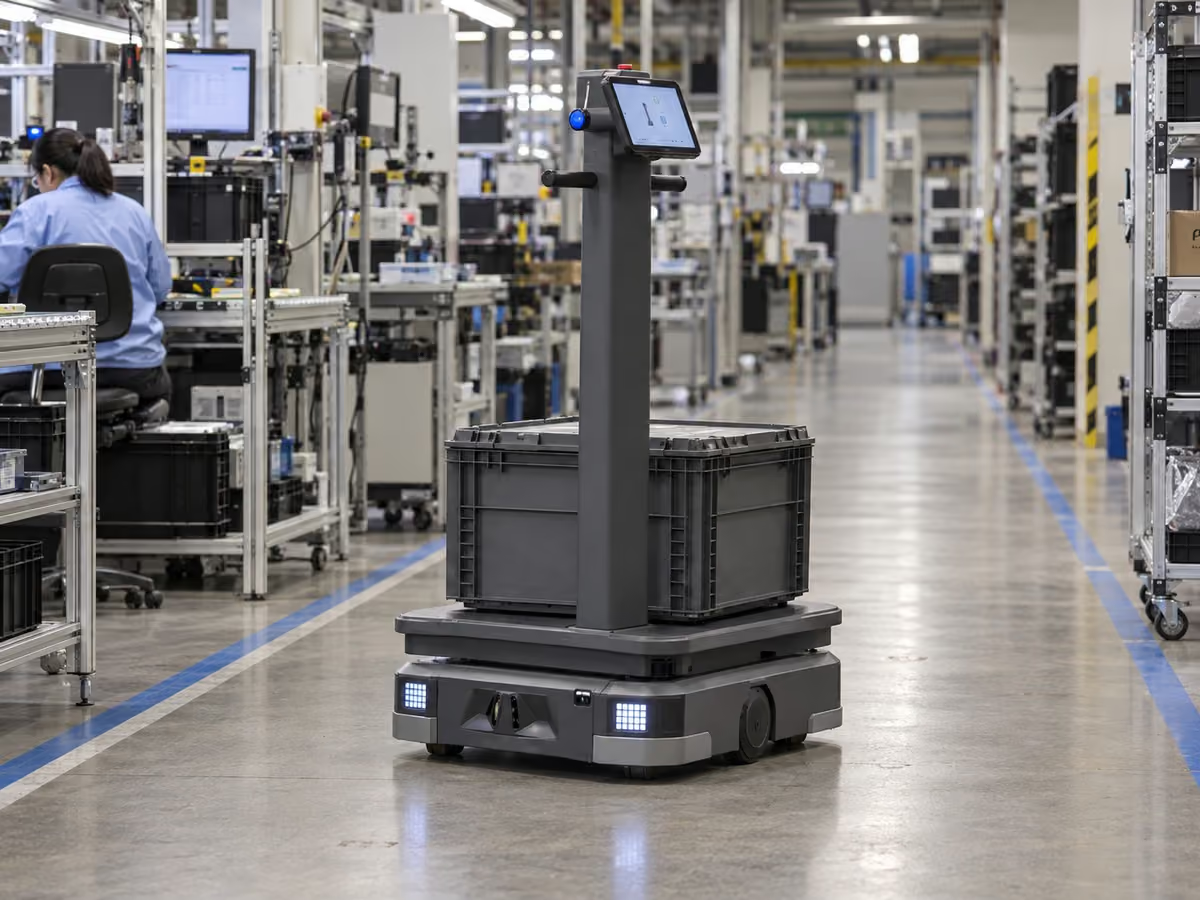
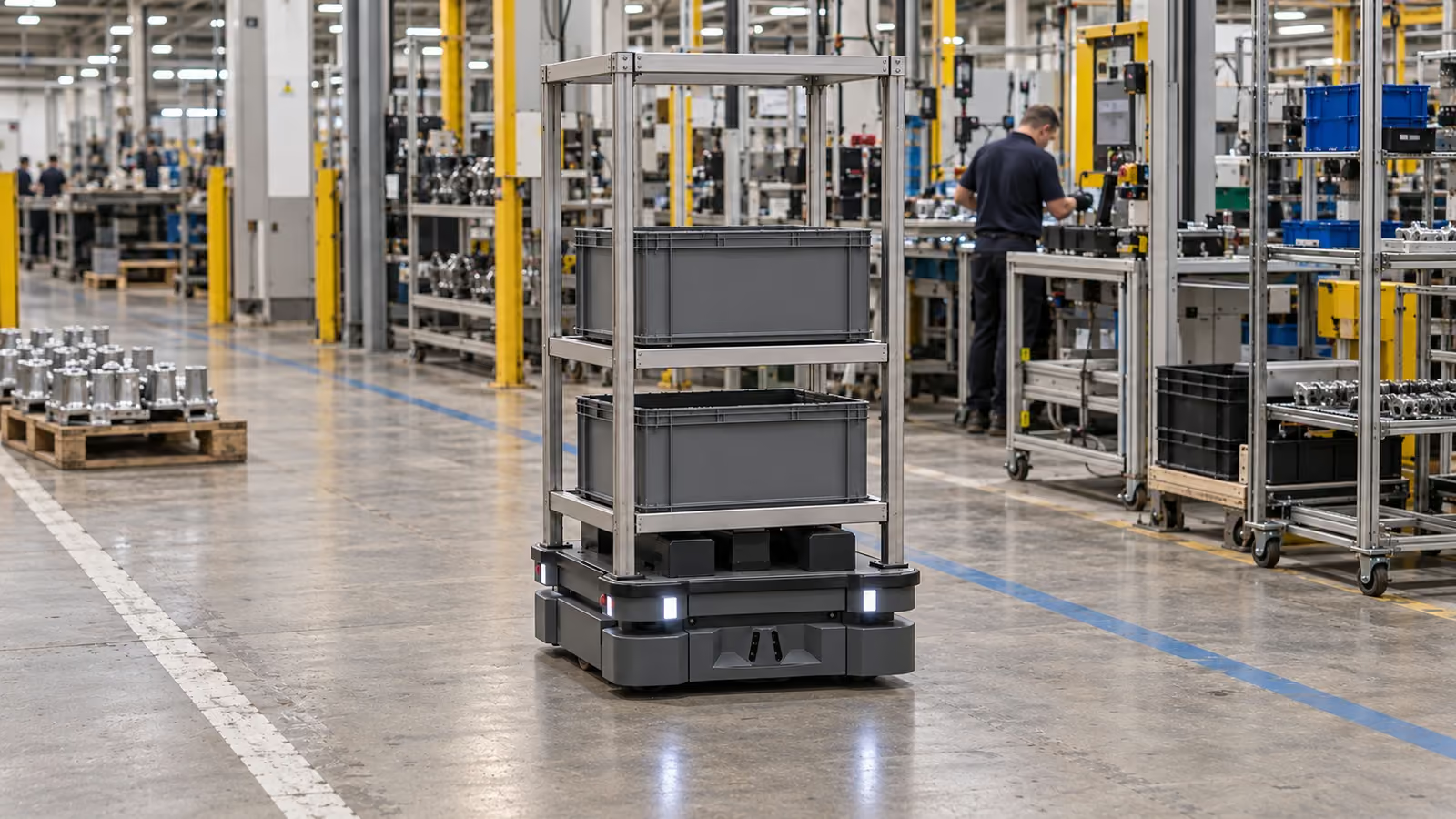
Move components, kits, tools, empty containers, and work-in-process between storage, preparation, quality, machines, and line-side stations.
robot flow
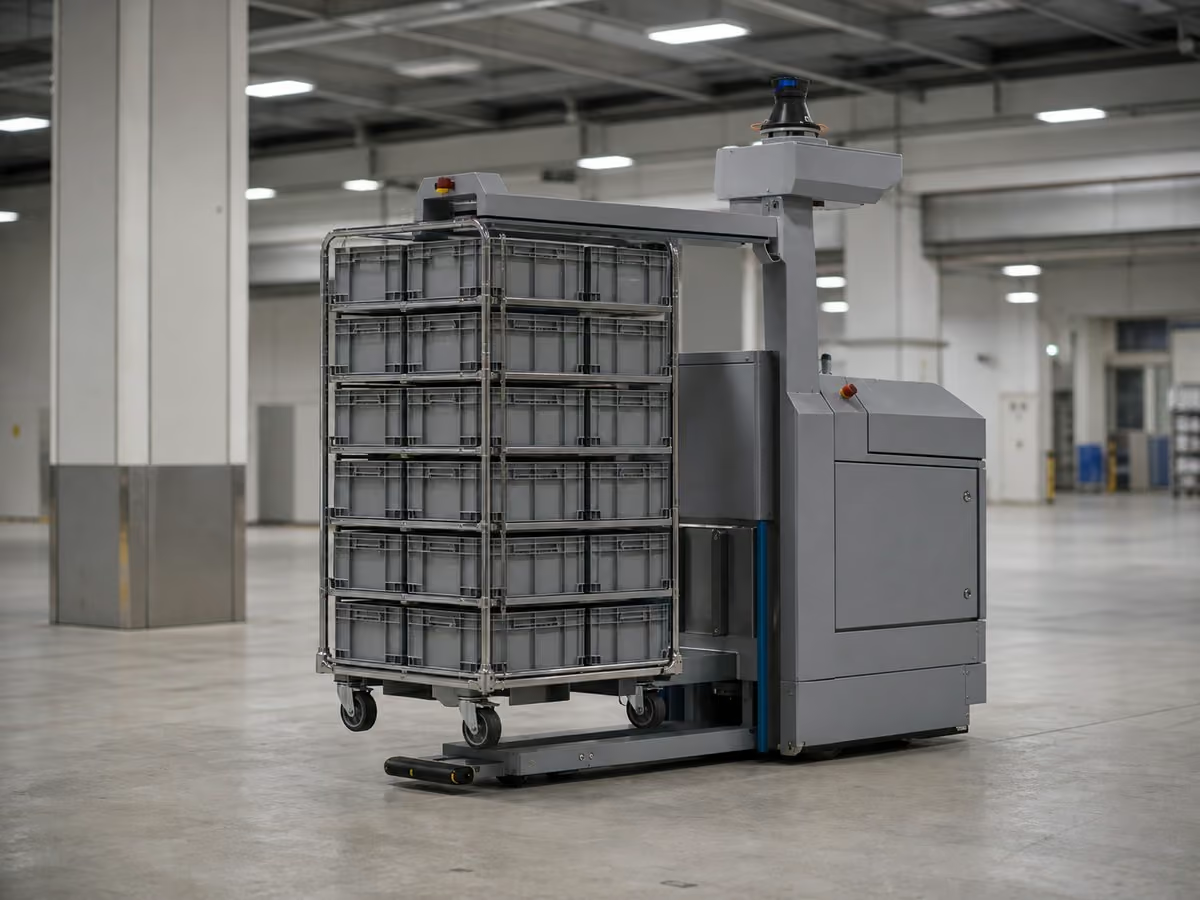
A configured AMR with a fixed deck, rack, container carrier, or engineered top module transports the load on scheduled or on-demand missions.
Deployment design
Load support and retention, center of gravity, route, station readiness, dispatch rules, charging, and exception recovery.
Shelves, carts, and tugger flows
Routine task
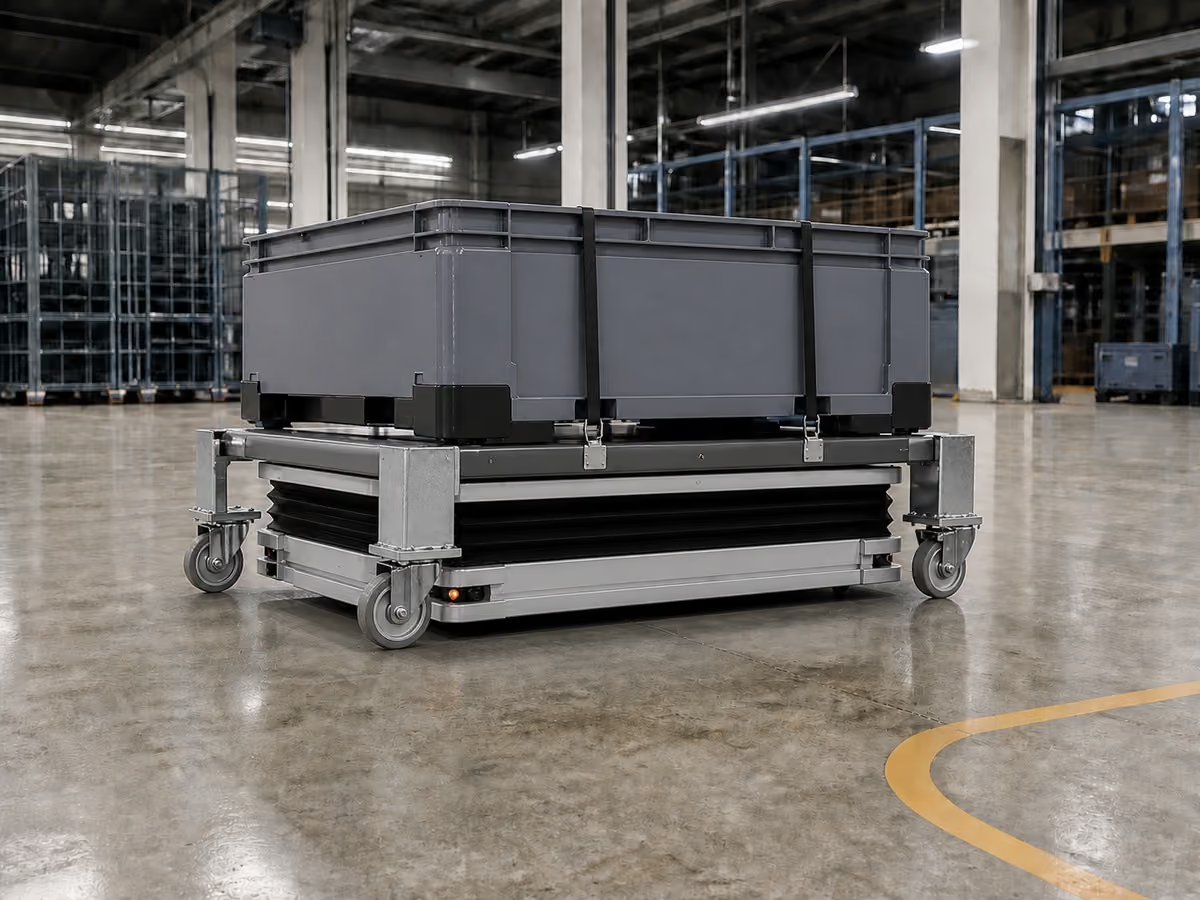
Move compatible shelves, carts, or material trains between supermarkets, buffers, production areas, warehouse zones, and return points.
robot flow
A lift-under, hook, or tow interface engages the purpose-designed carrier, transports it, and releases it at the assigned station.
Deployment design
Carrier clearance, lift contact or coupling, identification, train load, braking, turning envelope, drop-off state, and recovery.
Pallets and automatic station transfer
Routine task
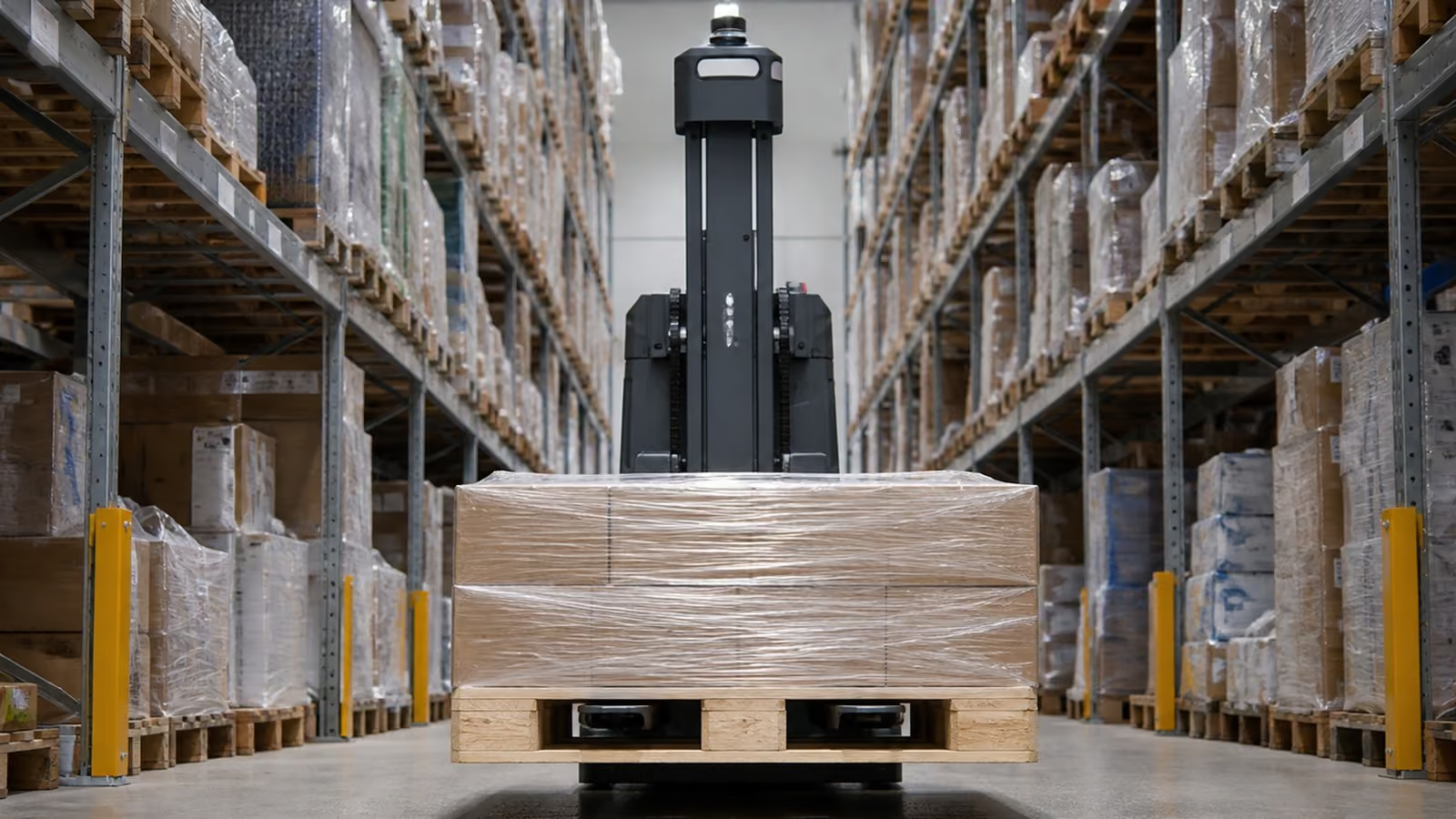
Move pallets, totes, bins, or cartons between floor positions, racks, conveyors, machines, staging areas, and order-fulfillment zones.
robot flow
A pallet lift, autonomous pallet mover, robotic forklift, or matched conveyor interface performs the configured pickup, transport, and handoff.
Deployment design
Load condition, fork or lift geometry, presentation, handoff height, docking tolerance, controls handshake, guarding, traffic, and recovery.
ONE CONTROLLED MATERIAL-MOVEMENT LOOP
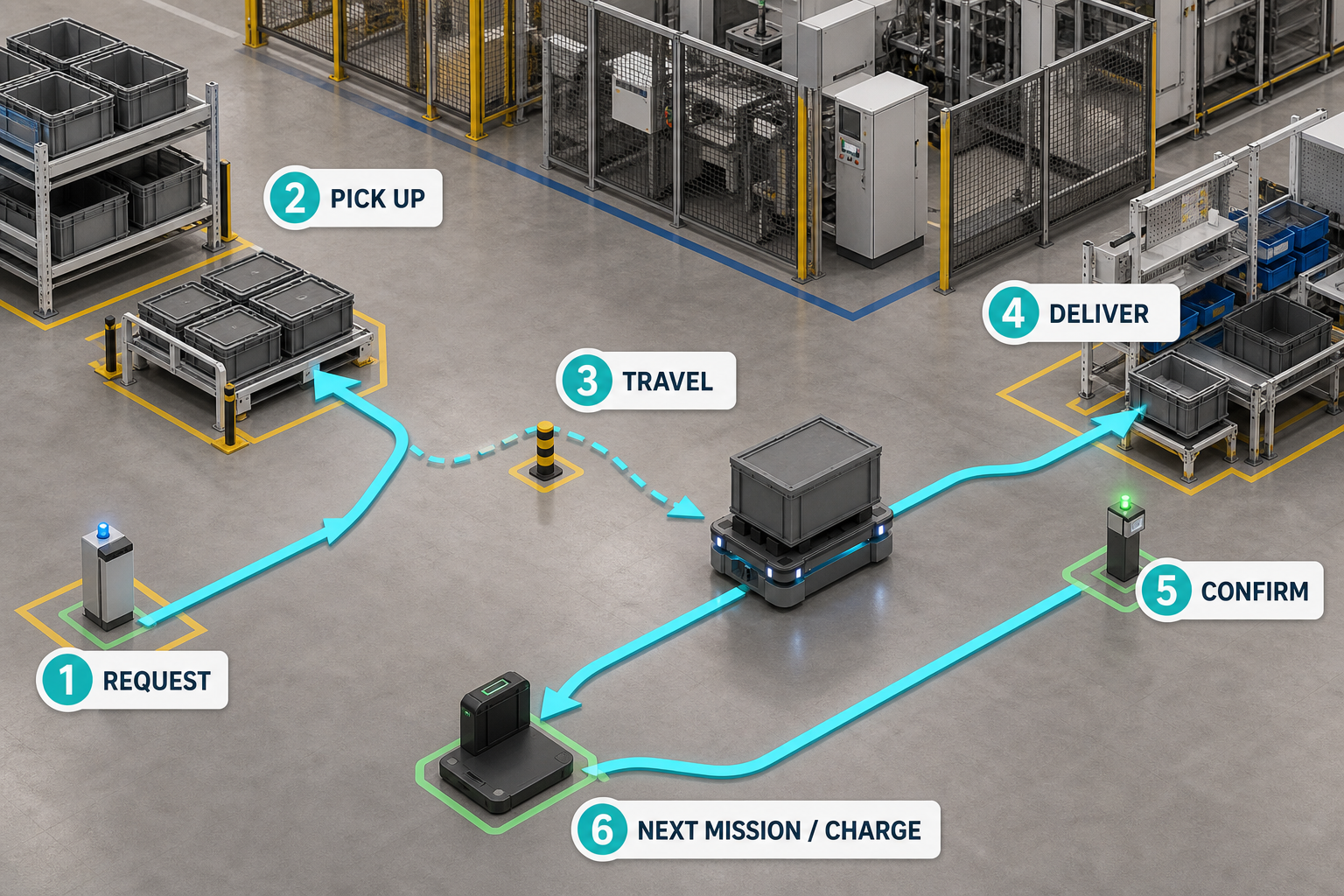
How the Warpify Material Handling Workflow Operates
Once commissioned, the solution turns production or warehouse requests into controlled robot missions. Fleet software coordinates assignment, traffic, charging, station status, and exceptions while operators retain clear control of priorities and recovery.
01
Receive the mission request
A call button, schedule, operator, machine, PLC, WMS, WCS, MES, ERP, or approved API creates a transport job.
02
Confirm load and station readiness
The workflow checks the pickup condition, carrier or pallet interface, destination availability, and required equipment signals.
03
Assign the robot and route
Fleet software selects an available robot, applies mission priority, and coordinates traffic and charging rules.
04
Transport through the operating zone
The AMR follows the commissioned route while responding to people, vehicles, obstacles, crossings, doors, and route restrictions within the designed application.
05
Complete the pickup or handoff
The robot docks, lifts, couples, transfers, or releases the load using the configured interface and station handshake.
06
Record status and continue operation
The system confirms completion, reports exceptions, dispatches the next mission, or sends the robot to charge according to fleet rules.
Warpify configures this operating loop around the actual material, load interface, stations, route, traffic rules, connected systems, and recovery process.
THE LOAD, HANDOFF, AND ROUTE DEFINE THE SYSTEM
Robot, Load Interface, Stations, and Software—Designed Together
Warpify selects and integrates the application architecture required by the material flow. Depending on the load and handoff, the solution can use a fixed top module, shelf lift, pallet lift, forks, tow coupling, powered conveyor transfer, or another validated interface. Fleet software coordinates missions, traffic, charging, and status; equipment and enterprise integrations connect the robot workflow with the systems that release work and receive completion signals. The deployment also defines how the system responds when a load is absent or misaligned, a station is occupied, a route is blocked, or an equipment or network signal is unavailable. This system-level design is what turns an AMR into an operational material handling solution.
Match the robot to the load
Configure the mobile platform, carrier, lift, coupling, fork, conveyor, restraint, and station geometry around the actual material.
Integrate the workflow
Connect mission requests, priorities, traffic, status, machines, PLCs, doors, lifts, and business systems within the agreed project scope.
Commission the complete application
Test the route, traffic interactions, handoffs, charging, failure modes, operator controls, recovery, and acceptance criteria on site.
Warpify addresses safety at the application level, including the robot, load interface, integrated equipment, operating zone, procedures, and change control. Applicable standards, risk assessment responsibilities, and validation requirements are confirmed for each project and jurisdiction.
WHAT CHANGES FOR THE OPERATION
Keep Materials Moving With Less Manual Transport
Consistent material delivery
Run scheduled and on-demand missions between production and warehouse stations using defined priorities and handoffs.
Visible mission status
Track job requests, robot status, completion, charging, blocked routes, and pickup or handoff exceptions through the configured control layer.
Reduced repetitive transport work
Assign routine walking, pushing, towing, or pallet-movement tasks to the robot workflow while people manage production and fulfillment decisions.
Scalable automation
Add routes, stations, workflows, and robots as operating demand grows and the updated application is validated.
MATERIAL FLOWS VARY BY SITE
Material Handling Robot Solutions Across the Facility
Warpify supports material flow from receiving and storage through production, quality, finished-goods staging, and dispatch. The same solution architecture is configured differently for factory traffic, line-side interfaces, warehouse aisles, pallet zones, controlled environments, and connected equipment.
LOAD AND ROUTE CONDITIONS CHANGE THE SOLUTION
One Solution Architecture, Configured for Each Environment
Warpify combines the robot, load interface, stations, fleet control, system connections, charging, recovery, and support model around the facility where the solution will operate.
Production
Production and line-side logistics
Automate kit and component delivery, work-in-process transfers, empty-container returns, machine-to-machine movement, quality handoffs, and finished-goods staging around shift schedules, production traffic, station interfaces, and MES or PLC signals.
Warehouse
Warehouse and distribution workflows
Automate tote, bin, replenishment, cart, tugger, and pallet flows across receiving, storage, picking, packing, staging, dispatch, and returns with coordinated missions and fleet traffic.
Special carriers
Special carriers and controlled environments
Configure purpose-built solutions for roll cages, irregular loads, cleanroom or ESD areas, cold storage, hygiene-controlled spaces, rough floors, slopes, thresholds, or other defined environmental conditions.
Production
Line-side supply
Deliver components, kits, tools, and empty returns between storage, preparation, supermarkets, and production stations.
Warehouse
Totes and containers
Move defined bins, totes, racks, and carriers between receiving, storage, quality, buffers, work cells, and return points.
Tugger
Carts and tugger flows
Transport compatible carts or trains with an engineered lift-under, hook, or tow interface.
Pallet
Pallet movement
Move compatible pallets and unit loads with a configured pallet lift, autonomous pallet mover, or robotic forklift.
Exception recovery, maintenance, spares, escalation, service coverage, documentation, and change control.
Warpify combines the robot, load interface, stations, fleet control, system connections, charging, recovery, and support model around the facility where the solution will operate.
WARPIFY MATERIAL HANDLING SOLUTION
A Complete Deployment Package for Your Material Flows
Warpify develops each deployment from the current material movement through solution architecture, integration, commissioning, and operating handover. The scope can start with one high-value flow and expand across additional routes, stations, and robot missions.
Current movement requirementsMaterial, carrier, origin, destination, mission volume, operating window, priorities, handoffs, exceptions, and success criteria.
+
Site and workflow fitMobile platform, load interface, stations, route, fleet software, charging, traffic logic, equipment connections, and enterprise-system integration.
+
Implementation requirementsSite preparation, risk and acceptance activities, commissioning, training, documentation, maintenance planning, support coverage, change control, and agreed commercial terms.
Workflow and demand
Define the material, carrier, origin, destination, mission rate, operating window, priorities, and completion signal.
Robot and load interface
Configure the platform, carrier, lift, tow, pallet, conveyor, charging, route, stations, and recovery method.
Fleet and integration
Connect mission requests, fleet rules, status, equipment, business systems, cybersecurity, and operating ownership.
Commissioning and support
Commission routes and stations, test normal and exception conditions, train teams, and establish maintenance and support.
The final platform, capacity, integration, deployment schedule, service coverage, and commercial terms are confirmed in the project scope.
DESIGN. INTEGRATE. DEPLOY. SUPPORT.
Warpify Delivers the Complete Material Handling Robot Solution
Warpify brings together the robot platform, application hardware, fleet software, facility interfaces, systems integration, commissioning, and operating support required to put material handling automation into service.
01
Material flow engineering
Define the material, carrier, route, handoffs, mission demand, exceptions, operating owner, and acceptance criteria.
02
Platform and interface configuration
Select and configure the AMR, lift, deck, carrier, tow, pallet, conveyor, charging, and station architecture for the application.
03
Fleet and systems integration
Configure missions, priorities, traffic, charging, status, and required connections with machines, PLCs, doors, lifts, WMS, WCS, MES, ERP, or approved APIs.
04
On-site commissioning and acceptance
Map the operating zone, commission routes and stations, test normal and exception conditions, and verify the agreed acceptance criteria.
05
Training and lifecycle support
Prepare operators and maintenance teams, document recovery and escalation, and provide the maintenance and support defined in the project agreement.
MATERIAL HANDLING ROBOT FAQ
Material Handling Robot Solution FAQs
Understand what Warpify delivers, where the solution operates, which loads it supports, how integration works, and how deployment is completed.
What does the Warpify material handling robot solution include?
The solution can include the AMR or autonomous pallet-moving platform, load interface, pickup and drop-off stations, charging, fleet software, traffic and mission configuration, facility or enterprise-system integration, on-site commissioning, acceptance testing, training, documentation, and agreed support.
Does the solution work in production environments as well as warehouses?
Yes. Warpify designs material handling workflows for production and warehouse operations. Factory applications include line-side supply, kit delivery, work-in-process transfers, machine and quality handoffs, empty-container returns, and finished-goods staging. Warehouse applications include receiving, storage, replenishment, tote and cart movement, pallet transport, picking support, staging, dispatch, and returns.
Which loads and workflows can the solution handle?
The application is configured for the material and carrier. Available architectures can include fixed-top transport, shelf or cart lift-under movement, towing, pallet handling, robotic forklift movement, and matched conveyor transfer. Warpify confirms the appropriate interface, capacity, route, and station design during solution engineering.
Can the robots connect with WMS, WCS, MES, ERP, PLC, doors, lifts, or machines?
Yes, when the selected platform and connected equipment support the required interface. Warpify defines the mission trigger, data exchange, acknowledgements, timeout and retry behavior, cybersecurity scope, testing, and system ownership for the project.
How is the solution deployed?
Warpify defines the workflow, engineers the platform and interfaces, prepares the route and stations, configures fleet and system connections, commissions the application on site, tests normal and exception conditions, trains the operating team, and hands over the agreed maintenance and support process.
A PRACTICAL FIRST STEP
What Warpify Needs to Configure Your Solution
Choose one repetitive production or warehouse movement. The following information helps Warpify define the right robot, load interface, integration, and deployment scope.
Material, weight, dimensions, condition, center of gravity, carrier, and support methodOrigin, destination, route, floor, traffic, crossings, doors, lifts, pickup, drop-off, and handoff geometryMission frequency, peak demand, shifts, priorities, current method, and desired completion signalRequired fleet, charging, station, machine, PLC, WMS, WCS, MES, ERP, API, or inventory connectionsSafety roles, operating procedures, exception recovery, maintenance, cybersecurity, service, and change-control needsAcceptance criteria, rollout priorities, and future routes or stations
Share these inputs with Warpify. We will recommend the solution architecture, confirm project feasibility, define the deployment scope, and prepare the commercial proposal.
Tell us what moves, how it is supported, where it starts and ends, how often it moves, and which systems or stations are involved. Warpify will define the solution architecture and deployment scope for your production or warehouse operation.