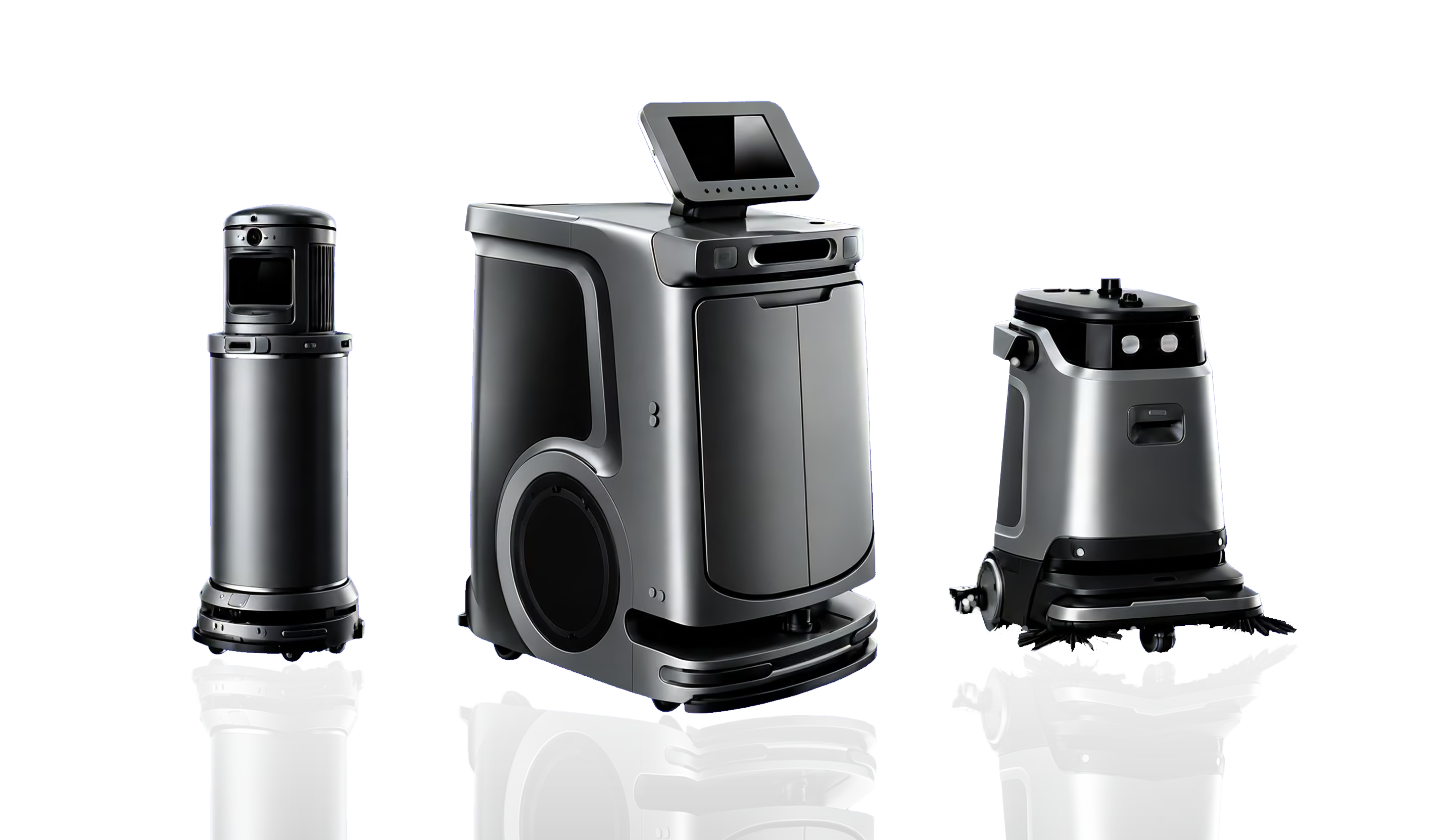
Reliable Hospital AMR Logistics, Route by Route

Warpify delivers integrated hospital autonomous mobile robot (AMR) logistics solutions for pharmacy, laboratory, sterile supply, operating-room support, and other non-clinical routes. We combine the mobile platform, payload interface, building and system integration, commissioning, pilot acceptance, and lifecycle support around one route at a time. Clinical decisions and patient-care responsibilities remain human-led.

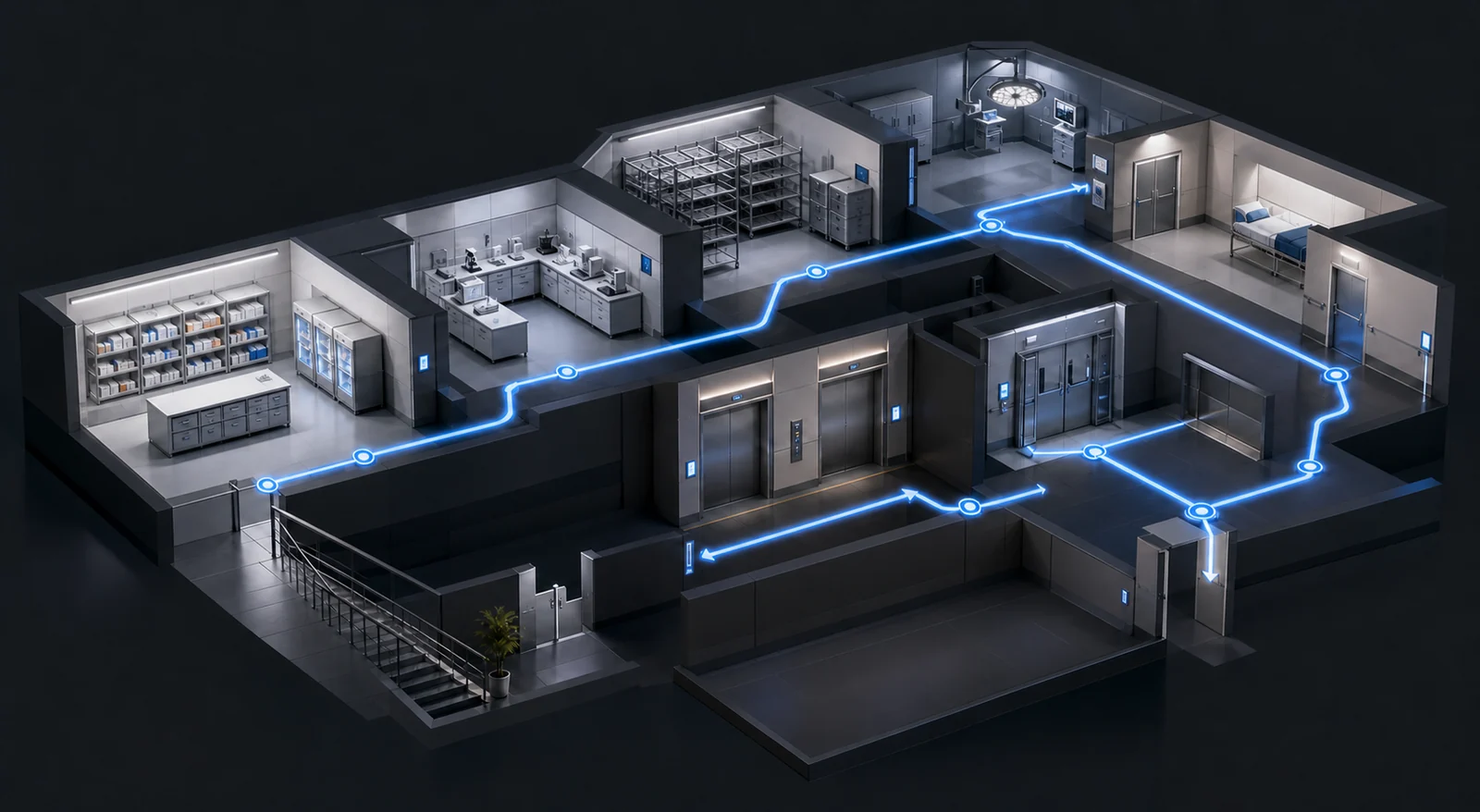
See How Hospital Logistics Routes Connect

Use this application visual to examine how payload preparation, building access, secure handoffs, charging and exception ownership must work together. The visual is illustrative and is not evidence of a named Warpify hospital deployment.

On this pageAll sections
Choose the hospital service before the platform

Start With a Route Whose Payload, Timing and Custody Can Be Defined

A hospital autonomous mobile robot (AMR) is most useful when it serves a repeatable, non-clinical logistics route with known endpoints, an approved container, a receiving team and a named response when the normal handoff fails.

Time-sensitive medication and specimen routes
Service question

Which releases are scheduled, urgent or multi-stop, and who verifies the container before and after transport?

Automation scope

A qualified mission may move a sealed load between pharmacy, collection, laboratory or ward handoff points with supported authentication and status records.

Human responsibility

Hospital staff retain preparation, identity checks, clinical acceptance, temperature policy and exception decisions.

Sterile supply and operating-room support
Service question

How are clean and soiled flows separated, and how are urgent instruments or high-value consumables released and reconciled?

Automation scope

A scheduled or requested route may connect sterile processing, stores, operating areas and approved buffer points using compatible enclosed payloads.

Human responsibility

Sterile status, item verification, inventory decisions, cleaning procedure and receiving acceptance remain hospital-controlled.

High-volume scheduled support services
Service question

Where do peak dispatch windows, elevator demand, cart exchange, charging or receiving delays limit service reliability?

Automation scope

Suitable routes may support infusion bags, general supplies, meals, linen or other approved loads using timed waves or on-demand dispatch.

Human responsibility

Departments retain payload release, clean/soiled rules, cart readiness, receiving windows and service prioritization.

The AMR automates movement within an approved service design. It does not make clinical decisions, prepare medication, accept a specimen, certify sterility or replace hospital infection-control and chain-of-custody procedures.

Design the service chain

Connect Dispatch, Payload Custody, Building Access and Receipt

A reliable route is a sequence of controlled events. Each mission needs a service promise, release authority, payload state, building path, receiving action, exception path and record of what happened.

01

Set the service promise

Define the route, request types, priority rules, service window, receiving commitment and manual fallback.

02

Authorize and prepare the load

The responsible team creates or approves the mission, verifies the container and records any required payload state.

03

Assign a ready mission

Fleet logic selects an available unit and preserves urgent, scheduled and routine priorities within the approved operating model.

04

Traverse the controlled route

The mission uses commissioned paths and supported door, elevator or access interfaces with safe behavior for congestion and loss of access.

05

Verify receipt or escalate

The receiving team completes the approved handoff; missed receipt, seal concerns or blocked access route to a named human owner.

06

Reconcile, charge and improve

Mission records, intervention reasons, charging readiness and service exceptions are reviewed before the route is expanded.

Hospital information systems, fleet software, elevators, automatic doors and access control are separate interfaces. Any connection depends on approved APIs or control hardware, cybersecurity review, data ownership, commissioning and a tested manual fallback.

Illustrative multi-level hospital logistics route connecting pharmacy, laboratory, sterile supply, elevator and handoff areas.
Illustrative route map. Actual routes, handoffs and building interfaces require site qualification.
Hospital controls around every mission

Reliable Logistics Depends on Clear Custody, Priority and Recovery Rules

The hospital remains the service owner. Automation should make transport easier to request and trace while preserving departmental authority over payloads, shared spaces, infection control and exceptions.

Payload custody

Define who may prepare, release, unlock, receive and investigate each load. Sensitive routes may require supported authentication, seals or electronic handoff records.

Priority and shared-space behavior

Set rules for urgent requests, corridor congestion, beds and carts, elevator queues, emergency traffic and temporary route closures.

Clean, soiled and controlled flows

Approve container separation, route timing, cleaning compatibility, spill response and responsibility for the carrier, charger and handoff areas.

Exception and service ownership

Name the first responder, department contact, facilities and IT escalation, maintenance provider and authority to pause or resume the route.

Operational value can include fewer routine interruptions, more predictable service windows and better handoff visibility. These effects must be measured in the hospital pilot and must not be assumed to equal staffing reduction.

Department route playbooks

Qualify Each Hospital Route as Its Own Service

A central-pharmacy route is not the same service as a laboratory or sterile-supply route. Each department has different release authority, payload protection, timing, receiving and exception requirements.

Operating-room support

Scheduled replenishment and urgent requests

Qualify high-value consumables or instrument routes around release authority, item-level accountability where required, sterile boundaries, urgent-call priority and receipt near controlled areas.

PIVAS

Infusion-bag distribution waves

Pharmacy intravenous admixture services (PIVAS) may generate heavy, time-bound ward deliveries. Assess container capacity, stable transport, peak dispatch, elevator demand, release records and receiving windows.

Central pharmacy

Routine, multi-stop and urgent medication routes

Define which requests may be grouped, which receive priority, how custody is recorded and what happens when a ward is not ready to receive the load.

Laboratory

Specimen collection and return services

Validate approved containment, chain of custody, time or temperature responsibility, night demand, multi-floor routing, receiving acceptance and spill or delay response.

Sterile processing

Clean supply and soiled-return loops

Central sterile services department (CSSD) routes need explicit clean/soiled separation, compatible carriers, controlled handoff points, cleaning responsibility and manual fallback.

Hospital support services

Meals, linen and general supplies

Timed routes may fit when carts, temperature responsibility, clean/soiled rules, staging space, elevator capacity, receiving windows and charging can be coordinated.

Environmental disinfection

Autonomous disinfection as a separate hospital service

Evaluate disinfection separately from logistics delivery. Define the approved treatment method, occupancy rules, route or room scope, exposure controls, validation evidence, charging, infection-prevention ownership and manual fallback.

Medical waste

Controlled collection and transport routes

Assess hospital-approved segregation, sealed containment, zoning, handoff records, cleaning, spill response, storage interfaces and the regulated manual fallback before automating any collection route.

Four decisions before a route enters pilot

Service window and priority

Demand by shift, scheduled waves, urgent requests, maximum wait, elevator peaks, receiving availability and fallback capacity.

Payload and chain of custody

Weight, volume, containment, seal, temperature responsibility, loading height, release authority, authentication and acceptance.

Building and system interfaces

Communications, doors, elevators, access control, dispatch source, status records, data ownership, charger and staging capacity.

Fallback and service ownership

Blocked-route response, missed handoff, manual transport, cleaning, maintenance, spares, remote support, training and change approval.

A route should not proceed when the hospital cannot establish safe clearance, approved containment, reliable communications, required interfaces, receiving ownership or a timely human fallback.

Illustrative hospital AMR route from a PIVAS preparation area through an elevator lobby to ward handoff points.

PIVAS to ward handoff

  1. 01PIVAS release
  2. 02Controlled route
  3. 03Elevator interface
  4. 04Ward receipt
Illustrative hospital AMR route from a secure collection point through a controlled door and elevator to laboratory receiving.

Specimen to laboratory

  1. 01Secure collection
  2. 02Controlled access
  3. 03Elevator interface
  4. 04Laboratory receipt
Illustrative hospital AMR route from sterile-supply dispatch through an elevator and controlled door to an operating-room support handoff.

Sterile supply to operating-room support

  1. 01Sterile dispatch
  2. 02Building interfaces
  3. 03Controlled handoff
  4. 04Receiving confirmation
Decide whether the route deserves a pilot

Model Hospital Route Economics With Demand, Consequence and Full Cost

A credible business case starts with route-level evidence: current trips and interruptions, the share eligible for automation, the operational consequence of missed service and every cost required to run the route.

Transport demandTrips, peaks, distance, escort, waiting and handoff effort
Service consequenceTimeliness, coverage, released capacity and traceable receipt
Total ownership costPlatform, carrier, interfaces, commissioning, support and change

Baseline demand

Trips by type and shift, urgent calls, staff minutes, distance, elevator delay, waiting, escort and failed handoffs.

Eligible service share

Missions that meet payload, timing, route and ownership rules, including expected intervention and manual fallback.

Hospital value case

Released capacity, service consistency, receipt visibility, reduced routine pushing and resilience during peaks or off-hours.

Lifecycle cost case

Platform, payload hardware, fleet software, building interfaces, network, commissioning, training, maintenance, spares and support.

Model hospital AMR route economics and TCO

Use downside, base and upside scenarios. The pilot should replace assumptions with observed completion, handoff, intervention, response, charging and staff-acceptance evidence before any scale decision.

From route brief to managed service

Warpify Aligns the Hospital, Platform and Service Responsibilities

Warpify structures the route as an operating agreement: what moves, who releases and receives it, which interfaces are required, what the pilot must prove and who supports the service after acceptance.

01

Route and service brief

Document departments, payload, demand, priority, custody, interfaces, exceptions and the decision the business case must support.

02

Platform, carrier and capacity match

Select mobility, compartment or cart interface, endurance, charging and fleet capacity only after the route is qualified.

03

Hospital interface and data plan

Define dispatch, doors, elevators, access, authentication, records, cybersecurity, data ownership, remote support and escalation.

04

Pilot evidence and acceptance

Test route behavior, custody, receipt, congestion, recovery, charging, staff workflow and agreed service thresholds.

05

Lifecycle governance and support

Assign training, preventive maintenance, spares, software updates, route changes, incident response, review cadence and local ownership.

Evidence before another department

Review Deployment Evidence Before You Generalize a Result

Look for workflow, limitations and operating ownership

Use approved case studies to examine what was automated, which conditions mattered, how people remained involved and what evidence supported the result. A route in one hospital does not prove fit in another.

Review Robotics Case Studies
Questions from pharmacy, laboratory, facilities, IT and operations

Hospital AMR Planning Questions

Which hospital logistics routes are suitable for AMR automation?

Good candidates are repeatable, non-clinical routes with known endpoints, an approved payload and container, measurable demand, a receiving workflow and a human exception owner. Medication, PIVAS, specimen, operating-room support, sterile supply, meal, linen, general-supply and controlled-waste routes may fit, but every route needs site qualification.

What is PIVAS, and how might an AMR support it?

Pharmacy intravenous admixture services prepare infusion products for controlled distribution. A suitable AMR route may support sealed, time-bound ward delivery when capacity, stable transport, release records, elevator demand, receiving windows, temperature responsibility and fallback are validated.

How should operating-room and sterile-supply routes be designed?

Define release authority, urgent-call priority, item accountability where required, sterile boundaries, compatible enclosed carriers, clean and soiled separation, controlled handoff points and manual fallback. The hospital remains responsible for sterile status and clinical use.

What remains human-led after a hospital AMR is deployed?

People remain responsible for clinical decisions, patient care, payload preparation and verification, medication and specimen policy, sterile and infection-control procedures, exception response and authorization to pause or change the service.

How can medication and specimen handoffs be controlled?

Where the selected system supports it, the design may use approved sealed containers, enclosed compartments, access control, authentication and mission records. The hospital defines who may prepare, release, receive, reject and investigate the payload.

Can hospital AMRs use elevators, automatic doors and controlled areas?

They can when the platform and approved building interfaces support the requirement. Door, elevator and access-control behavior must be designed, cyber-reviewed, commissioned and tested with congestion, priority traffic, failure and manual-recovery scenarios.

How does the AMR connect with hospital and facility systems?

Integration may cover transport requests, fleet status, doors, elevators, access control, alerts or reporting where approved interfaces exist. Scope should define system ownership, data fields, authentication, logs, retention, remote support and the authoritative record.

What infection-control and clean/soiled procedures are required?

The hospital's infection-prevention team should approve payload containment, clean and soiled separation, route rules, compatible cleaning or disinfection methods, spill response and responsibility for the robot, carrier, charger and handoff areas. An AMR does not replace hospital SOPs.

Who owns exceptions, maintenance and service response?

The operating model should name the dispatch owner, department contact, facilities and IT contacts, infection-control reviewer, first responder, maintenance provider and escalation path. Acceptance criteria should state response expectations and the manual fallback for each critical route.

How should a hospital evaluate route economics and choose the first pilot?

Start with one route whose trips, peaks, staff effort, missed-service consequence and handoffs can be measured. Estimate the eligible automation share and include platform, payload, interfaces, commissioning, support and lifecycle cost. Use ranges and replace assumptions with pilot evidence.

Is a hospital logistics AMR the same as an autonomous disinfection robot?

Not necessarily. Some platforms may support more than one module, but logistics transport and environmental disinfection are separate hospital services. Each requires its own platform fit, treatment method, occupancy and exposure controls, infection-prevention approval, validation evidence, fallback and operating owner.


Bring a route brief, not a robot shortlist

Assess One Hospital Logistics Service

Choose one route that matters operationally and describe the payload, demand, handoff, building path and fallback. That is enough to begin a credible fit assessment.

Sending and receiving departments Payload, container and custody rules Scheduled, urgent and peak demand Doors, elevators and shared-space constraints System, data and cybersecurity boundaries Fallback owner and pilot evidence

Warpify can turn that brief into a route qualification, interface plan, pilot scope, acceptance evidence and lifecycle support model, while keeping clinical decisions and hospital policy with the responsible teams.

HOSPITAL PLANNING RESOURCES

Plan one hospital route with evidence

Use these resources to qualify route fit, safety, deployment ownership, and operating evidence. Return to the Solutions overview or send one hospital route for assessment.

Bring a Hospital AMR Solution to Your Market

If you have hospital customers, integration opportunities, or a healthcare distribution channel, Warpify Robotics can help turn hospital AMR interest into a structured solution that is easier to discuss, evaluate, and deploy.