Which Hospital Logistics Workflows Fit AMRs?
A workflow-fit method for screening hospital logistics tasks by payload, route, handoffs, urgency, exceptions, infrastructure and operating ownership.
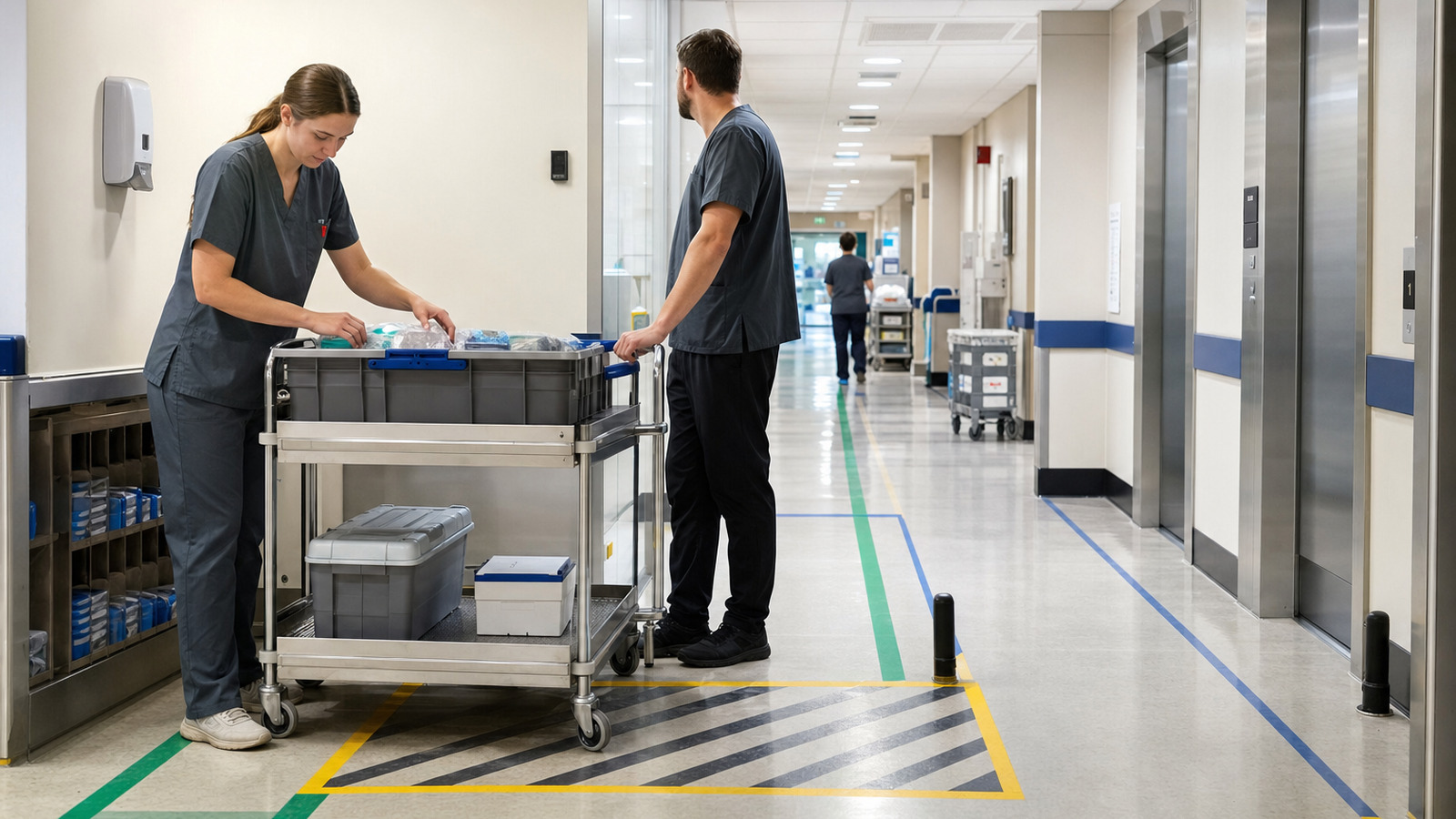
The best hospital autonomous mobile robot (AMR) candidate is not a department or a product category. It is a bounded logistics workflow with a repeatable origin, destination, payload, handoff and exception path. Use that workflow boundary to evaluate hospital AMR logistics solutions before selecting hardware.
An AMR may fit a routine internal transport task when the site can define what moves, when it moves, how it is secured, where people interact with it, which infrastructure it uses and who responds when the normal route fails. Clinical judgment, urgent care and undefined work should remain outside that first automation scope.
Start with one workflow, not a list of robot use cases
A useful robotics solution assessment begins with a current-state map. Choose one route and record:
- origin, destination and allowed intermediate stops;
- payload class, container, loading and release controls;
- request, dispatch, receipt and confirmation steps;
- routine demand, peaks, urgent exclusions and delivery windows;
- corridors, doors, elevators, access zones, charging and storage;
- people, carts, beds and equipment that share the route;
- normal completion evidence and every known exception owner.
A 2024 qualitative study observed hospital robots transporting medications, supplies and equipment, while also finding that the systems still needed human support in a complex and unpredictable environment. That evidence supports evaluating both the transport task and the human work around it.
Apply six workflow-fit gates
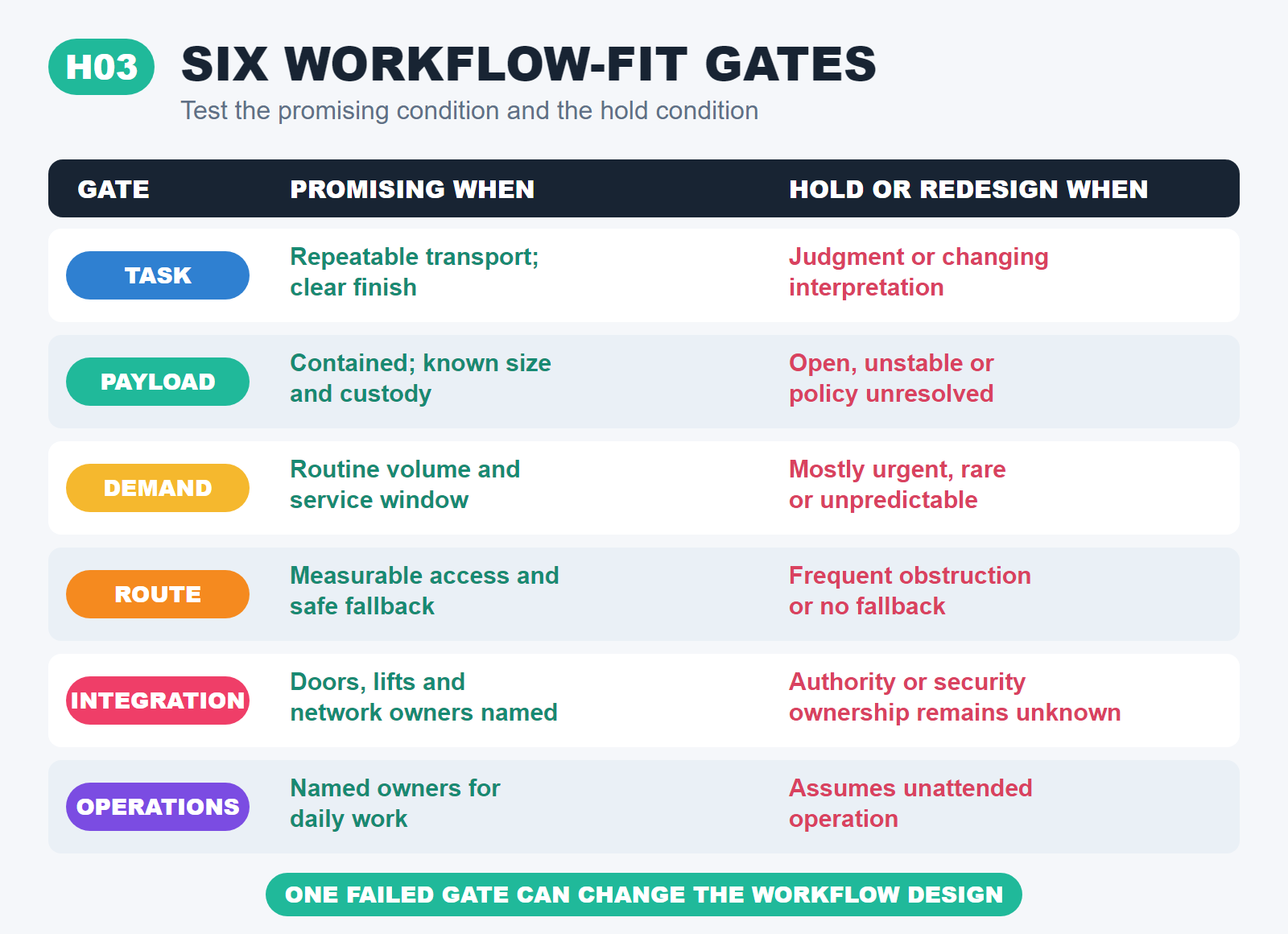
Scroll horizontally to compare all columns.
| Gate | Promising condition | Hold or redesign condition |
|---|---|---|
| Task | Repeatable internal transport with a defined completion state | Task requires clinical judgment, manipulation or changing interpretation |
| Payload | Contained load with known dimensions, weight, security and handoff | Open, unstable, incompatible or policy-unresolved payload |
| Demand | Observable routine volume and service window | Mostly urgent, rare or highly unpredictable requests |
| Route | Accessible path with measurable traffic and clearance | Frequent obstruction, unresolved access or no safe fallback |
| Integration | Doors, elevators, network and dispatch ownership can be assigned | Interface authority, security or building-system access is unknown |
| Operations | Loading, receipt, charging, cleaning, monitoring and exceptions have owners | The business case assumes unattended operation without an operating model |
Candidate families to investigate
Potential candidate families include routine movement of appropriately contained supplies, linens, meals, waste streams, equipment or non-urgent medications and specimens. These are categories for discovery, not blanket approvals. Each item class still needs policy, containment, chain-of-custody, cleaning, security and handoff review.
Start where the route and handoffs are visible and measurable. A high-volume workflow may still be a poor candidate if it is dominated by urgent exceptions or unresolved elevator access. A lower-volume route may be useful as a learning pilot if it exercises the infrastructure and operating responsibilities needed later.
Test the real environment
A 2024 navigation study proposed context-specific hospital tests with static obstacles, moving obstacles and confined environments rather than treating a clear demonstration route as sufficient evidence. Translate that principle into site acceptance scenarios: peak traffic, carts parked near turns, changing doors, narrow passing points, destination congestion and realistic handoffs.
A 2026 single-site study found that elevator congestion affected non-urgent medication-delivery success and delay. Do not import that site's results as a threshold. Measure the target hospital's elevator occupancy, waiting, boarding, obstruction and fallback behavior across the intended operating window.
Define exceptions before the pilot
- request cannot be accepted or dispatched;
- payload is not ready, secure or compatible;
- door, elevator, network or access-control dependency is unavailable;
- route is blocked or the robot cannot complete a maneuver;
- recipient is absent or refuses the handoff;
- mission exceeds its delivery window;
- robot needs charging, cleaning, service or manual recovery.
For each exception, assign detection, first response, escalation, manual fallback, evidence and closure. A workflow that has no acceptable fallback is not ready merely because the normal path can be demonstrated.
Choose capability after workflow fit
Once the workflow passes the gates, use the hospital AMR, AGV and service robot comparison to match navigation, payload interface, building integration and operating support. The workflow should determine the capability; the selected robot should not redefine the problem to fit its feature list.
Evidence a pilot should produce
Record eligible requests, completed end-to-end missions, delivery-window performance, intervention and exception categories, infrastructure failures, handoff completion, affected staff tasks and manual fallback. Define the denominator and observation window before testing. The result should support a go, revise or stop decision for that workflow—not a claim that all hospital logistics can be automated.
Sources and scope
This guide combines the cited primary sources with an editorial decision framework. It does not quote a market price, promise a result, replace a site assessment, or provide legal, financial, clinical, cybersecurity or safety advice.
- Integrating Collaborative Robots into a Complex Hospital Setting: A Qualitative Descriptive Study — Delaware Journal of Public Health / PubMed
- Feasibility of autonomous medication delivery robots considering elevator utilization in high-traffic hospital environments — DIGITAL HEALTH / SAGE
- Navigation benchmarking for autonomous mobile robots in hospital environment — Scientific Reports
Related planning: After screening workflow fit, build the hospital delivery robot TCO boundary from the same route, handoff and service assumptions.
Take the next step
Bring one bounded route, payload and handoff into an assessment rather than asking whether a hospital is ready for robots in general: Assess a hospital logistics workflow.

Iven Wang
Iven Wang is the Co-Founder of Warpify Robotics, specializing in the commercialization and deployment of robotic solutions. With a background in electrical engineering and product management, he works with manufacturers, integrators, and enterprise clients across industrial inspection, security, logistics, and Robotics-as-a-Service.
Subscribe to our newsletter today
Get practical robotics deployment insights, case studies, and planning guidance from Warpify Robotics.