Hospital Autonomous Mobile Robots vs. AGVs and Service Robots
Compare hospital autonomous mobile robots (AMRs), automated guided vehicles (AGVs), and service robots by workflow, payload, integration, and deployment considerations.

Hospital autonomous mobile robots (AMRs), automated guided vehicles (AGVs) and service robots differ in navigation, payload, interaction and operating responsibility. The useful comparison starts with the workflow: what must move, who prepares and receives it, which building systems are involved, and what happens when the task cannot be completed.
This guide focuses on non-clinical hospital logistics. It does not recommend robots for direct patient care, clinical decision-making or unverified infection-control claims.
Define the three categories in operating terms
- AGV: a vehicle that follows a defined guidance method or constrained route. It can fit repeatable backend logistics where the path and handoffs are tightly controlled.
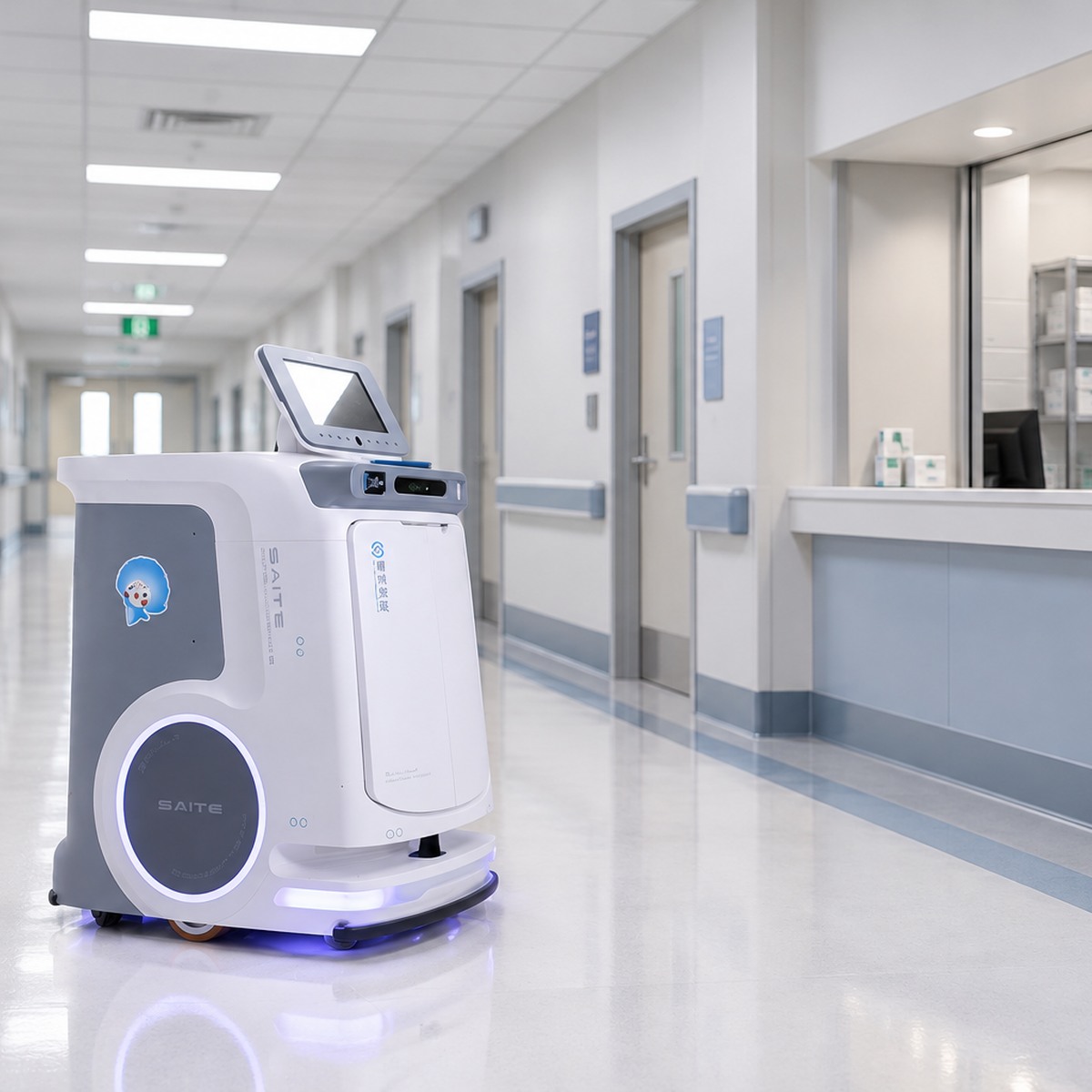
- AMR: an autonomous mobile robot that localizes and plans within an approved operating area. It can navigate around some obstacles, but it still depends on route clearance, payload design, building interfaces and exception rules.
- Service robot: a broad category defined by the service task. A service robot may be mobile or stationary and may interact with staff, visitors or other users.
Compare by workflow fit
Scroll horizontally to compare all columns.
| Decision factor | AGV | AMR | Service robot |
|---|---|---|---|
| Typical fit | High-volume, repeatable backend movement on controlled routes | Flexible point-to-point logistics within a mapped operating area | A defined service task that may involve closer human interaction |
| Navigation | Uses a defined guidance or route-control method | Localizes and plans within approved maps and constraints | Varies by the service and platform |
| Payload | Often designed around carts, racks or heavy logistics interfaces | Often uses lockers, shelves, carts, lifts or other workflow-specific interfaces | Varies widely; payload may be secondary to the service interaction |
| Infrastructure | May need route markers, reflectors or other guidance infrastructure | May need doors, elevators, charging, network and access-control integration | May need application-specific interfaces and interaction design |
| Exception focus | Blocked route, guide-path issue, unavailable handoff or building system | Blocked route, map/localization issue, unavailable handoff or building system | User interaction, task ambiguity, handoff and service recovery |
| Selection evidence | Route capacity, payload interface, traffic control and recovery tests | Route, integration, payload, mission and recovery tests | Task usability, safety, interaction and service-outcome tests |
Screen the workflow before selecting the category
Record payload, containment or security needs, origin and destination, volume by hour, urgency, route length, elevator dependency, contamination boundary, access restrictions, handoff complexity, staffing responsibility and manual fallback. A routine linen route may have a different answer from medication, laboratory specimen or meal movement.
The hospital AMR logistics solution explains the wider deployment boundary. The separate hospital workflow-fit guide helps identify which tasks deserve assessment first.
Expect building and IT integration work
AMRs can often operate without a fixed guide path, but the project may still require changes or interfaces for doors, elevators, charging, network coverage, access control, fleet software and handoff stations. Test normal and failure behavior for every dependency. Define who owns a failed lift call, locked door, blocked corridor, unavailable recipient or lost connection.
Keep payload and handoff controls explicit
The payload interface should match the item and operating method. Consider containment, cleaning, loading, secure access, weight and center of gravity, identification, receipt confirmation and what happens when a compartment or cart is not ready. Do not show or approve an unsupported cart or carrier arrangement.
Separate logistics from clinical responsibility
Hospital logistics automation should not blur responsibility for clinical judgment, patient supervision, medication authorization, infection-control approval or emergency priority. Define the robot's role, the human decision points and the conditions that return the task to manual operation.
The AMR safety guide provides industrial-mobile-robot context. Hospitals also need site-specific review for public circulation, accessibility, emergency operations, privacy, cybersecurity and clinical governance.
Choose a bounded first pilot
Prefer a repeatable, measurable workflow with controlled payloads, clear owners and a practical manual fallback. Baseline the current route, volume, queue and staff time. Pilot with representative traffic and building-system conditions, then measure mission completion, interventions, handoff performance, workflow impact and recovery separately.
A pilot should answer whether the hospital can operate and govern the service, not merely whether the robot can traverse a hallway.
Sources and limitations
This comparison is technology-neutral and does not represent every product. Verify the selected equipment, payload, interfaces, instructions and applicable requirements.
Assess the hospital workflow
Review the hospital AMR case study as evidence with its stated scope and limitations, then request a hospital logistics assessment.

Iven Wang
Iven Wang is the Co-Founder of Warpify Robotics, specializing in the commercialization and deployment of robotic solutions. With a background in electrical engineering and product management, he works with manufacturers, integrators, and enterprise clients across industrial inspection, security, logistics, and Robotics-as-a-Service.
Subscribe to our newsletter today
Get practical robotics deployment insights, case studies, and planning guidance from Warpify Robotics.