Power Plant and Substation Robot Inspection: A Readiness Framework
Assess routes, inspection payloads, evidence quality, recovery and site controls before piloting a robot in a power plant or substation.
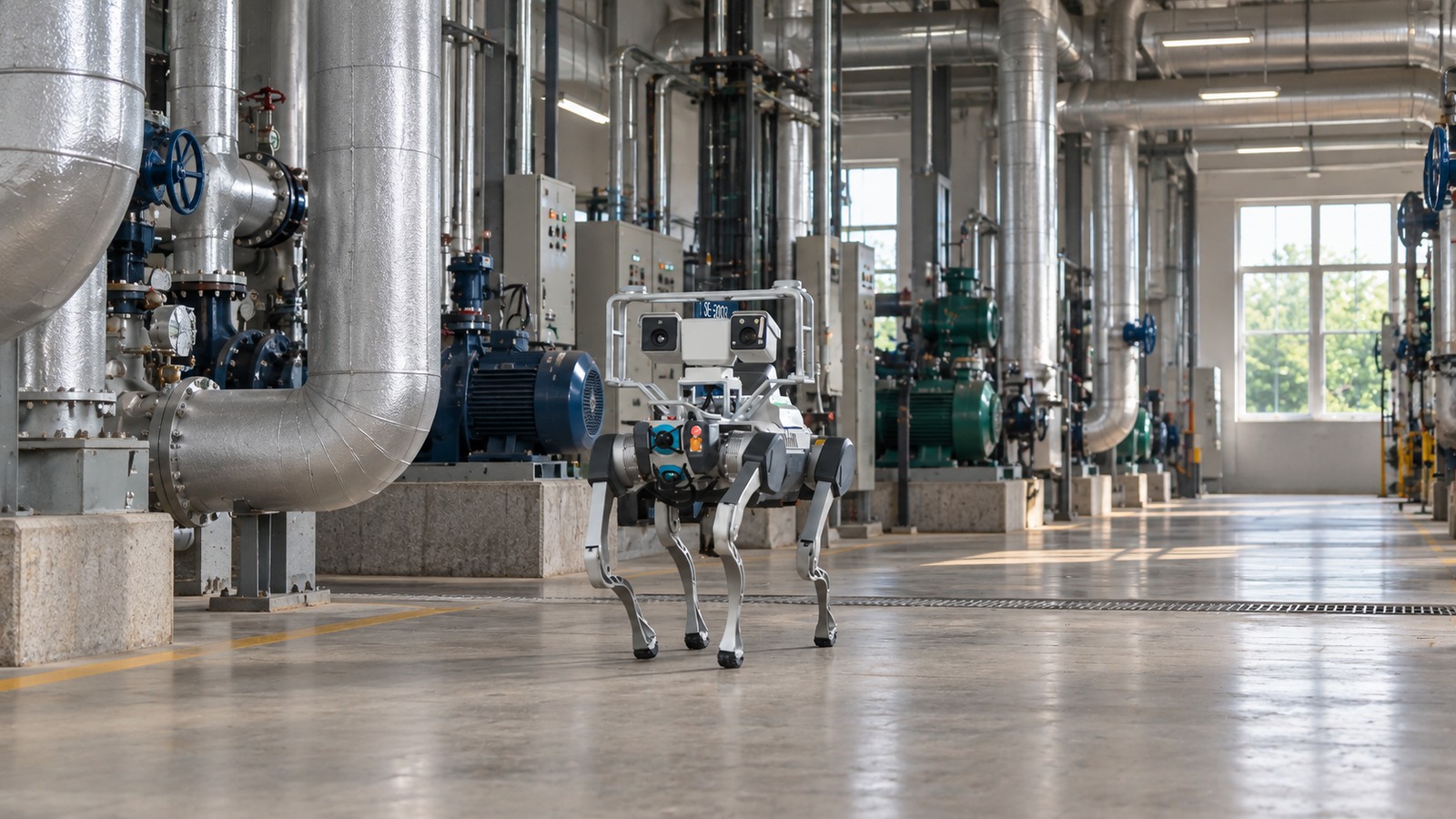
A power plant inspection robot should be evaluated against an inspection decision: which assets need observations, what constitutes a usable reading, and who responds when an abnormal condition is found. Traversing a substation aisle is only one part of that service. A useful readiness assessment connects route access, sensor capability, evidence quality and the plant’s existing operating authority.
This framework concerns observation and inspection planning. It does not authorize electrical work, switching, entry into restricted areas or operation near energized equipment. Site electrical and safety authorities must determine the permissible application and conditions. Begin with the scope of industrial inspection robotics, then assess individual routes and read points.
Build a read-point register before a route map
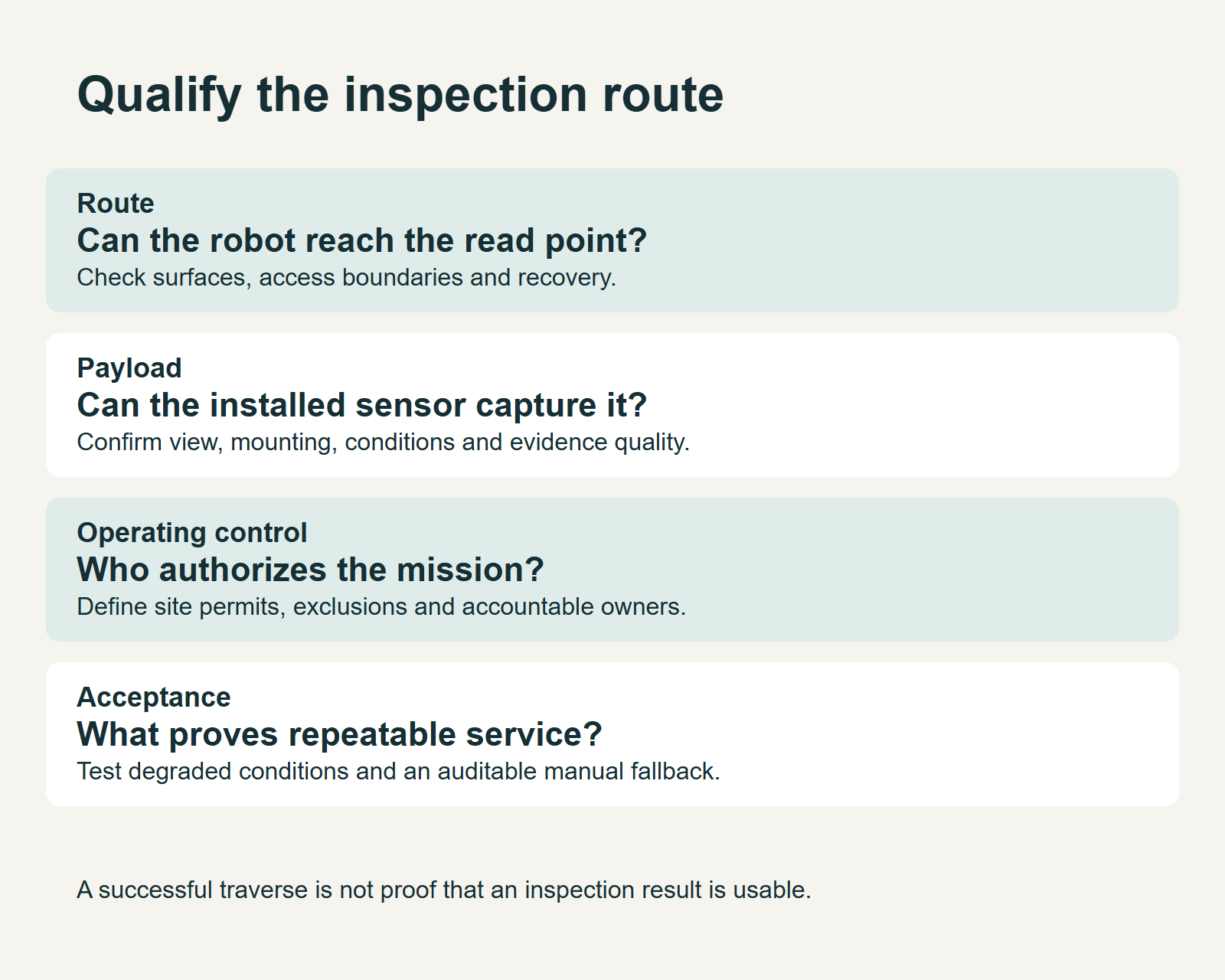
For every proposed observation, record the asset identifier, physical location, required modality, inspection question, frequency, permitted viewpoint, expected output and escalation owner. Separate visual gauge reading, thermal observation and other sensing tasks. A robot’s mobility rating does not establish that its payload can produce the required evidence.
Mark read points as accessible, conditionally accessible or outside the current scope. Record why: a closed enclosure may conceal the relevant component; glare may prevent a reliable visual reading; a changing operating state may affect interpretation. Keep manual or existing instrumented inspection for tasks that the proposed system cannot validate.
DEEP Robotics’ official power-inspection material describes visual and infrared sensing in its solution. That is evidence of the manufacturer’s application offering, not proof that a particular plant, inspection target or integration has been accepted.
Match the platform and payload to the permitted route
Survey surfaces, steps, gratings, thresholds, drainage, lighting, weather exposure, radio coverage, doors and recovery access. Assess the complete configured system, including sensor payload, mounting, cabling and any protective hardware. Ask the supplier for configuration-specific limits and supporting test evidence.
Do not assume that an ability to climb stairs establishes permission to use any industrial stairway. Route suitability also depends on geometry, condition, traffic, rescue access and site rules. Likewise, an enclosure protection claim does not establish suitability for every chemical, thermal or hazardous-area condition.
The inspection route design guide can support waypoint planning after the operating boundary is agreed. Keep prohibited areas and temporary exclusions explicit in both procedures and the accepted route configuration.
Separate observation from plant control
Map the complete information path: sensor capture, asset association, quality check, interpretation, alert and human disposition. Decide whether the system is an observation aid, a scheduled inspection service or an input to a maintenance workflow. Do not allow an inspection alert to become an unreviewed control command through an undefined integration.
For every alert, retain the original observation, timestamp, operating context, quality flags and destination record. Identify who decides whether the observation requires another inspection, maintenance action or a plant response. A low-confidence read should produce an explicit exception rather than silently appearing as a normal result.
Review safety and cybersecurity through the site owners
In the United States, OSHA 29 CFR 1910.269 contains requirements for covered electric-power work. Its applicability depends on the work and installation. Qualified site personnel must determine the relevant controls; this article does not interpret a robot as a substitute for electrical safety procedures.
For operational technology cybersecurity, NIST SP 800-82 Revision 3 addresses security alongside performance, reliability and safety. Record network boundaries, authentication, remote-support access, update control, logging and recovery dependencies in the inspection project. As of this article’s research date, Revision 4 is a public draft and should not be described as a final replacement.
Treat remote connectivity as a defined interface. State what the robot may do when connectivity is unavailable, how evidence is retained, and who can authorize resumption. Verify the selected system’s actual behavior in a controlled test.
Design acceptance around usable inspection coverage
Count usable, correctly associated observations as well as completed missions. Separate route completion, read-point coverage, unreadable results, false alerts, missed conditions and human interventions. A mission can finish while important readings remain unusable.
Build the evaluation set with the plant’s inspection specialists. Include representative target types, viewpoints, light, equipment states and known difficult conditions. Retain unsuccessful attempts in the denominator. Compare against an independently established reference appropriate to each modality; do not use the robot’s own output as its ground truth.
Test the exception path before expansion
Run controlled exercises for an unavailable read point, blocked route, lost connection and ambiguous observation. Agree safe testing boundaries first. Record detection, escalation, manual fallback and the evidence needed to restart. Recovery that requires an unplanned person to enter an unacceptable area is a design problem, even if ordinary missions succeed.
The readiness decision should identify accepted observations, excluded tasks, operating conditions, accountable reviewers and remaining validation work. Expand only when new routes and read points have equivalent evidence; adding floor area alone is not an acceptance method.
Bring the read-point register and route constraints to an inspection workflow assessment. They provide a stronger basis for selecting a platform and service scope than a request for a robot with the longest feature list.
Sources and scope
- NIST SP 800-82 Rev. 3: Guide to Operational Technology Security — OT security must account for performance, reliability and safety constraints; not site-specific compliance approval.
- OSHA 1910.269: Electric power generation, transmission and distribution — US electricity-work requirements have defined scope; not a global robot certification.
- DEEP Robotics: Power inspection applications — Manufacturer description of inspection applications and sensors; no guaranteed site outcome.

Iven Wang
Iven Wang is the Co-Founder of Warpify Robotics, specializing in the commercialization and deployment of robotic solutions. With a background in electrical engineering and product management, he works with manufacturers, integrators, and enterprise clients across industrial inspection, security, logistics, and Robotics-as-a-Service.
Subscribe to our newsletter today
Get practical robotics deployment insights, case studies, and planning guidance from Warpify Robotics.