Security Robot Privacy Assessment: Cameras, Retention and Access
Assess patrol robot cameras, recording zones, role access, retention and deletion before starting a supervised security workflow.
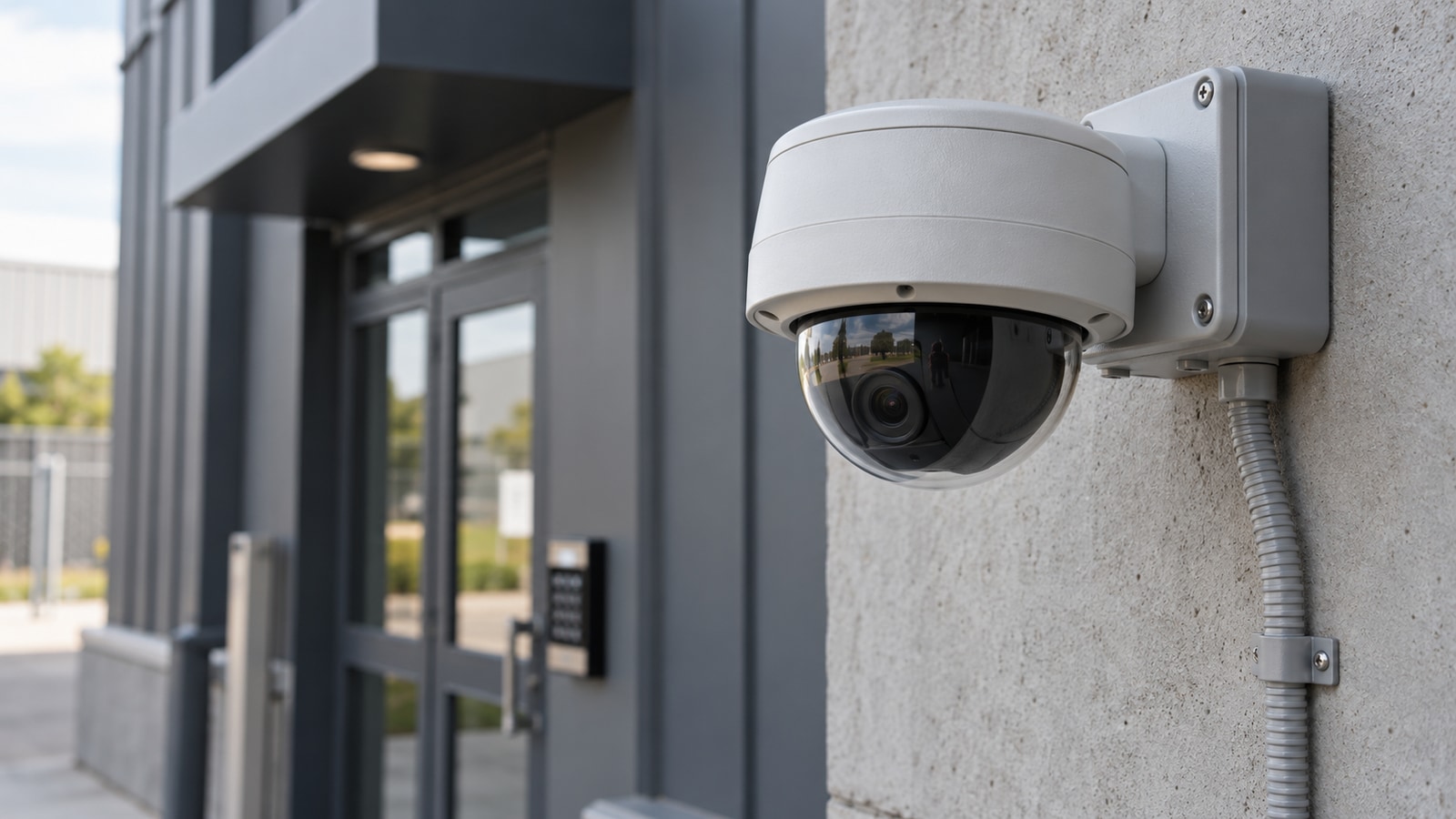
A security robot privacy assessment should define which observations a patrol needs, where those observations may be collected and how people can be affected by their use. A mobile camera changes its view as the route changes. Reviewing only the dashboard misses important decisions about recording zones, sensor orientation, support access and retained copies.
Begin with the supervised workflow for security patrol robots: the observation or verification task, the authorized response team and the boundaries of robot operation. Treat sensing, human investigation and any access-control decision as separate responsibilities.
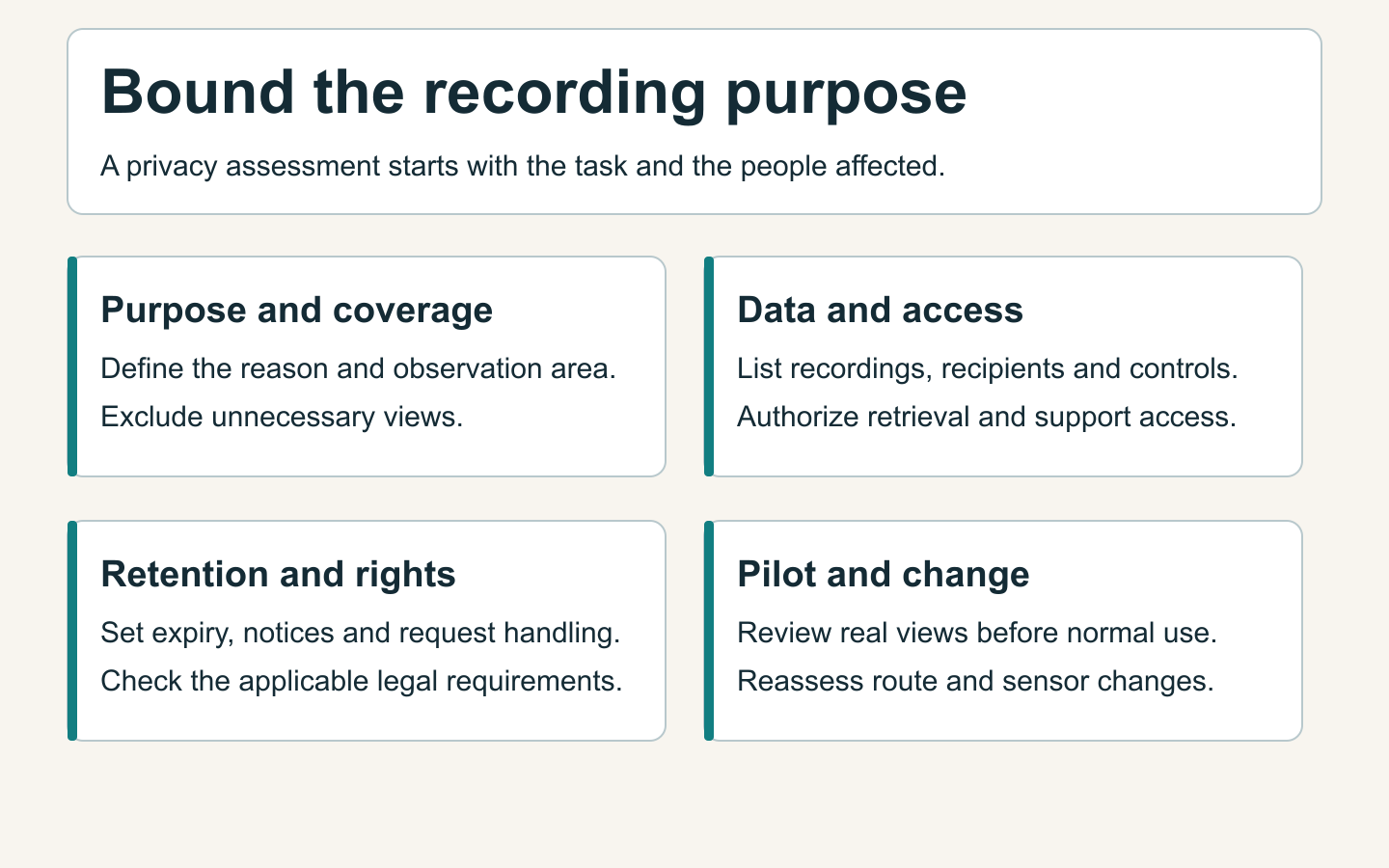
State the purpose for each sensor and output
List visible-light cameras, thermal sensors, microphones and other installed devices. Record which are enabled, what they collect, whether they record continuously, and what outputs reach the operator. An image used for navigation may have a different purpose and storage path from an incident clip.
Ask whether the same purpose can be served with less collection: a different camera angle, a restricted recording zone, event-triggered capture or a shorter retained clip. Confirm the product supports the proposed controls and test their actual behavior.
Do not include face recognition, audio capture or other sensitive processing merely because a product offers it. Give any proposed additional capability its own purpose, authorization and review.
Map viewing zones along the complete route
Walk the route and examine the camera view at turns, waiting positions and charging locations. Identify private areas, neighboring property, public-facing boundaries, workstations and places where people expect greater privacy. Include what the camera sees during recovery and repositioning.
Where supported, configure privacy masking and restricted recording zones. Check recordings and exported clips to verify those controls persist outside the live view. Document route segments where technical masking is insufficient and a route or operating restriction is required.
The EDPB’s video-device guidance addresses purpose, transparency and retention in its GDPR context. Its jurisdiction-specific guidance should be considered by the responsible privacy reviewer where applicable; it is not a universal permission to record everywhere.
Document the data path and access boundary
Follow data from sensor to robot storage, fleet software, control room, cloud services and supplier support. Include thumbnails, alerts, downloaded evidence, diagnostic bundles and backups. Record the organization responsible for each stage and the locations involved.
Separate routine patrol operators, incident investigators, system administrators and supplier support. Define who may view live feeds, search records, export clips, change settings and authorize disclosure. Test a revoked account and a user without investigation privileges.
Include logging of access and exports. A record can be technically protected in the main system while an uncontrolled downloaded copy creates a different exposure.
Set retention around the documented purpose
Define retention by record category. Routine patrol video, operational telemetry and a preserved incident record need not share the same lifecycle. Establish a deletion mechanism and specify who may apply a preservation hold, its scope and how it ends.
Avoid copying a retention period from another site or assuming a fixed period is legally required everywhere. The responsible reviewer should determine the applicable obligations and a justified schedule. Test deletion across the actual storage path, including export handling and backup expiry.
Address transparency and human response
Determine how people are informed about the collection and whom they can contact. Check signage placement against the mobile route, and provide the relevant policy information through the site’s approved channels. Include staff, visitors and contractors in the communication plan as appropriate.
Define how an operator verifies an alert and decides whether a response is warranted. Do not present a detection as proof of wrongdoing. Record what information is available, how uncertainty is handled and the authorized escalation path.
Make the assessment a pilot entry condition
The acceptance packet should include the purpose register, route and viewing-zone map, configured collection controls, access matrix, retention schedule, deletion evidence and human response process. Record the named privacy and security owners and any restrictions.
Reopen the review when routes, sensors, recording modes, hosting locations or third-party access change. A new software feature may change the processing even if the robot follows the same route. Request a patrol assessment with the proposed observation tasks, site boundaries and existing privacy policy so the pilot can begin within an agreed collection scope.
Sources

Iven Wang
Iven Wang is the Co-Founder of Warpify Robotics, specializing in the commercialization and deployment of robotic solutions. With a background in electrical engineering and product management, he works with manufacturers, integrators, and enterprise clients across industrial inspection, security, logistics, and Robotics-as-a-Service.
Subscribe to our newsletter today
Get practical robotics deployment insights, case studies, and planning guidance from Warpify Robotics.