Solar Cleaning Robot Cost and ROI Model
Build a solar cleaning robot cost and ROI model using compatible coverage, complete workflow costs and attributable energy value.

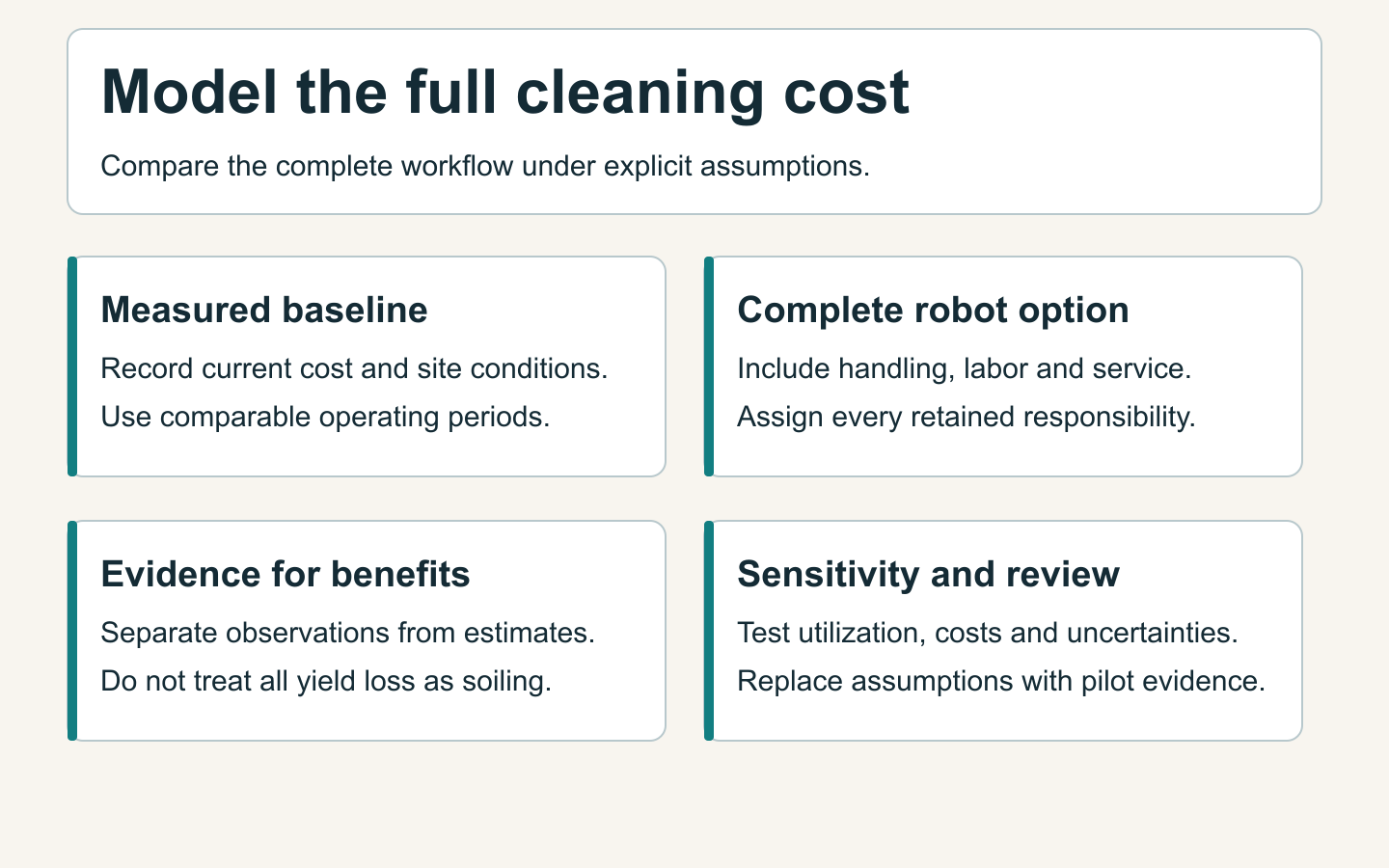
A solar cleaning robot cost model should compare complete cleaning workflows over the same site scope and time horizon. The purchase price is only part of the decision. Transport, row changes, operator effort, consumables, service and the value of recoverable generation can determine whether the investment works.
Begin with a compatible operating scope for solar panel cleaning robotics. Exclude sections the proposed configuration cannot serve. Use the commercial robot TCO framework to separate initial investment from recurring costs, then populate the model with site records and pilot measurements.
Define the baseline and comparison period
Document how the site currently cleans the selected area: frequency, quality requirement, labor, contractor fees, water, transport, equipment and access arrangements. Include work that remains necessary after robotic cleaning is introduced. Comparing a full manual service with only the robot’s brush time creates a misleading saving.
Choose a common analysis period and currency. Keep tax treatment, financing, inflation and residual value assumptions visible. Procurement and finance should agree which costs are incremental, which are already committed and which can actually be avoided.
Record whether the objective is lower cleaning cost, improved cleaning timing, recoverable energy value or some combination. Do not count the same outcome under several benefit headings.
Build the initial investment from the deployment scope
Include equipment, application-specific accessories, delivery, commissioning, operator training, charging or water arrangements, storage and site modifications. Add integration or monitoring work where it is required. Identify warranty coverage, exclusions and the party responsible for local service.
For a subscription or managed service, record setup charges, minimum term, included work, usage limits, renewal conditions and exit costs. Avoid comparing a service fee that includes maintenance with a purchase scenario that omits it.
Keep unresolved quotes as open inputs. Do not replace missing costs with zero or use another site’s purchase price as an installed cost estimate.
Measure recurring effort across the full cycle
Use pilot records for preparation, transport, placement, cleaning, row changes, replenishment, recovery and storage. Separate productive cleaning time from operator time and total elapsed service time. Include cleaning-head maintenance, worn contact materials, batteries, inspections and consumables where applicable.
Calculate usable coverage from the accepted workflow. Account for weather restrictions, access windows, incompatible sections and equipment availability. A theoretical cleaning rate multiplied by every available hour is not a dependable annual service plan.
Keep labor capacity released separate from cash saved. Reduced task time becomes an avoided labor cost only when the organization can reduce paid hours, avoid overtime, reduce a contractor invoice or otherwise realize the value.
Estimate energy value from recoverable soiling loss
NLR’s System Advisor Model treats soiling as an irradiance-loss input. That is distinct from total underperformance, which can have other causes. Establish the share of loss that the approved cleaning workflow can address, using the site’s monitoring and pilot evidence.
For each period, calculate incremental energy value = attributable incremental energy × applicable realized energy value. Include export limits, curtailment, tariff arrangements and timing where they affect revenue. Do not assume every recovered unit is sold at the highest advertised tariff.
Use a supported counterfactual: what would happen under the existing cleaning schedule? The relevant benefit is the difference between the proposed and baseline workflows, including soiling between cleans and natural cleaning effects. A brief trial’s measured improvement should not be multiplied across the year without examining seasonal conditions.
Calculate net benefit without double counting
Use annual net operating benefit = avoided baseline cost + incremental energy value − added recurring robotic workflow cost. Show each component separately so reviewers can trace it to evidence.
Simple payback is initial incremental investment ÷ annual net operating benefit, and is useful only when that benefit is positive and reasonably stable. It does not capture the timing of cash flows. For longer decisions, finance can evaluate discounted cash flows using its approved assumptions and compare service and purchase arrangements on the same basis.
The cleaning method must remain within the installed module and mounting requirements. Equipment damage or warranty exposure cannot be treated as an ordinary trade-off against nominal energy gain.
Test the inputs that could change the decision
Vary compatible coverage, operator handling time, cleaning frequency, equipment availability, maintenance cost, recoverable soiling and realized energy value. Use ranges grounded in observed or quoted evidence and identify unsupported inputs.
The decision packet should show which assumption changes the result, what evidence is still needed and who owns it. If the model depends on unverified energy recovery or unrealizable labor savings, commission additional evidence before committing. Request a solar cleaning assessment with the current service cost, array scope and monitoring records to build a cost comparison around the site’s actual operating process.
Sources

Iven Wang
Iven Wang is the Co-Founder of Warpify Robotics, specializing in the commercialization and deployment of robotic solutions. With a background in electrical engineering and product management, he works with manufacturers, integrators, and enterprise clients across industrial inspection, security, logistics, and Robotics-as-a-Service.
Subscribe to our newsletter today
Get practical robotics deployment insights, case studies, and planning guidance from Warpify Robotics.