Commercial Robot Cost: Hardware, Integration, Service and TCO
A commercial robot cost framework covering workflow discovery, hardware, payload, integration, site work, commissioning, operations, service, risk and exit.
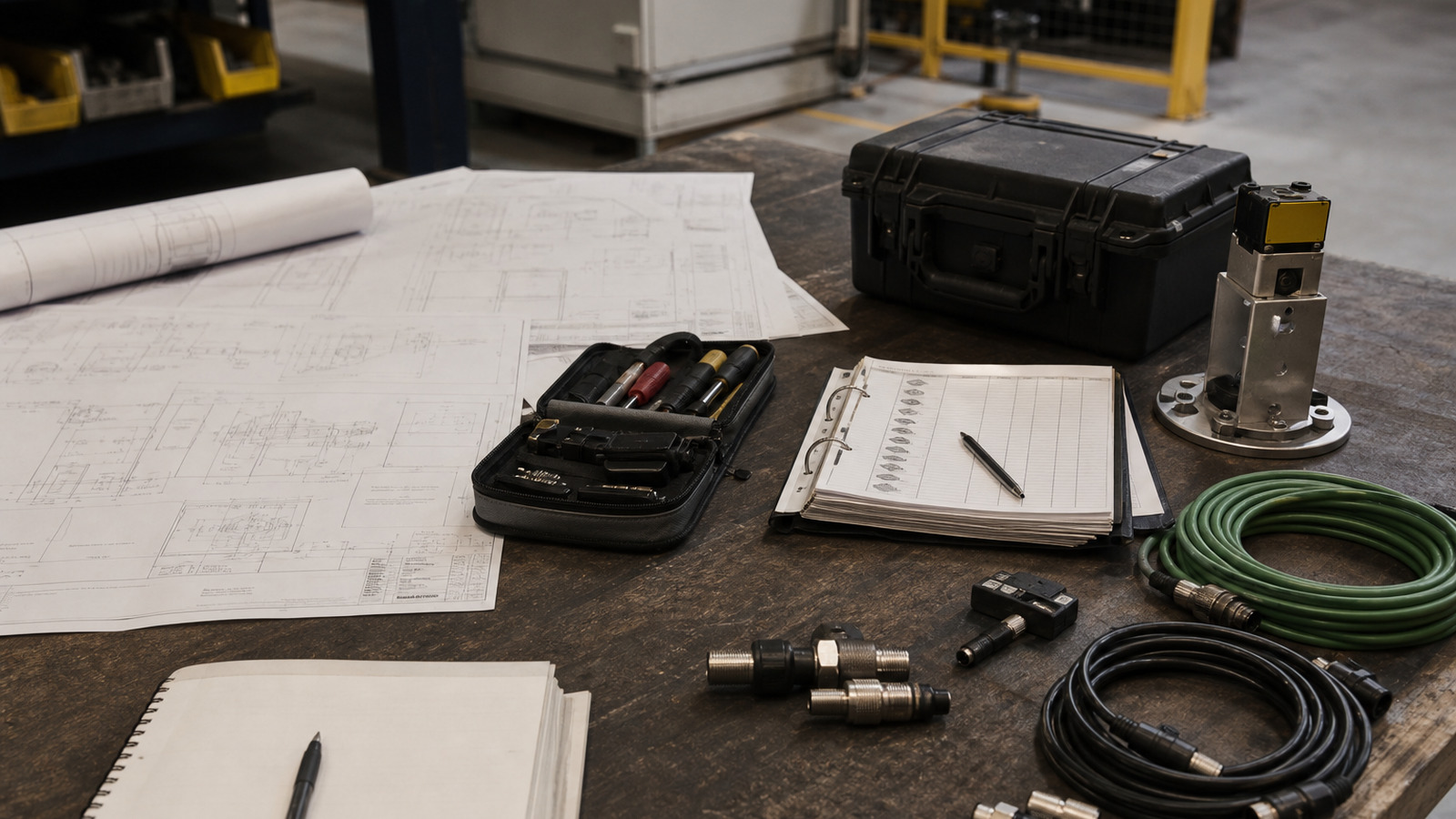
Commercial robot cost is the cost of making a defined workflow operable over time. The hardware price may be visible first, but it rarely defines the complete budget or risk. Start with the task, site, payload, interfaces, people and service model, then compare robotics application solutions on a common total-cost-of-ownership (TCO) boundary.
This guide is application-neutral. Hospital logistics, industrial inspection, material handling, service and other workflows need their own technical detail; the method below prevents the commercial comparison from starting with incompatible scopes.
Define the baseline before the price
Use a robotics workflow assessment to record:
- work item, origin, destination and completion state;
- payload, tool, sensor or material interface;
- environment, route, workcell and shared-space conditions;
- volume, variability, operating window and urgent exclusions;
- software, machine, building and data interfaces;
- human handoffs, supervision and exception ownership;
- service coverage, change expectations and evaluation period.
GAO's cost guide describes a reliable estimate as comprehensive, documented, accurate and credible, built from a technical baseline and tested through sensitivity and risk analysis. Apply those qualities to the business case without implying that GAO sets robot prices.
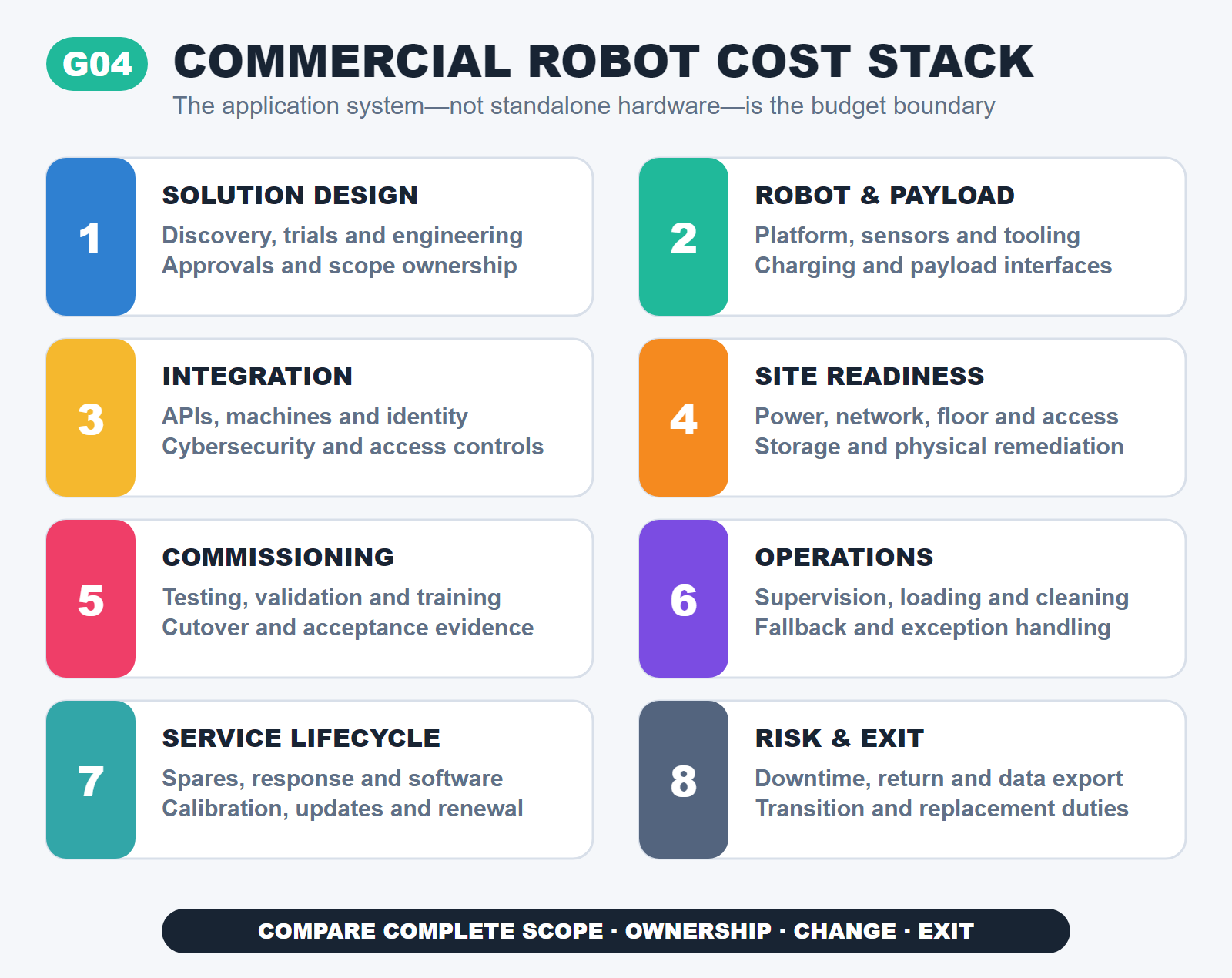
Use an eight-layer cost stack
Scroll horizontally to compare all columns.
| Layer | Cost questions |
|---|---|
| Workflow and solution design | Discovery, engineering, simulation, trials, project management and approvals |
| Robot and application hardware | Platform, payload, tooling, sensors, charging, batteries, cabinets, carts, guarding or fixtures |
| Integration | APIs, adapters, fleet/workcell software, doors, lifts, machines, identity, data and cybersecurity |
| Site readiness | Power, network, floor, route, storage, construction, access and work controls |
| Commissioning and change | Configuration, testing, validation, training, cutover and process redesign |
| Operations | Supervision, loading, cleaning, consumables, charging, review and manual fallback |
| Service and lifecycle | Monitoring, preventive maintenance, spares, response, restoration, software, calibration and refresh |
| Risk and exit | Exceptions, downtime, insurance, compliance review, transition, removal, return, data export and residual value |
OSHA's industrial robot application boundary includes the robot system and surrounding equipment such as controllers, sensors, end effectors, conveyors, worktables and process equipment. That industrial example makes the costing principle clear: the application system, not the standalone robot, is the budget boundary.
Normalize commercial models
A purchase, lease and service contract can place the same line in different documents or assign it to different parties. Use the current RaaS, purchase and lease comparison and restate every offer as:
Comparable TCO = one-time implementation + recurring fixed cost + usage-based cost + customer-retained operating cost + expected exception/risk cost + lifecycle/exit cost.
Use the same period, currency, tax assumption, workflow demand, service window, integration scope and refresh plan. List every exclusion with an owner and estimate status. Do not compare a managed service that includes monitoring and spares with a hardware sale that leaves those items unpriced.
Separate cost and value
Build potential benefits in a separate robot ROI and TCO model. Measure the current workflow and define the value boundary before estimating time, quality, throughput, exposure, service or capacity effects.
NIST MEP describes robotics adoption as an operational assessment, prioritized recommendation, business case, connection with integrators and vendors, and rigorous measurement of results. That sequence prevents a product feature or theoretical capacity from becoming an unsupported financial benefit.
Price operations and exceptions
Recurring human work often remains: loading, receipt, inspection review, replenishment, cleaning, charging-area management, route or workcell changes, credential administration, incident response and vendor coordination. Identify who does each task and the operating window.
Use an exception log rather than one contingency percentage. Record categories such as payload not ready, route blocked, invalid read, machine unavailable, network loss, access denial, recipient absent, low battery, service fault and manual recovery. Estimate only after the target workflow produces usable evidence.
Choose measures that explain the system
NIST IR 8177 illustrates separate robot, job and network measures such as latency, travel time, accuracy, repeatability, job time, energy and dropped packets. Do not copy those as universal KPIs. Use the principle to avoid one blended utilization or success number that hides failure mode, workflow impact or who owns the correction.
Run sensitivity and threshold tests
Test downside, base and upside cases for demand, operating hours, number of systems, payload complexity, integration effort, site work, exception frequency, service coverage, spares, energy, software and hardware refresh, inflation/indexation and exit. State the threshold that changes the decision—for example, the maximum implementation cost or minimum eligible workload at which the option remains acceptable.
Evidence procurement should retain
- versioned technical and operational baseline;
- cost work breakdown and assumptions register;
- provider, customer and third-party responsibility matrix;
- acceptance, service and measurement definitions;
- downside/base/upside sensitivity and decision thresholds;
- change, renewal, refresh, transition and exit terms;
- plan for replacing forecasts with pilot and operating actuals.
The output is a comparable decision model, not a universal business robot price.
Sources and scope
This guide combines the cited primary sources with an editorial decision framework. It does not quote a market price, promise a result, replace a site assessment, or provide legal, financial, clinical, cybersecurity or safety advice.
- Cost Estimating and Assessment Guide: Best Practices for Developing and Managing Program Costs — U.S. Government Accountability Office
- Industrial Robot Systems and Industrial Robot System Safety — U.S. Occupational Safety and Health Administration
- Robotics and Manufacturing Automation — National Institute of Standards and Technology
- NIST IR 8177: Metrics and Key Performance Indicators for Robotic Cybersecurity Performance Analysis — National Institute of Standards and Technology
Take the next step
If you can define the task, environment, payload, interfaces, operating window and exception model, use that scope to build a comparable cost case: Assess your robot workflow.

Iven Wang
Iven Wang is the Co-Founder of Warpify Robotics, specializing in the commercialization and deployment of robotic solutions. With a background in electrical engineering and product management, he works with manufacturers, integrators, and enterprise clients across industrial inspection, security, logistics, and Robotics-as-a-Service.
Subscribe to our newsletter today
Get practical robotics deployment insights, case studies, and planning guidance from Warpify Robotics.