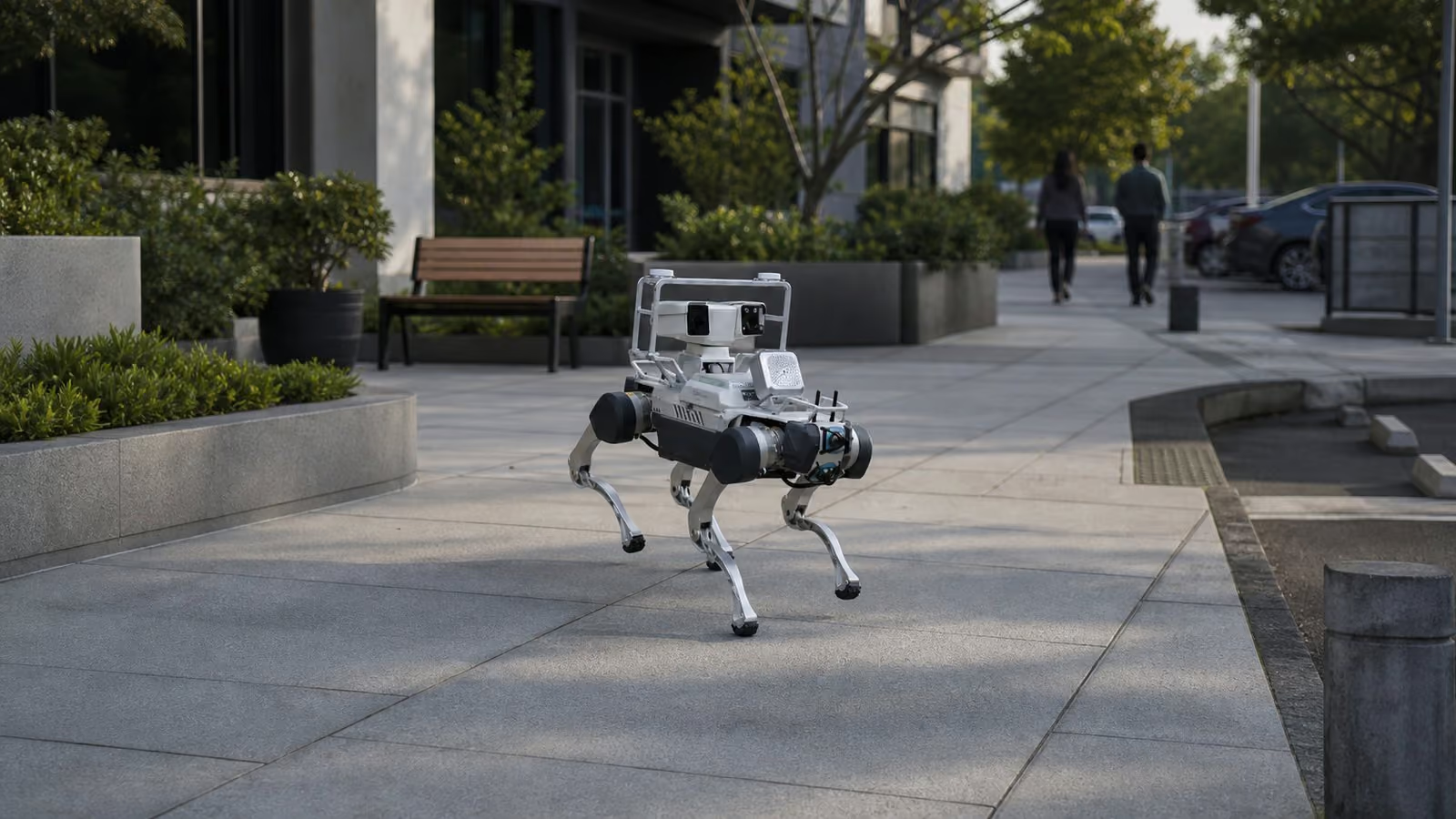
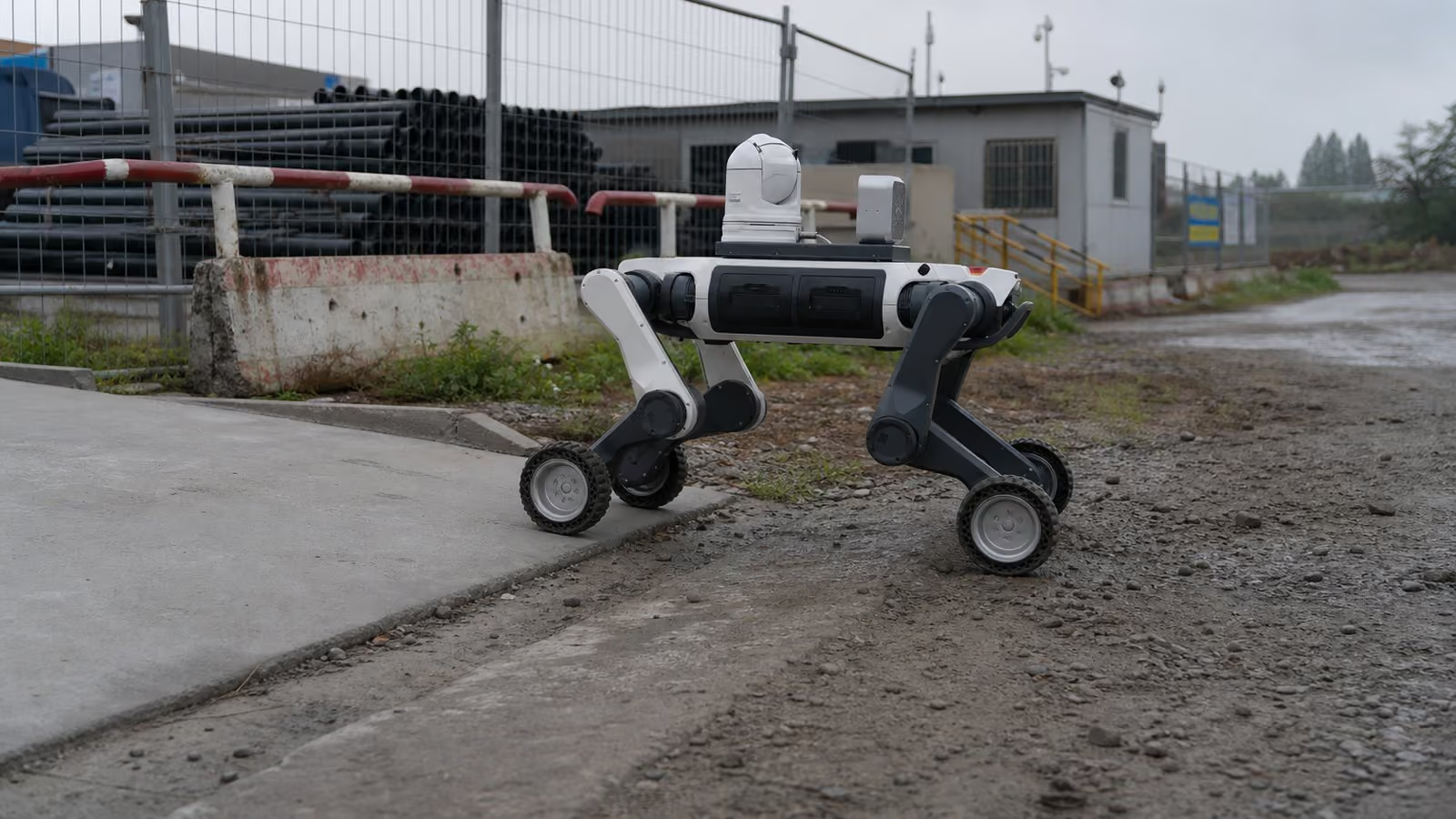
Integrated Security Patrol Robot Solutions for Defined Routes
Warpify delivers integrated security patrol robot solutions for defined facility and perimeter routes. We combine the mobile platform, observation sensors, mission software, communications, site integration, commissioning, and lifecycle support around a human-reviewed security workflow. People retain all access, intervention, and emergency-response decisions.
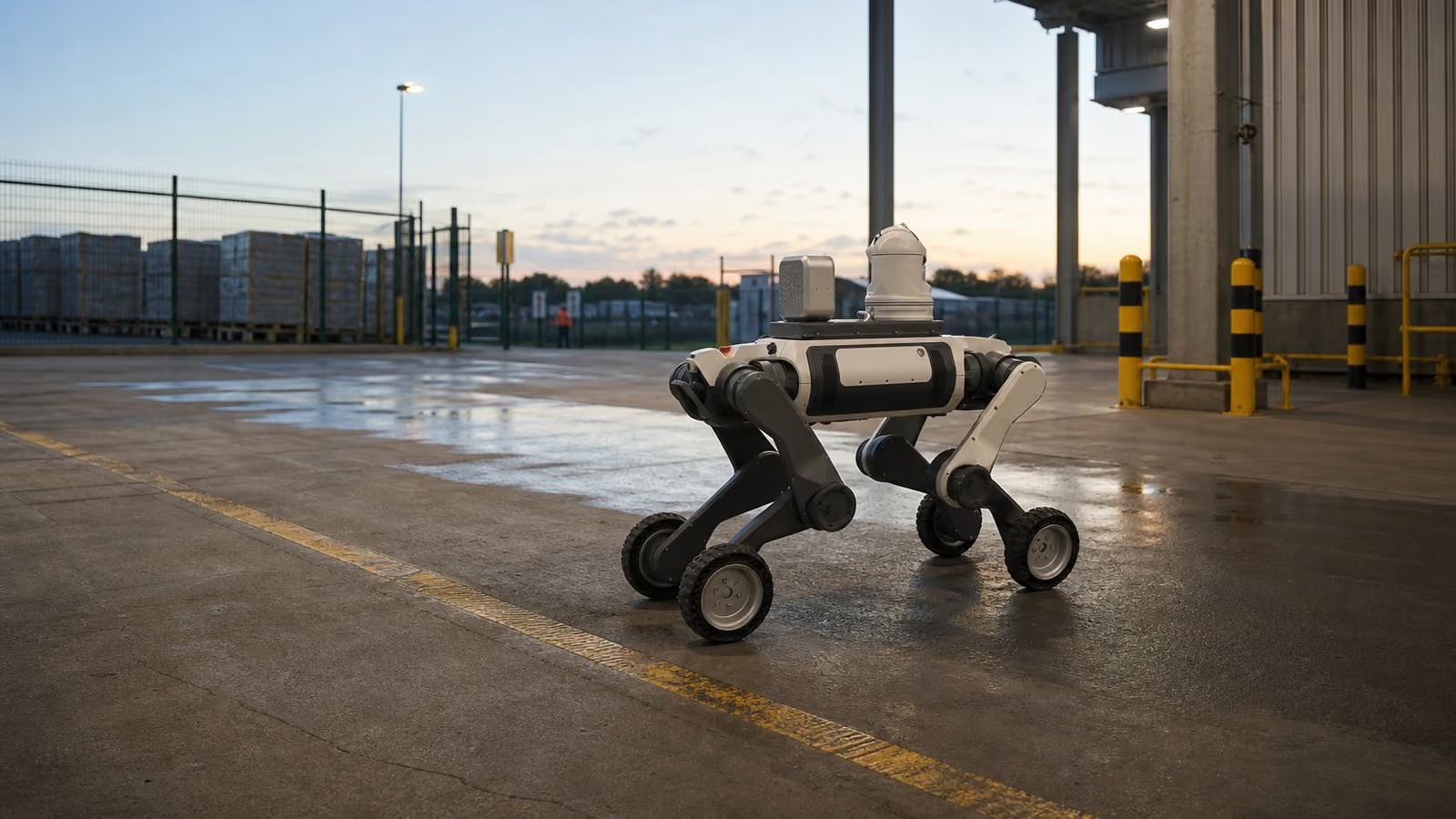
See Security Patrol Robots in Real Operating Context
Warpify's solution connects a supported mobile platform, route-based observation, communications, human review, escalation procedures, charging, recovery, and site acceptance into one operating workflow. Each deployment is qualified for route conditions, privacy, data handling, connectivity, safety, and local requirements.
Warpify
On this pageAll sections
FROM ROUTINE ROUND TO SUPPORTED SECURITY WORKFLOW
Turn Repetitive Patrol Tasks Into Consistent, Reviewable Routes
Start with work the security team already performs. A robot can support selected, repeatable observation tasks where the route, site conditions, and response workflow are qualified. People remain responsible for judgment, access decisions, intervention, and emergency response.
Perimeter and yard rounds
Routine task
Personnel walk approved fence lines, yards, compounds, or storage areas and record visible conditions.
Supported robot route: the robot follows a qualified route and captures supported visual context at defined checkpoints.
Team value
Provide more consistent route records for human review—not an automatic security decision.
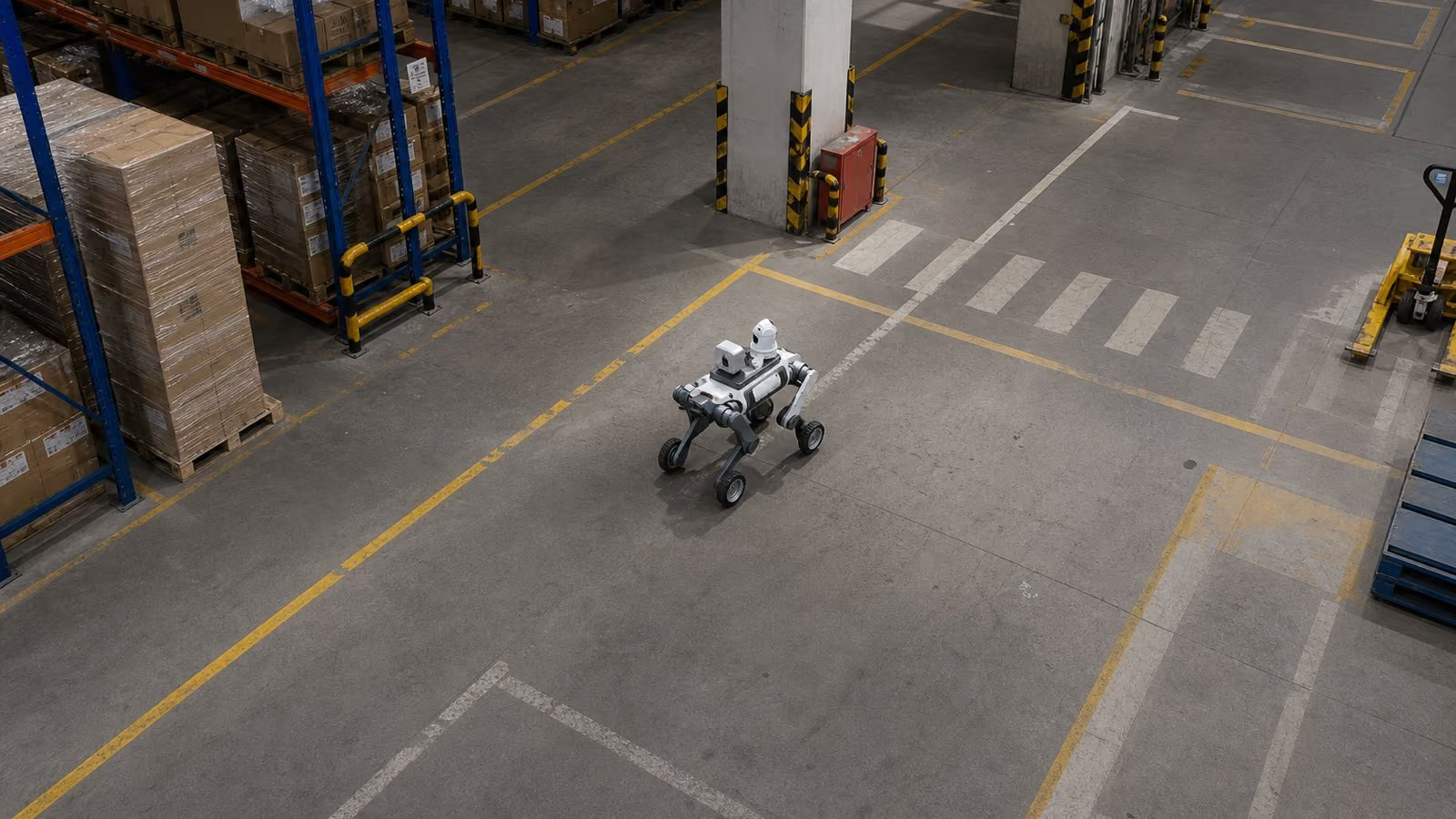
Warehouse and loading-area checks
Routine task
Teams check selected aisles, loading zones, access areas, and after-hours routes while working around active operations.
Supported robot route: the robot travels approved lanes and pauses at defined observation points with clear path, door, and egress controls.
Team value
Give authorised personnel traceable context from a scheduled, site-tested route.
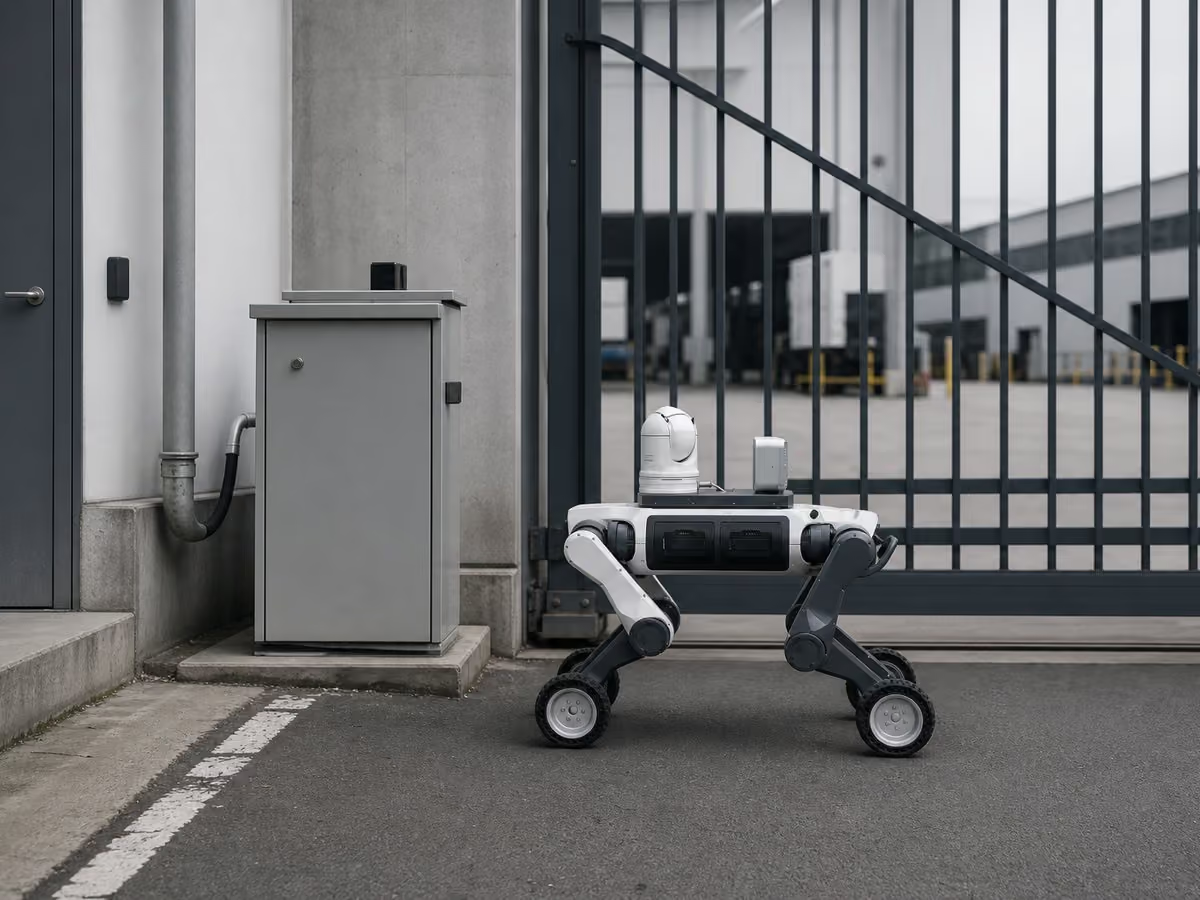
Doors, gates, and selected access points
Routine task
Personnel visually confirm the status of selected entrances, gates, panels, or restricted zones.
Supported robot route: the robot records supported visual or sensor context at an approved approach and reports it for human review.
Team value
Preserve a time-stamped observation trail while people retain every access and response decision.
ONE RESPONSIBLE OPERATING LOOP
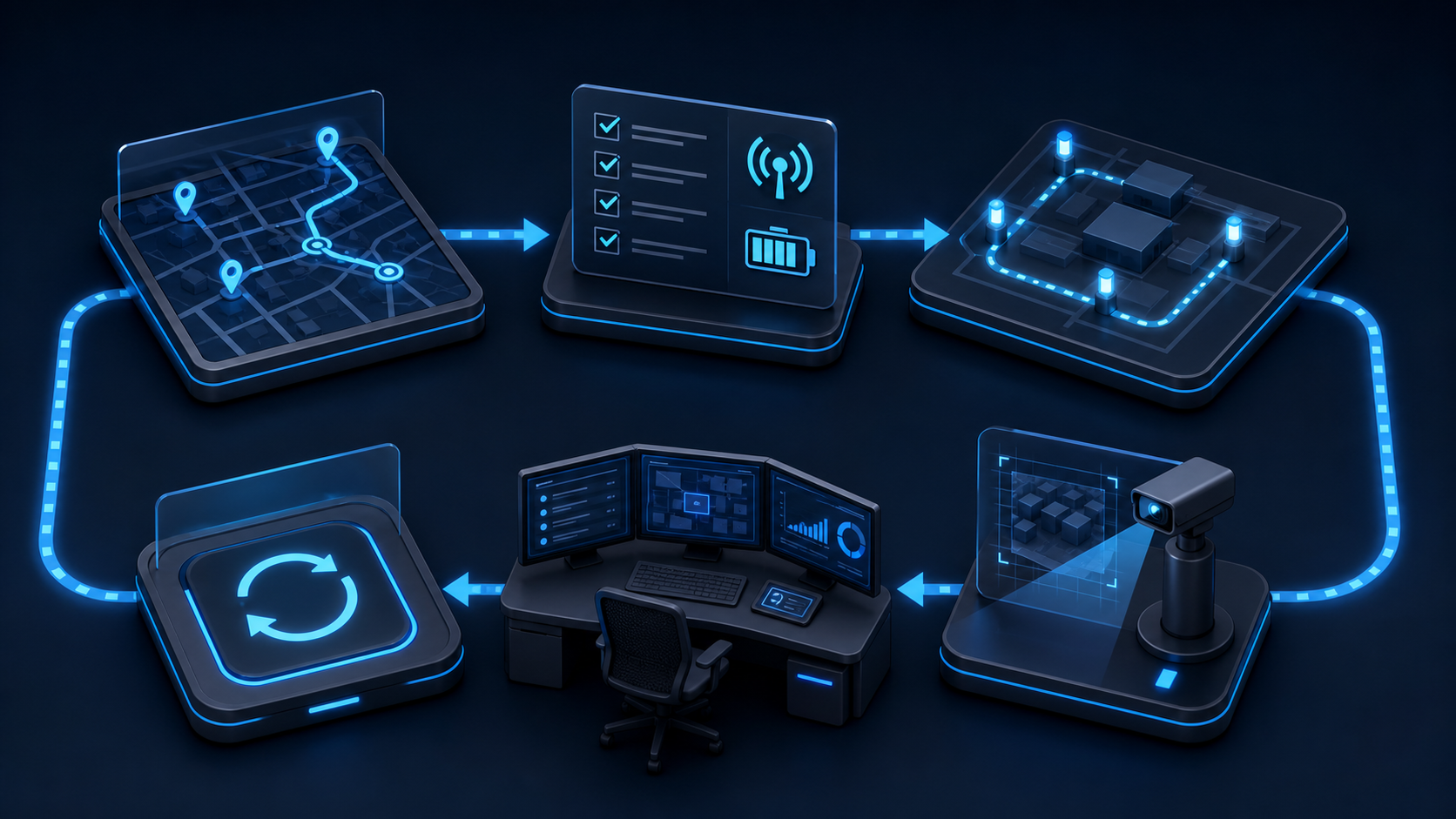
From Route Plan to Human Review: How a Patrol Workflow Operates
A patrol robot is one part of a controlled security process. The workflow should make route constraints, observation limits, human responsibility, and recovery behavior explicit before a site operates it.
Travel the qualified route with path, obstacle, weather, lighting, and fallback limits tested for the site.
04
Capture supported context
Record defined visual or sensor information only within the approved operating scope.
05
Review and escalate
Authorised people interpret alerts, verify unusual conditions, and decide whether any action is needed.
06
Dock, recover, and repeat
Return to charge or recovery, retain permitted records, review exceptions, and prepare the next scheduled route.
The route produces context for people. It does not make an enforcement, detention, or emergency-response decision.
CONTROLLED OBSERVATION, NOT AUTOMATED INTERVENTION
Make Human Oversight, Privacy, and Escalation Part of the Design
A responsible security-patrol evaluation specifies what the robot may observe, how authorised people receive that context, who decides what happens next, and what data handling is permitted. Recording, retention, signage, access, cybersecurity, local rules, facial-recognition boundaries, charging, downtime, and recovery need site review before a route is accepted.
Define the checkpoint
Associate each observation with a defined route point, time window, and intended human reviewer.
Set response ownership
Document who verifies an alert, what the escalation path is, and when a person must attend the site.
Test operating limits
Validate low light, weather, surface conditions, doors, connectivity, charging, recovery, and false-alert handling on the real route.
That turns patrol context into a controlled, human-led operating process.
WHAT CHANGES FOR THE SECURITY OPERATION
The Value Is a Better-Defined Patrol Process, Not Just a Moving Robot
Repeatable scheduled routes
Run approved routes and checkpoints on a defined schedule, subject to real site conditions and availability.
More traceable observation records
Give authorised reviewers time-stamped context from repeatable patrol points.
Focused human attention
Let security personnel prioritise verification, communication, intervention, and response decisions rather than every routine round.
Visible operating boundaries
Treat privacy, access, incident handling, and recovery as part of the solution rather than afterthoughts.
The outcome depends on route suitability, terrain, lighting, communications, sensor configuration, intervention rate, data policy, human response, maintenance, and acceptance testing. A robot can miss events or generate incorrect alerts; it does not guarantee detection or prevention.
SECURITY ROUTES VARY BY SITE
Where a Security Patrol Workflow May Fit
The same operating loop can apply to different sites, but every deployment must be evaluated around its route conditions, audience, privacy requirements, response ownership, and service constraints.
VISUAL SCENARIOS
Conditions Shape Every Route
Compare each environment by route surface, traffic, lighting, weather, connectivity, privacy, charging, recovery, and response ownership before selecting a platform.
WAREHOUSE & LOGISTICS
Warehouses, factories, and logistics facilities
Evaluate selected aisles, loading areas, access points, equipment zones, and after-hours routes around traffic separation, doors, lighting, connectivity, charging, and response ownership.
PROPERTIES & CAMPUSES
Properties, campuses, and managed outdoor areas
Evaluate approved common-space routes, pathways, building exteriors, and parking areas around visitors, residents, signage, privacy, retention, remote review, and human escalation.
OUTDOOR PERIMETERS
Industrial perimeters and changing outdoor routes
Evaluate fence lines, yards, compounds, and changing work areas around ground conditions, weather, low light, communications, downtime, safe recovery, and access constraints.
Perimeters and yards
Fence lines, storage areas, compounds, and selected exterior routes where checkpoints and human review are clearly defined.
Access points
Doors, gates, panels, restricted approaches, and designated entry areas where every access decision stays with authorised people.
Loading and logistics zones
Aisles, loading bays, vehicle areas, and after-hours circulation routes around traffic separation and response ownership.
Parking and property grounds
Paths, car parks, building exteriors, and approved common areas around visitors, privacy, signage, and escalation.
Low-light routes
Locations where lighting, sensor fit, weather, and response processes are separately qualified.
Alarm-review context
A defined route to provide authorised people with context when a site system asks for review.
Conditions to qualify
Access and route boundaries
Define approved areas, checkpoints, people nearby, doors, traffic separation, and recovery access before a route is accepted.
Privacy and data handling
Set observation purpose, notices, authorised access, retention, cybersecurity, and local-rule responsibilities before operating.
Human escalation
Document who receives context, verifies unusual conditions, decides action, and attends the site when necessary.
Lighting, weather, and traffic
Test real route conditions, visibility, surface changes, vehicle activity, and operating windows at the site.
Connectivity and charging
Confirm communications, dock approach, charging, mission recovery, and monitoring behavior for the intended route.
Recovery and downtime
Define safe recovery, route interruption, maintenance, service ownership, and fallback procedures before routine operation.
OPERATIONAL VALUE AROUND ONE PATROL ROUTE
Assess Security Patrol Fit Before Making a Commercial Decision
The operating case starts with the current route, observation goal, operating limits, and human response. Warpify makes scope, responsibilities, and uncertainty visible without relying on a generic return claim.
Current patrol requirements
Route length, checkpoints, schedule, people involved, access, reporting, and the current response process.
Any cost, coverage, availability, or performance discussion requires project-specific evidence and approved commercial terms. This page does not promise savings, payback, uninterrupted operation, or security outcomes.
FROM PATROL REQUIREMENT TO DEPLOYED WORKFLOW
What Warpify Delivers for Security Patrol Operations
Warpify combines the robot platform, observation payload, mission software, communications, site integration, commissioning, operator procedures, and lifecycle support into a complete security patrol solution. Route, privacy, response, service, and commercial details are confirmed for the specific site and market.
01
Workflow assessment
Clarify route, checkpoints, observation purpose, people, response, and operating boundaries.
02
Mobility and observation fit
Evaluate appropriate movement, sensing, communications, endurance, and environmental constraints for the proposed route.
03
Mission and integration design
Define permitted alerts, records, access, system handoffs, privacy controls, and operator experience.
04
Site evaluation and acceptance
Test route completion, usable context, charging, connectivity, recovery, human response, and acceptance criteria.
05
Service and operating readiness
Confirm ownership, maintenance, training, escalation, data handling, support geography, and commercial scope before any deployment decision.
Deployment evidence
Security patrol case context
Review Scope-Bound Security Patrol Context
Review an anonymized factory security project with its stated scope and limits; it is context, not a promise that the same route or result can be repeated at another site.
The right solution depends on the route, observation purpose, environment, privacy, human response, and operating limits. These answers clarify what a responsible site evaluation needs to prove.
What should a site define before evaluating a patrol robot?
Start with the route, checkpoints, operating hours, lighting, surface and weather conditions, access controls, people nearby, connectivity, observation purpose, existing systems, privacy requirements, response owner, charging, recovery, and acceptance criteria.
Can a security patrol robot replace guards or emergency responders?
No. The page scopes a robot as a support for approved patrol routes and information collection. Authorised people review alerts, make access and intervention decisions, and manage every emergency or escalation response.
What should a pilot or site evaluation prove?
It should test the real route: route completion, usable observation, appropriate human oversight, access and privacy controls, connectivity, charging, recovery, incident-handling workflow, operating limits, service readiness, and agreed acceptance criteria.
A PRACTICAL FIRST STEP
What to Bring to a Security Patrol Route Assessment
Do not choose the robot first. Choose one repeatable patrol route and define what a responsible, useful workflow would need to prove.
Route and environmentFrequency and current workloadExceptions and human ownershipReporting and integration needsPilot success criteria
Share that information with Warpify. We will define a site-specific patrol solution around the route, people, privacy, response, and operating limits.
Tell us where the patrol occurs, what selected areas need review, when it runs, what authorised people need to see, and what should happen when something unusual is found. Warpify will use that route to define the platform, sensing, integration, commissioning, support, and acceptance scope for a deployable security patrol solution.