Robotics Data Governance: Ownership, Retention, Access and Deletion
Define robotics data ownership, access, retention, export and deletion across devices, cloud services and supplier support before deployment.

Robotics data governance defines how operational information is collected, used, retained, shared and removed throughout a deployment. The practical question is not simply who owns the data. It is whether the site can explain each data flow and exercise the access, export and deletion controls it needs.
A robot may produce task records, images, maps, audio, diagnostic logs and operator actions. Some records describe equipment; others may reveal people, sensitive areas or operating patterns. Establish the data boundary alongside the workflow described in Warpify’s robotics solutions, before approving storage or support arrangements.
Build a data register around purpose
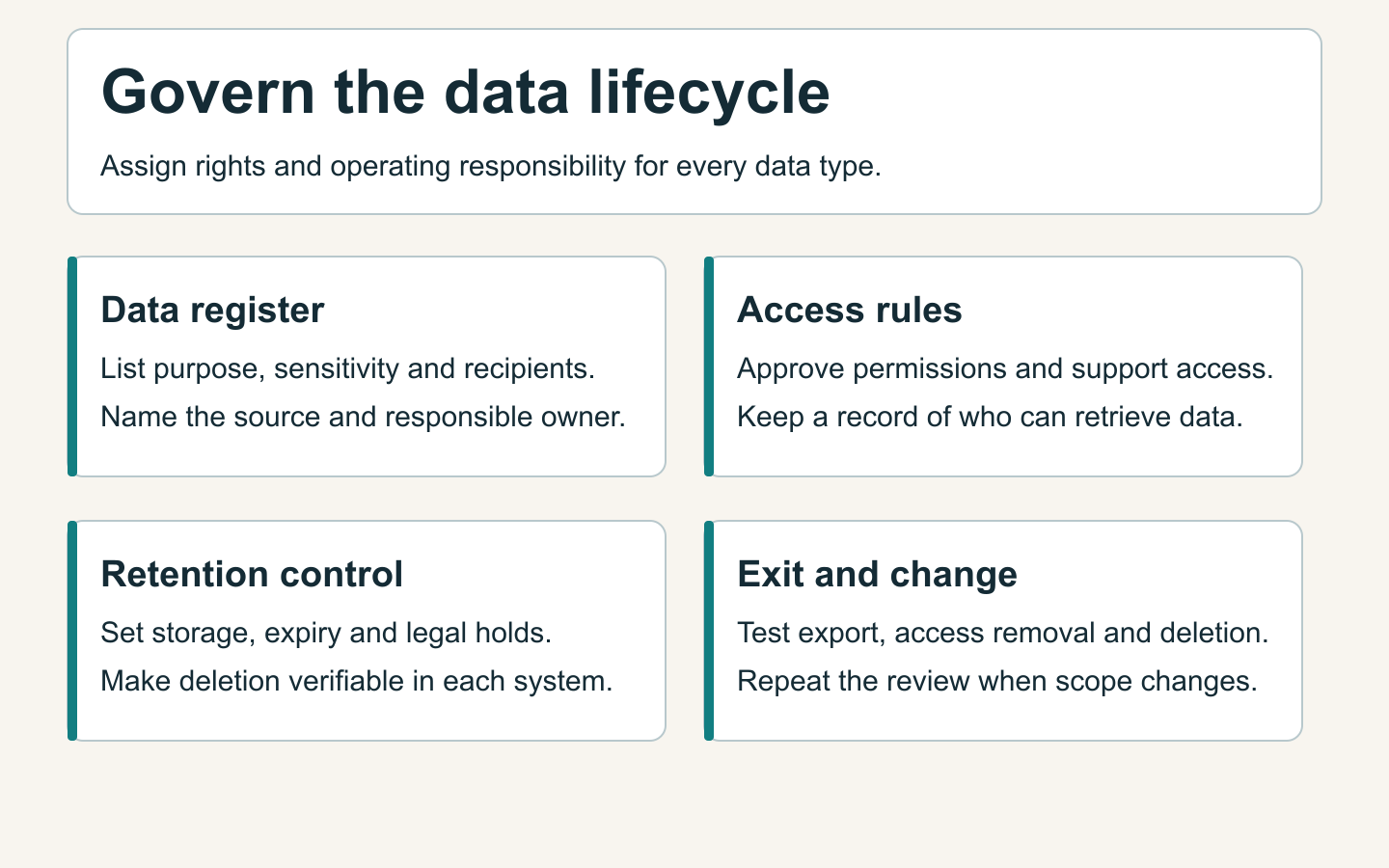
For each data category, record why it is needed, where it originates, where it travels, who can access it and when it should stop being retained. Include temporary device storage, the fleet manager, cloud services, support exports and backups. A supplier’s central dashboard is rarely the entire storage estate.
Distinguish raw sensor inputs from derived outputs. An alert, a thumbnail and the underlying video may have different access needs and retention rules. Record whether information is used only for the customer’s operation or also for product development, analytics or model training. Obtain an explicit contractual answer rather than inferring usage from dashboard settings.
NIST’s Privacy Framework treats privacy as a risk management issue. For robotics, that makes a useful starting question: what problems could this processing create for people, and which operational purpose justifies keeping it?
Separate ownership from usable rights
A statement that the customer owns its data should be accompanied by specific rights. Can the customer retrieve a usable export? Does the export include timestamps, asset identifiers, event context and attachments? Can the customer continue reading historical records after the service ends?
Clarify rights to maps, site configurations, derived observations and annotations. Record which supplier software or intellectual property is excluded. Decide who may approve third-party sharing and how subcontractors are disclosed. The same review should identify the locations and entities involved in hosting and support.
Contract terms and technical controls must describe the same arrangement. A promised export right is difficult to use if the only available output is a screenshot.
Design access by task and role
Separate routine operators, investigators, administrators, maintenance staff and supplier support. Define which roles may view, download, change, disclose or delete each category. Give elevated permissions an approval owner and a review process.
Test access using representative accounts. Include a user with no authorized reason to see images, an operator who can resolve tasks, and a support user whose permission has been revoked. Verify access to exported files and support portals as well as the main application.
Record administrative changes in an audit trail. Shared accounts weaken the ability to determine who accessed sensitive records or changed retention settings.
Set retention by purpose and record type
Avoid assigning a single retention period to every data category. Routine route telemetry may serve a different purpose from an incident record retained for an active investigation. Give each rule an owner, rationale, start event, review condition and deletion mechanism.
Describe exceptions explicitly. If an incident creates a preservation hold, record who may apply it, which records it covers and how it ends. A hold should not silently preserve unrelated routine data. Include cached files, exports and backup copies in the retention design; distinguish immediate application removal from eventual backup expiry.
Prove deletion and service exit
Before accepting the system, test the process for deleting an ordinary record, removing a user and closing the service. Ask what remains on the robot, supplier systems, diagnostic tools and backups. Record the evidence that the supplier can provide and any limits on verification.
An exit plan should cover export format, transfer responsibility, revoked credentials, equipment return and confirmation of residual retention. Check the plan alongside the commercial robot TCO framework, because migration work and transition access can create real costs.
Assign decisions before an incident forces them
Name the site owner for operational data, privacy review, information security, legal terms and incident handling. Define how those owners resolve conflicting requests, such as a support engineer asking for a full diagnostic bundle containing images.
The acceptance packet should include the data register, role permissions, retention settings, tested export and deletion procedures, supplier commitments and open issues. Review it when sensor use, geography, hosting, integrations or support arrangements change. Request a workflow assessment with the intended data categories and access needs so the deployment scope includes their full lifecycle.
Sources

Iven Wang
Iven Wang is the Co-Founder of Warpify Robotics, specializing in the commercialization and deployment of robotic solutions. With a background in electrical engineering and product management, he works with manufacturers, integrators, and enterprise clients across industrial inspection, security, logistics, and Robotics-as-a-Service.
Subscribe to our newsletter today
Get practical robotics deployment insights, case studies, and planning guidance from Warpify Robotics.