Robotics-as-a-Service vs Robot Rental vs Managed Service: Where Responsibility Changes
Compare RaaS, robot rental and managed service by responsibility, retained customer effort, incident response and acceptance boundaries.
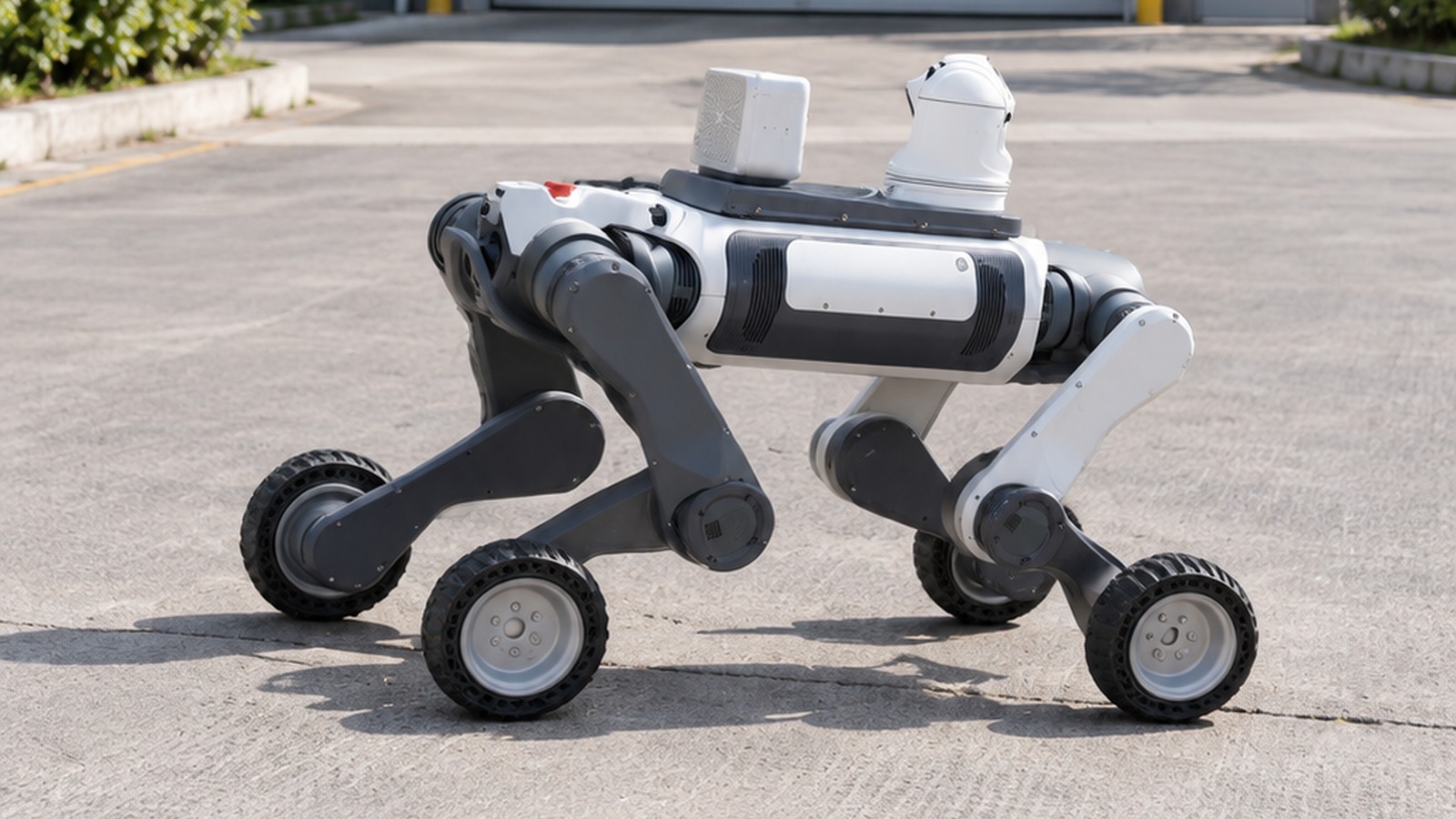
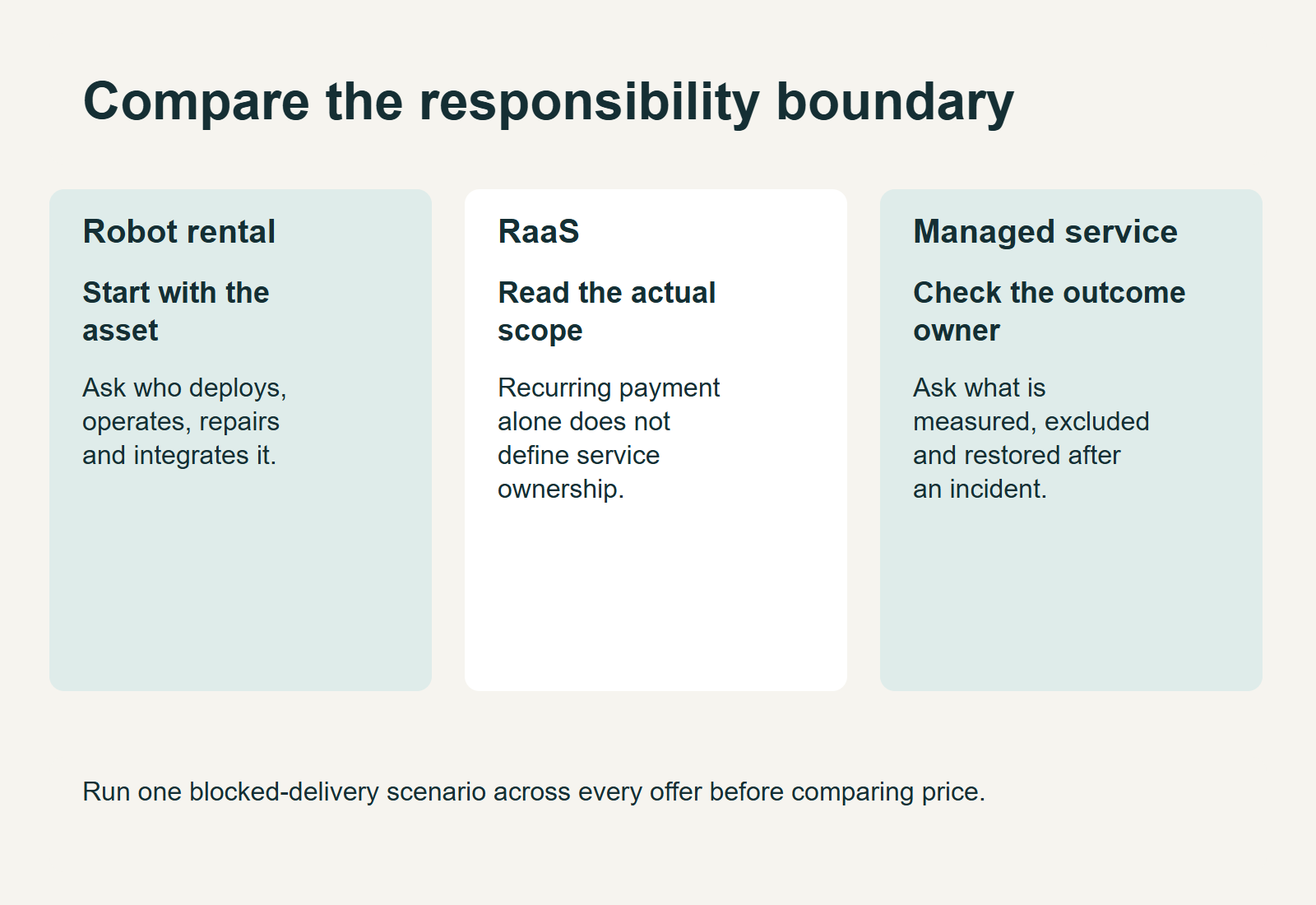
Robotics-as-a-Service (RaaS), robot rental and managed service can describe overlapping commercial arrangements. The useful comparison is the work and risk assigned to each party: who deploys the application, monitors operation, restores service, pays for changes and handles the end of the agreement. Compare those responsibilities before comparing monthly fees.
This guide uses the labels as starting points for questions, not universal legal definitions. A supplier may combine equipment rental with support, or offer a managed service using equipment the customer already owns. The actual scope and contract determine what the customer receives.
Separate the asset from the operating service
Ask two questions independently: who provides the equipment, and who owns the recurring work needed to deliver the task? These questions reveal combinations that a sales label can conceal.
An equipment-access proposal may give the customer a robot for an agreed period while leaving deployment and daily operation largely with the customer. A service proposal may include monitoring, maintenance and defined operating support. Either can contain exclusions that return important work to the customer.
Warpify’s RaaS page provides the commercial context. Use the responsibility matrix to make the proposed allocation explicit for the actual application.
Compare the same responsibility rows
For every offer, obtain a named owner and scope for each of the following activities. Record shared work carefully: shared without an accountable lead is not an operating arrangement.
- Design and integration: workflow definition, payload, maps, software and building interfaces.
- Commissioning: site preparation, configuration, testing, acceptance and staff training.
- Daily operation: dispatch, loading, receiving, cleaning, charging and exception handling.
- Support: monitoring, first response, remote diagnosis, field attendance, parts and restart approval.
- Change: relocation, new routes, software updates, additional tasks and revised demand.
- Exit: equipment return, data export, access revocation, removal and service transition.
Ask what evidence demonstrates each commitment. Monitoring might mean watching equipment connectivity, reviewing failed missions or managing the complete customer service. Those are different scopes with different staffing implications.
Use one incident to expose the differences
Consider an illustrative delivery service in which a robot reaches a locked destination door. The robot itself is healthy, but the work cannot finish. Under one proposal the customer’s operator receives the exception and coordinates the door owner. Under another the provider receives the alert and coordinates recovery, while the customer still controls access permissions.
Neither arrangement is inherently superior. The question is whether the selected division of work fits the site’s staffing and authority. The provider cannot restore a customer-controlled dependency merely by promising a rapid response.
Repeat the exercise for an unavailable receiver, a charger problem and a hardware fault. Compare the alert, responsible owner, restoration process, manual fallback and applicable charges. This makes gaps visible before the service starts.
Read service levels at the workflow boundary
Distinguish acknowledgement, technical response, equipment restoration and completed service. Ask which event starts and stops each clock, which operating hours apply and how customer dependencies affect measurement. The robot SLA guide provides a framework for those definitions.
Do not equate a connected robot with an available workflow. A unit may be online while awaiting cleaning, a receiver or a building interface. Conversely, manual fallback may preserve the customer’s service even when the robot is unavailable. Report the two conditions separately.
Compare full cost and retained effort
Build a common cost boundary before evaluating price. Include initial integration, recurring charges, usage charges, consumables, local operating effort, support exclusions, changes and transition. Use the same operating period and demand assumptions for every option.
Show retained customer work explicitly. A lower fee may be appropriate when the customer already has the staff and processes to operate the fleet. It may be misleading when the business case assumes those tasks disappear. Keep estimated staff time separate from cash savings unless the organization has a credible way to realize the saving.
Avoid inferring accounting treatment from a commercial name. IFRS lease analysis considers the actual arrangement, including control of an identified asset and substitution rights. The applicable reporting framework and contract facts require professional assessment.
Select the allocation your team can operate
An equipment-focused arrangement may fit an organization with application engineering, operations and service capacity. A broader managed scope may fit a site seeking defined support across those activities. In both cases, verify the provider’s scope, local delivery capacity and exceptions rather than assuming the label supplies them.
Create a comparison sheet that lists task boundary, accountable owner, evidence, exclusions, customer effort and cost treatment for each responsibility. Mark unresolved items as questions. Do not award a complete-service score to a promise that the supplier has not defined.
Take that comparison and the measured workflow to a robotics assessment. The objective is to choose an operable responsibility model, with pricing that reflects the work each party will actually perform.
Sources and scope
- IFRS Interpretations Committee: March 2023 update — Identified asset, control and substantive substitution rights; not a determination for any contract.

Iven Wang
Iven Wang is the Co-Founder of Warpify Robotics, specializing in the commercialization and deployment of robotic solutions. With a background in electrical engineering and product management, he works with manufacturers, integrators, and enterprise clients across industrial inspection, security, logistics, and Robotics-as-a-Service.
Subscribe to our newsletter today
Get practical robotics deployment insights, case studies, and planning guidance from Warpify Robotics.