RaaS Responsibility Matrix: Who Owns Deployment, Data and Support?
A lifecycle RaaS responsibility matrix for site readiness, safety, data, operations, support, change, suppliers and contract exit.

Robotics as a Service (RaaS) changes the commercial model; it does not remove operational responsibility. The customer still controls a site and workflow. The service provider may coordinate hardware, software and support. Integrators, facilities teams, network providers and original manufacturers may each own part of the result. If those boundaries remain implicit, incidents turn into arguments.
A RaaS responsibility matrix makes the service operable. It connects contract language to named owners, response paths, evidence and decision rights. This guide is a planning framework, not legal advice; counsel and relevant technical specialists should review the final agreement.
Map outcomes before organizations
Start with the service outcome: what work is performed, where, during which hours and under what approved conditions. Then break the lifecycle into discovery, design, site readiness, deployment, acceptance, routine operation, maintenance, incident response, change, renewal and exit.
For each task, name one accountable party. Several parties can contribute, but shared accountability usually means no one can make the decision. Use a RACI-style model (responsible, accountable, consulted and informed) only after defining the task and evidence precisely.
Scroll horizontally to compare all columns.
| Workstream | Accountable party must decide | Evidence | Escalation trigger |
|---|---|---|---|
| Site readiness | Whether route, power and interfaces are ready | Signed readiness record | Condition differs from approved design |
| Data | Purpose, access, retention and deletion | Data map and access log | New data use or suspected exposure |
| Operations | Who dispatches, cleans, recovers and stops service | Approved procedure and training | Uncontrolled workaround |
| Support | Incident severity and restoration route | Ticket and system timeline | Safety event or missed service target |
| Change | Who approves configuration or scope changes | Versioned change record | Risk, cost or interface impact |
| Exit | Return, transition, export and deletion | Verified exit checklist | Termination or supplier transition |
Keep site and safety duties explicit
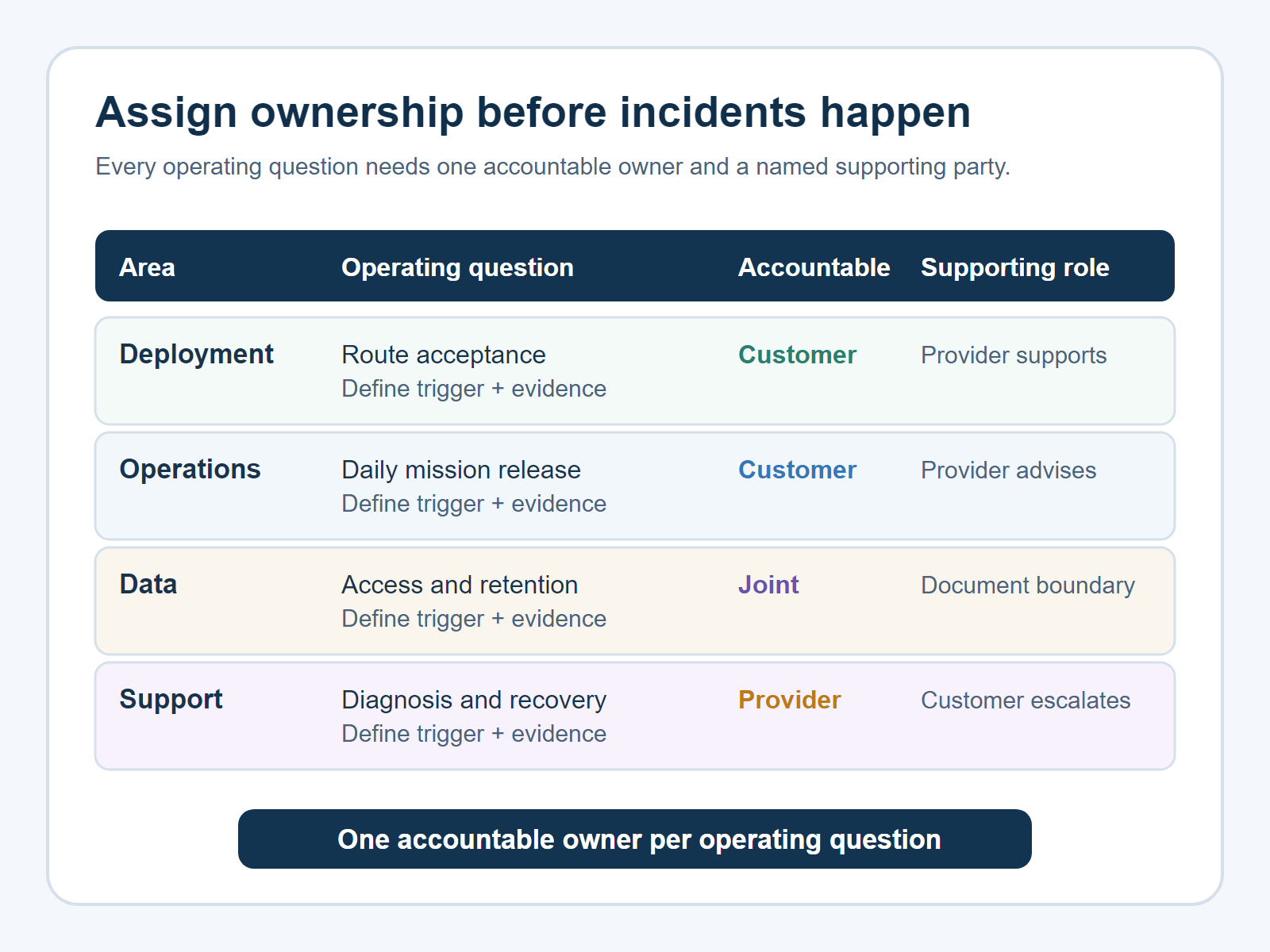
The customer commonly controls access, local procedures, staff instructions and physical conditions. The provider may supply site requirements, system limits, training and technical controls. An integrator may design interfaces or conduct commissioning. The final allocation depends on the jurisdiction, contract and actual control, not a generic label.
Identify who approves the intended use, risk assessment, route, payload, charging location, integration and operating procedure. Define who may stop service and who may authorize restart after an incident. Contractual responsibility must align with practical authority; a party cannot manage a condition it cannot observe or change.
Define data responsibility across the lifecycle
List the data the service creates or accesses: maps, task events, video or sensor data, diagnostic logs, user accounts, remote-support sessions and location history. For each category define purpose, controller or decision owner, permitted access, hosting location, retention, export, deletion and incident notification. Minimize collection where the purpose does not require it.
NIST's cybersecurity supply-chain guidance treats risk across the lifecycle, including acquisition, deployment, maintenance and disposal. Applied to RaaS, supplier due diligence should cover software updates, remote access, sub-processors, vulnerability handling, credential management, logging and end-of-service deletion. This is a governance principle, not proof that a particular offering is secure.
Connect support ownership to the SLA
A responsibility matrix says who acts; the service-level agreement says when and how performance is measured. Align incident detection, acknowledgement, triage, response, workaround, restoration, resolution and closure. Define the system boundary and clock. If a building interface fails, who diagnoses it, who contacts the third party and when does the service clock pause?
The customer also needs continuity duties: an approved manual fallback, staff availability, safe access for service and timely incident reporting. Provider exclusions should be narrow and evidenced. Avoid language that excludes every dependency while still promising an end-to-end outcome.
Govern changes and subcontractors
RaaS will change over time. Record who can request and approve changes to software, maps, routes, payloads, integrations, access and reporting. Classify emergency changes and define retrospective review. Preserve versions so incident analysis can reconstruct what was operating.
Make the operating chain visible. If the provider relies on an integrator, cloud service, connectivity vendor or original manufacturer, identify which obligations flow down, who coordinates them and what happens if a supplier changes. The customer should have one operational escalation route even when several organizations investigate.
Plan exit before service begins
Exit covers more than collecting equipment. Define notice, final invoices, data export format and timing, credential revocation, remote-access closure, verified deletion, configuration ownership, removal work, site restoration, spare parts and transition support. Decide what evidence confirms completion.
Review the matrix during acceptance, after material changes, after major incidents and before renewal. Names can sit in an operating appendix so roles stay current without silently changing contractual accountability.
Make the matrix a working control
Test it with scenarios: a blocked route, failed door interface, security alert, damaged payload, missed service level and contract exit. If the team cannot identify the first action, accountable decision-maker and required record, the matrix is not ready.
Learn how Warpify structures Robotics as a Service, compare the RaaS pricing models and robot SLA guide, then carry those owners into fleet utilization and lifecycle operations. When the boundary is clear, assess your service requirements with operations, IT, procurement and counsel involved.

Iven Wang
Iven Wang is the Co-Founder of Warpify Robotics, specializing in the commercialization and deployment of robotic solutions. With a background in electrical engineering and product management, he works with manufacturers, integrators, and enterprise clients across industrial inspection, security, logistics, and Robotics-as-a-Service.
Subscribe to our newsletter today
Get practical robotics deployment insights, case studies, and planning guidance from Warpify Robotics.