Operating a Hospital AMR Fleet: Charging, Support and Service Coverage
An operating model for hospital AMR fleets covering mission states, charging capacity, service coverage, remote support, fallback and lifecycle evidence.
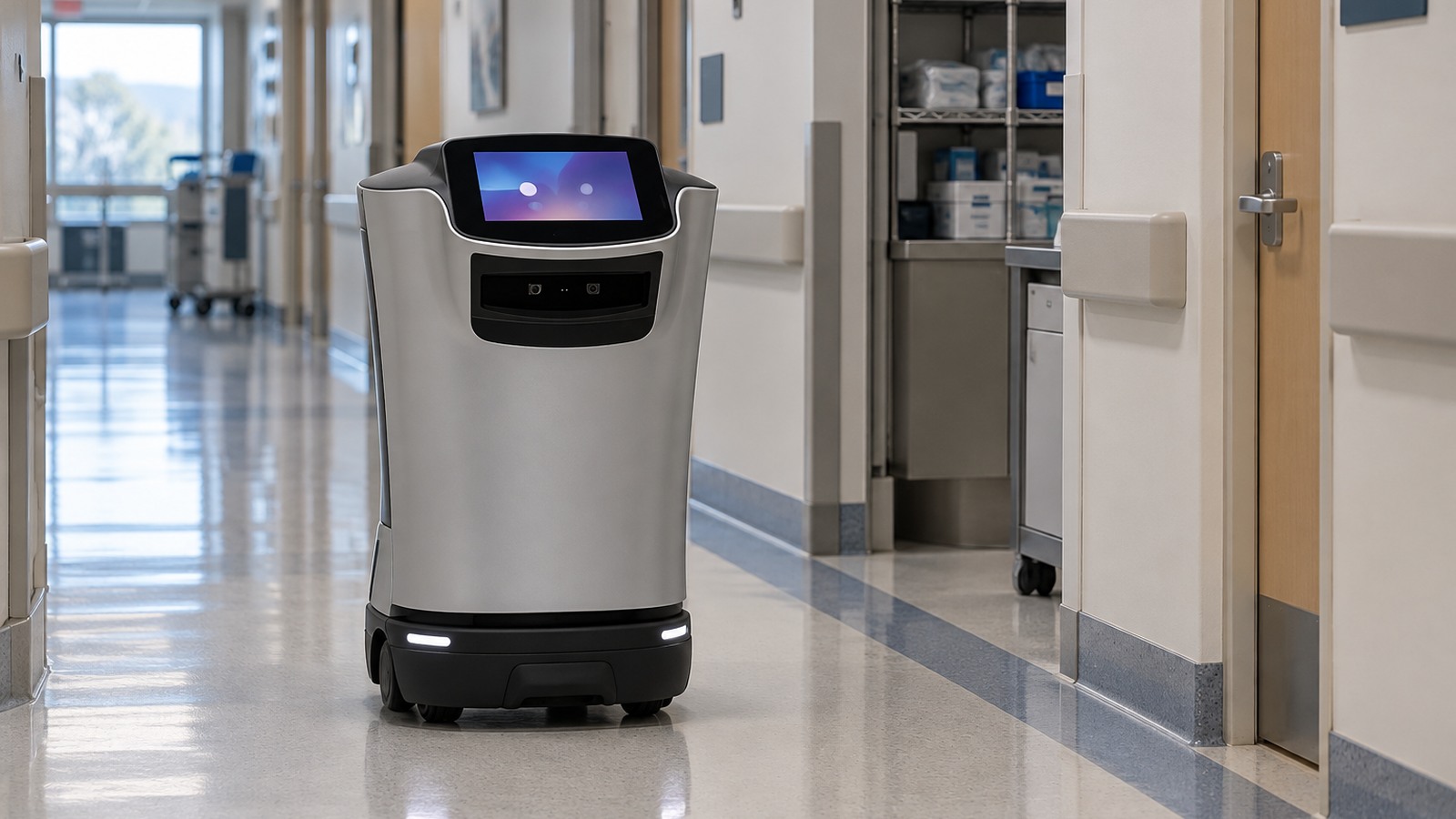
A hospital autonomous mobile robot (AMR) fleet should be operated as a set of route services, not a row of machines. Each route has demand, payload, receiving, priority, cleaning, charging, support and manual-fallback requirements. Fleet control is reliable only when those requirements are visible in daily decisions.
Before expanding beyond a pilot, define every operating state, the evidence needed to enter or leave it, and the person who owns exceptions. A robot that is powered on may still be unavailable because it is cleaning, awaiting a receiver, below reserve charge, outside the accepted configuration or on incident hold.
Start with route service classes
Group routes by operational consequence rather than department name. A time-critical specimen route, scheduled linen wave and on-demand general-supply route may require different response, reserve and fallback even if they share the same corridor. For each class, define service window, priority, maximum wait, receiving commitment, payload constraints, manual fallback, alert path and restart authority.
Measure demand by shift, including peaks, urgent requests, empty travel, elevator delay, waiting at handoff, cleaning and operator intervention. Keep ineligible or clinically controlled work outside the automated denominator. Fleet size and charging plans built from daily averages can fail during overlapping peaks.
Scroll horizontally to compare all columns.
| State | Entry evidence | Who owns it | Exit condition | Fallback impact |
|---|---|---|---|---|
| Available | Accepted configuration, charge reserve and cleanliness confirmed | Fleet operations | Mission assigned or hold applied | None |
| Assigned | Payload, route, receiver and priority accepted | Dispatch and receiving teams | Receipt, exception or cancellation recorded | Manual route if service window is threatened |
| Charging | Approved charger, access and battery state | Facilities and fleet operations | Required reserve reached and checks pass | Another unit or rescheduled mission |
| Cleaning or quarantine | Defined trigger and tagged status | Environmental services/infection prevention | Approved cleaning and release evidence | Unit excluded from dispatch |
| Maintenance or incident hold | Fault, change or incident record | Service owner plus hospital authority | Qualified repair and functional acceptance | Manual service and backlog control |
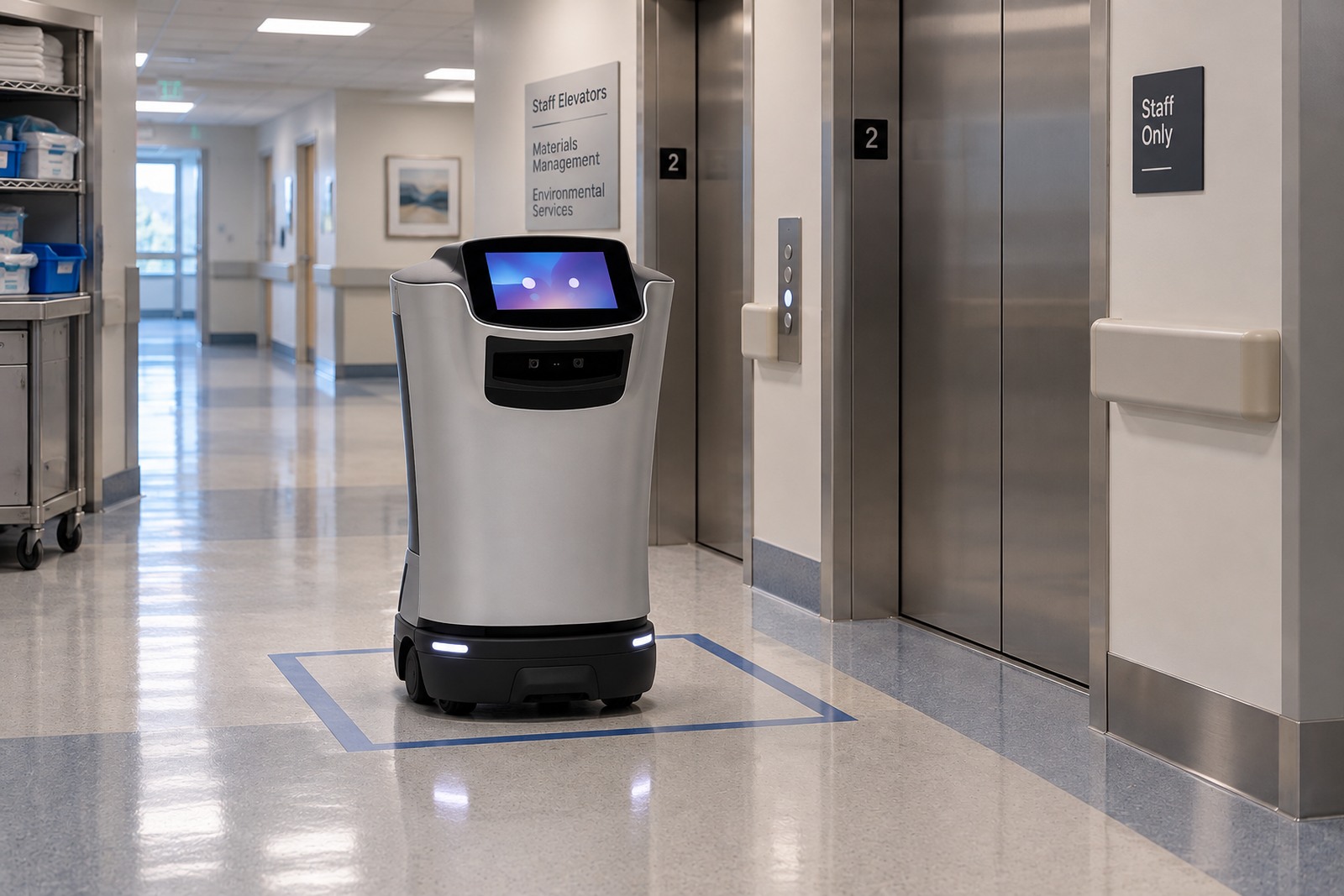
Make fleet states explicit
Use one authoritative state model across dispatch, support and hospital operations. At minimum distinguish available, assigned, charging, cleaning/quarantine, planned maintenance, recoverable fault, incident hold, manual control and out of service. Define whether the fleet controller, robot, service desk or hospital authority owns each transition.
Avoid “online/offline” as the only operational distinction. Record why a unit is unavailable, the affected route class, expected restoration, permitted actions and current fallback. This lets operations decide which missions to defer or move manually without waiting for technical diagnosis.
Plan charging from observed energy demand
Build an energy budget from actual mission distance, payload, stops, lift waits, wireless behavior, ambient conditions, cleaning time and battery reserve. Use the manufacturer-approved battery and charger limits for the selected platform. Do not convert nominal endurance into guaranteed route capacity.
Model concurrent charger demand during normal peaks, shift transitions, cleaning windows and one-unit failure. Record charger quantity, location, electrical supply, ventilation or environmental requirements, access control, egress, docking clearance, housekeeping, inspection and maintenance ownership. Qualified electrical, fire-safety and infection-prevention teams should approve the actual installation.
Set a dispatch reserve that protects critical fallback rather than consuming the last available energy on a low-priority mission. Define what happens when a charger is blocked, a unit repeatedly fails to dock, battery state is inconsistent or a mission cannot complete with the current reserve.
Design service coverage around route consequence
Map coverage for every service class: alarm receipt, safe-state check, local first response, remote diagnosis, field dispatch, parts release, customer communication and restart. Include business hours, nights, weekends, public holidays, deputies, languages, site-access requirements and escalation to facilities, IT, infection prevention or clinical leadership.
Separate response from restoration. A prompt acknowledgement does not restore service. Define the evidence that starts and stops each clock, applicable exclusions, customer dependencies and the manual fallback. Test the contact path with controlled exercises.
Control remote access and configuration
NIST SP 800-82 Rev. 3 recommends that OT cybersecurity account for performance, reliability and safety requirements. For hospital fleets, remote support should use named accounts, strong authentication, least privilege, customer-approved windows, session logging, controlled file transfer and emergency revocation.
Maintain a versioned baseline for robot software, fleet software, maps, charger configuration, doors, lifts, access control, certificates, network rules, payload settings and interfaces. Review and test changes for route behavior, safe state, data, cleaning and fallback. Keep a known-good backup and prove that it can be restored.
Treat fleet integration as a contract, not a logo
VDA 5050 Version 3.0.0 defines an interface for exchanging job and status data between fleet control and mobile robots in intralogistics. It can inform interoperability questions, but it is not a hospital safety, charging or universal compatibility certificate. Confirm the platform version, supported messages, actions, maps, zones, error semantics and vendor responsibilities in the actual implementation.
For any fleet interface, define the authoritative dispatcher, priority conflict rule, state synchronization, duplicate-command behavior, offline mode, clock source, retained logs, cybersecurity boundary and recovery test. Avoid assuming that a common protocol removes the need for application integration and acceptance.
Connect cleaning and maintenance to dispatch
Cleaning status must be visible to the scheduling system and people. Define triggers, approved materials, protected components, contact time where applicable, who performs the work, inspection and release evidence. A unit under cleaning or quarantine cannot be silently returned to available.
Schedule preventive work from manufacturer instructions, configuration, environment, usage and condition evidence. Link faults, repeat interventions, parts, software changes and completed tests to the asset record. Distinguish temporary recovery from permanent repair and require qualified acceptance after changes that can affect safety or service.
Operate a daily control loop
At shift start, review route demand, priority, staffing, available units, battery reserve, charger state, cleaning holds, maintenance, incidents, planned building work and manual fallback. During operation, monitor service completion, intervention, handoff delay, elevator queues, blocked routes, charging exceptions and repeated faults.
At shift close, reconcile unfinished missions, payload custody, state changes, manual trips and unresolved alerts. Escalate recurring exceptions into route, capacity, training or commercial review. Do not normalize frequent human rescue as autonomous service performance.
Use lifecycle evidence for expansion
ISO 55001:2024 frames lifecycle asset decisions around performance, risk and expenditure aligned with organizational objectives. Apply that view to route services: completion and timeliness, patient/staff safety, intervention, cleaning, restoration, service cost, spares, software support and remaining life.
Expand only when the accepted routes meet their service evidence across representative shifts and degraded-state tests. New departments, payloads, lifts, buildings or vendors reopen the relevant risk, charging, support and integration decisions.
Build the fleet around one accepted route at a time
Use Warpify's hospital AMR solution framework, hospital delivery robot TCO framework, hospital AMR safety and infection-control guide and hospital AMR pilot acceptance guide.
Bring route classes, shift demand, fleet states, charging assumptions and coverage requirements to an assessment. Assess hospital AMR fleet operations before adding units or service scope.
Sources and scope
This guide synthesizes ISO 55001's lifecycle framing, NIST OT-security guidance, VDA 5050 Version 3.0.0 and the public scope of ISO 3691-4. This is an illustrative scenario: the fleet-state, charging and coverage models require hospital and manufacturer approval for the actual site.

Iven Wang
Iven Wang is the Co-Founder of Warpify Robotics, specializing in the commercialization and deployment of robotic solutions. With a background in electrical engineering and product management, he works with manufacturers, integrators, and enterprise clients across industrial inspection, security, logistics, and Robotics-as-a-Service.
Subscribe to our newsletter today
Get practical robotics deployment insights, case studies, and planning guidance from Warpify Robotics.