Connecting Inspection Robots to CMMS, Historians and Alarm Workflows
A data-contract and alarm-quality framework for moving inspection-robot observations into historians, CMMS records and accountable maintenance workflows.
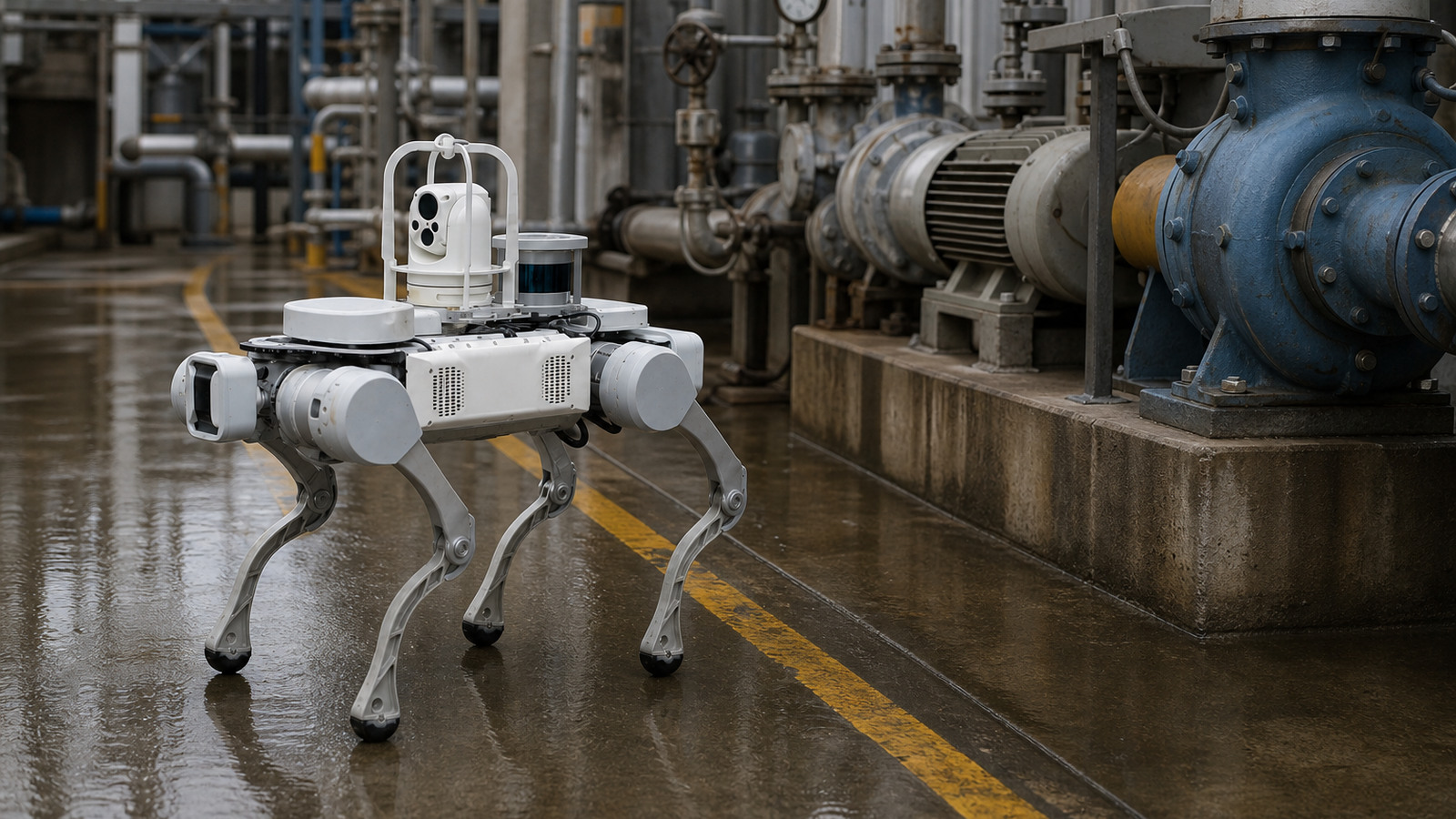
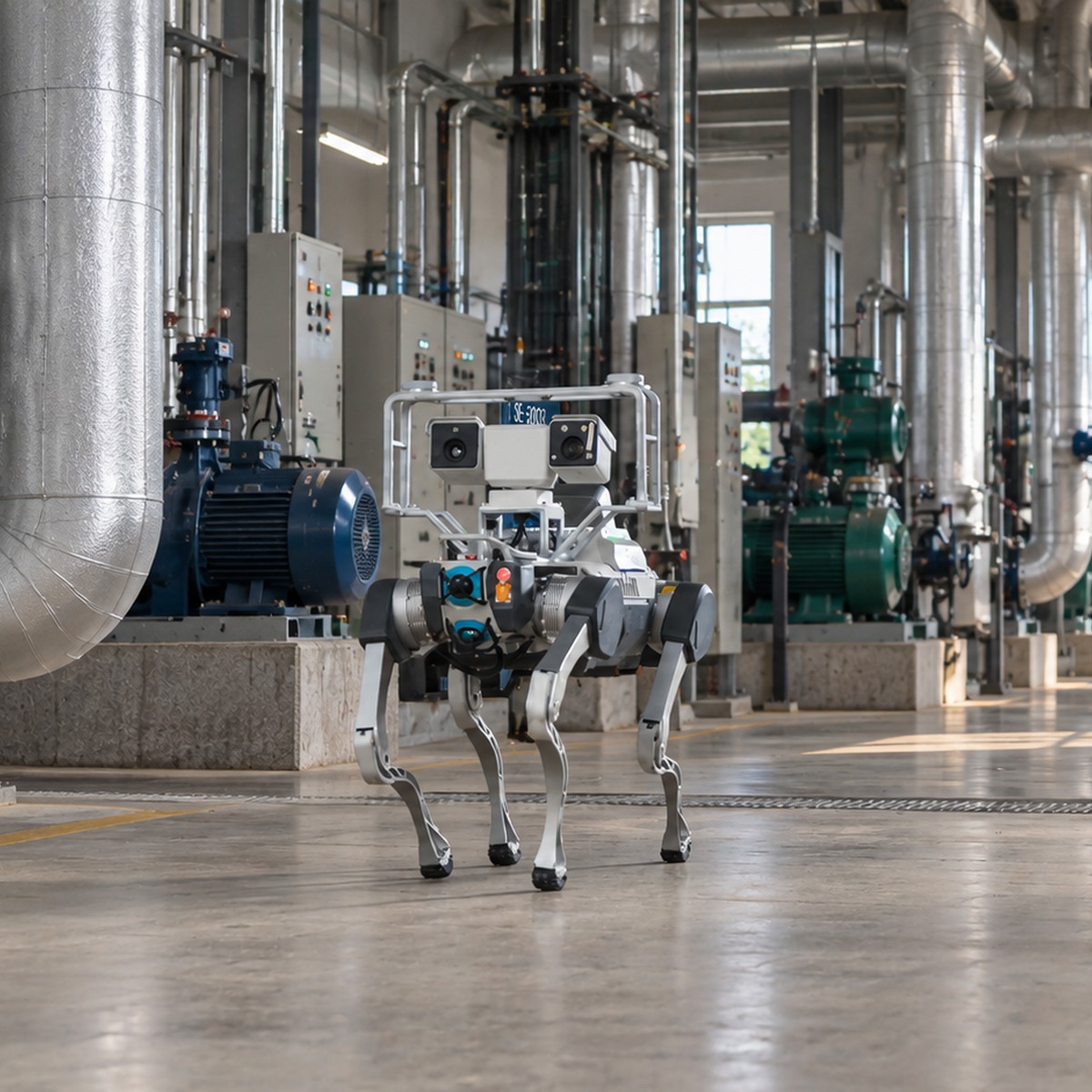
An inspection robot can collect more observations than a maintenance team can review. Sending every reading directly into a CMMS does not solve that problem; it can produce duplicate work, nuisance alarms and records that cannot be traced back to the inspected asset, mission or evidence.
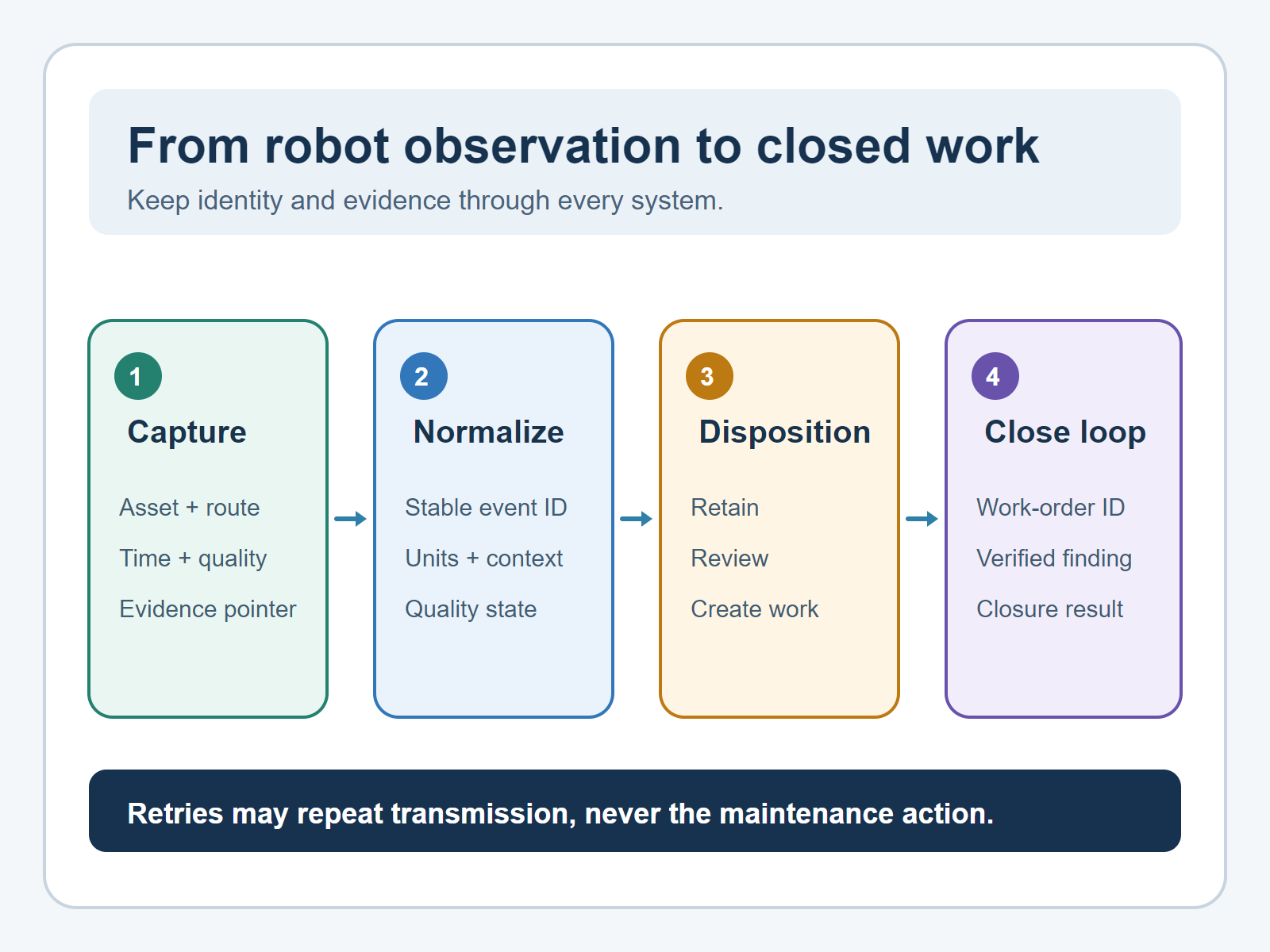
The integration should behave like a controlled decision pipeline: preserve raw evidence, normalize identity and time, evaluate data quality, apply an approved condition rule, route the result to the right human or system, and return closure evidence to the inspection program.
Separate evidence storage from maintenance action
A historian and a CMMS serve different questions. Historical access preserves time-series data and events for trends, replay and investigation. A CMMS manages assets, maintenance decisions, job plans and work history. Not every retained observation deserves a work order, and a work order should not be the only copy of the source evidence.
OPC UA Part 11 defines historical access for data and events. OPC UA Part 9 models conditions, unique identifiers, acknowledgements and confirmations. These standards do not design the whole inspection workflow, but they illustrate useful semantics: a condition can be observed and acknowledged without implying that corrective action is complete.
Use a five-stage architecture
A practical pattern is: robot and sensor capture; edge normalization and quality checks; historian or governed evidence store; condition and disposition service; then CMMS alert, inspection task or work order. The closure path returns verified findings, work performed, false-positive status and asset condition to the analytics owner.
Keep the robot-side interface bounded. It should publish the accepted data contract and health state, not hold every site-specific maintenance rule. Keep the CMMS connector bounded too: it should create or update records idempotently and surface errors, not silently decide what severity means.
Define the data contract before the connector
The table below is a Warpify modelled framework. It is an illustrative scenario for integration design, not a standard profile or a claim that every robot, historian or CMMS supports these fields. Select the applicable fields, protocols and retention controls with the system owners.
Use stable asset identity across systems. If the robot route calls an object “pump-7,” the historian “P-007” and the CMMS a different location record, create a governed mapping and version it. Do not ask operators to reconcile identities during an incident.
Preserve meaning when sensors or routes change
A time series is comparable only when its measurement context remains known. Record the sensor identity, calibration or verification state where applicable, unit, sampling or aggregation rule, robot pose or observation point, mission version and environmental qualifiers needed to interpret the value. When a sensor, payload, route waypoint or processing model changes, create a new version boundary rather than silently appending unlike data to the same trend.
Define a commissioning baseline for each monitored asset and observation method. The baseline should include known-good evidence, expected data-quality states and the rule versions approved for use. This gives maintainers a reference when a trend shifts: they can ask whether the asset changed, the measurement changed or the decision logic changed.
Put an alarm-quality gate before work-order creation
Define disposition classes such as retain only, notify for review, schedule a confirmatory inspection, create planned work, or escalate immediately under an approved site procedure. The gate should check data quality, asset identity, clock state, rule version, persistence, duplicate or chattering behavior, existing open work, maintenance state and whether a human verification step is mandatory.
OPC UA includes concepts for retained conditions, acknowledgement, suppression, shelving and audit. IBM Maximo documents measurement limits that can drive alerts or work orders with job plans. Product features vary by version and configuration, so verify the exact deployed systems. More importantly, define site policy for when an observation becomes actionable—technology should implement that policy, not invent it.
Design for duplicates and failed interfaces
Create an idempotency key from the stable event identity and intended disposition. A retry should not create a second work order. Record connector attempts, destination response and final record ID. If the CMMS is unavailable, queue the action with an expiry and escalation policy; do not mark the condition handled because transmission was attempted.
When a rule changes, retain its version beside every generated condition. This allows the team to explain why two similar observations received different dispositions and to replay historical evidence without rewriting the original record.
Protect the OT-to-enterprise boundary
NIST SP 800-82 advises securing OT in a way that respects performance, reliability and safety. Prefer brokered, least-privilege interfaces over broad direct access. Assign service identities, restrict write paths, review remote access, protect credentials outside the content repository, monitor connector health and include integration changes in OT change control. A CMMS work-order write must not create an uncontrolled path back into physical control.
Test the full chain with known outcomes
Use positive and negative controls: a known in-range reading, a known actionable condition, bad quality, missing asset mapping, duplicated event, late event, clock error, suppressed condition, CMMS outage and closure feedback. Verify both the created record and the absence of records that should not exist.
Report coverage from eligible observations through accepted identity, usable evidence, disposition, work-order creation and closed-loop outcome. A connector uptime percentage alone cannot show that maintenance received the right work.
Close the loop with disposition codes that improve the inspection program: confirmed condition, no fault found, wrong asset, bad measurement, duplicate, threshold unsuitable, repaired, deferred with authority or monitoring required. Keep free text for context, but use controlled codes for analysis. Review false positives and missed conditions by asset, mission and rule version; do not retrain or retune logic from unverified technician comments alone.
Start with Warpify's industrial inspection workflow and the related inspection robot cost and TCO guide. To map the data boundary for a real site, request an assessment.

Iven Wang
Iven Wang is the Co-Founder of Warpify Robotics, specializing in the commercialization and deployment of robotic solutions. With a background in electrical engineering and product management, he works with manufacturers, integrators, and enterprise clients across industrial inspection, security, logistics, and Robotics-as-a-Service.
Subscribe to our newsletter today
Get practical robotics deployment insights, case studies, and planning guidance from Warpify Robotics.