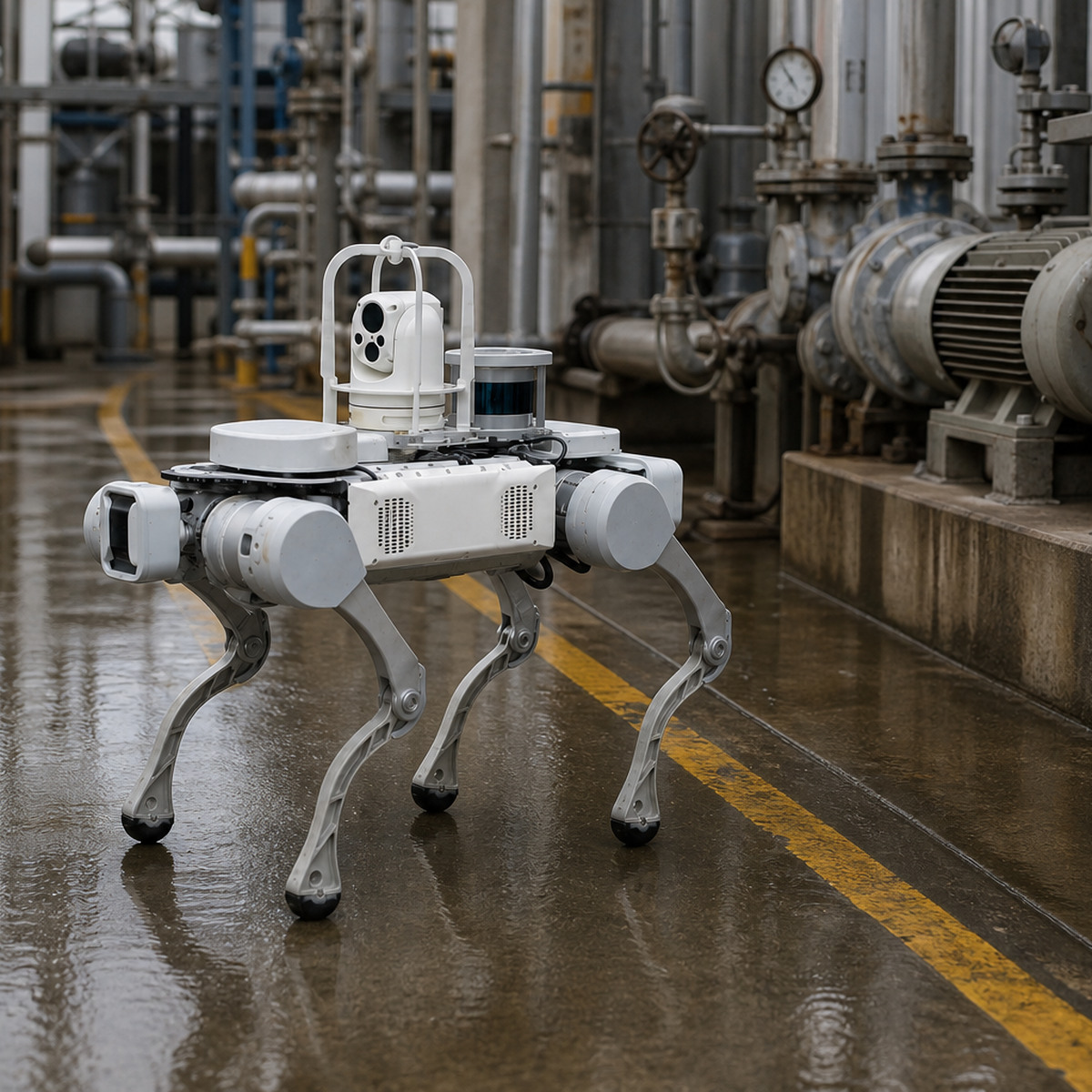
Industrial Inspection Robot Cost and TCO: What to Include
A TCO framework for industrial inspection robotics covering platform, payload, route engineering, integration, data, safety, service and lifecycle costs.

An industrial inspection robot quote is useful only when it prices the complete inspection system. Start with the assets, readings, route, environment, data handoff and exception model, then compare platform, payload, integration and service proposals against that same baseline. That is the workflow-first boundary for industrial inspection robotics solutions.
Total cost of ownership (TCO) covers the cost to specify, integrate, commission, operate, support, change and retire the system over a defined period. It should not be reduced to the mobile base, quadruped or sensor price.
Define the technical baseline before asking for cost
Use the current industrial inspection deployment guide to document the route, access constraints, target assets, required readings, read positions, frequency, operating window, environmental exposure, communication, data destination, manual fallback and people who review or escalate findings.
A reliable estimate needs a defined purpose, technical baseline, work breakdown, assumptions, sensitivity analysis and a process for updating forecasts with actual costs. That method comes from GAO's general cost guidance; it is applied here as an estimating discipline, not as a robotics benchmark.
Price the complete inspection application
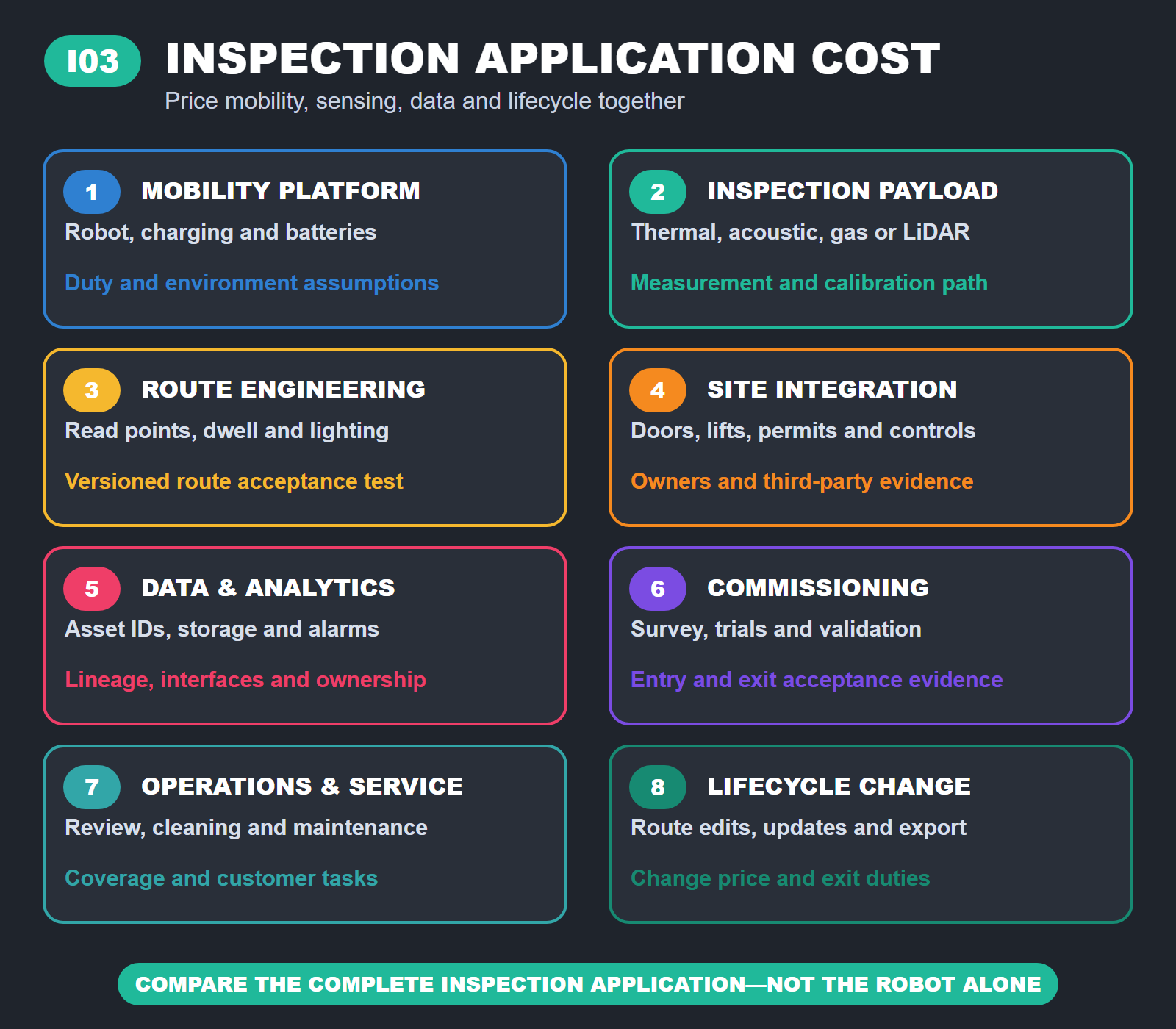
OSHA describes an industrial robot application as more than the robot itself: it can include controllers, sensors, end effectors, conveyors, elevators, worktables, inspection equipment and other machines. For autonomous inspection, the same system boundary means that mobility is only one cost layer.
Scroll horizontally to compare all columns.
| Layer | Include in the estimate | Evidence to request |
|---|---|---|
| Mobility platform | Base robot, charging, batteries, environmental protection and safety hardware | Configuration and duty assumptions |
| Inspection payload | Visible, thermal, acoustic, gas, LiDAR or other task-specific sensors; mounts and protective housings | Supported measurement task and calibration path |
| Route engineering | Mapping, access, approach poses, read points, dwell, lighting and obstacle cases | Versioned route and acceptance test |
| Site integration | Doors, gates, lifts, charging, permits, work controls and interfaces | Responsibility and third-party scope |
| Data and analytics | Acquisition, timestamps, asset IDs, storage, transfer, visualization, alarms and retention | Data lineage, interfaces and ownership |
| Commissioning | Site survey, configuration, trials, safety validation, training and cutover | Entry/exit criteria and evidence owner |
| Operations and service | Monitoring, mission review, cleaning, calibration, maintenance, spares, response and restoration | Coverage, exclusions and customer tasks |
| Lifecycle and change | Route edits, asset additions, software updates, refresh, decommissioning and data export | Change prices and end-of-term obligations |
Make measurement quality a costed responsibility
NIST's manufacturing monitoring program emphasizes that trusted diagnostics require sensing, data infrastructure, analytics, and verification and validation. A mobile route that collects data is not automatically an inspection outcome. The estimate should show who defines the measurand, selects and calibrates the payload, approves the read point, checks data quality, reviews anomalies and maintains traceability.
Cost both the normal route and the exception path: a missed read, obstructed asset, communication failure, out-of-range value, contaminated lens, changed machine geometry or unsafe access may require repeat missions or human follow-up.
Use one TCO equation for every proposal
TCO = platform and payload + route and integration + data and commissioning + recurring operation and service + expected exception cost + lifecycle and exit.
Apply the same evaluation period, currency, shift pattern, route set, payload requirement, service window and ownership boundary. Record unpriced third-party work explicitly. If one offer includes remote monitoring and another excludes it, normalize the scope before comparing totals.
Keep value separate from the cost total
Use a separate robot ROI and TCO model for potential benefits. Establish the current inspection process and measure the target outcome: for example, route completion, valid reads, review time, exception closure or exposure hours within a defined boundary. Do not convert inspection capacity into avoided downtime, detection into prevented failure, or staff time into cash savings without a supported causal and financial model.
Test the assumptions that can reverse the decision
- number of routes, read points and operating windows;
- payload and calibration requirements;
- route change frequency and environmental variability;
- communications and data integration effort;
- repeat missions and manual exception follow-up;
- service coverage, spares and site-access constraints;
- software, sensor and battery refresh;
- contract change and exit obligations.
A useful proposal review produces a scope-normalized cost range and a short list of site facts that must be measured before commitment. It does not produce a universal industrial inspection robot price.
Sources and scope
This guide combines the cited primary sources with an editorial decision framework. It does not quote a market price, promise a result, replace a site assessment, or provide legal, financial, clinical, cybersecurity or safety advice.
- Cost Estimating and Assessment Guide: Best Practices for Developing and Managing Program Costs — U.S. Government Accountability Office
- Industrial Robot Systems and Industrial Robot System Safety — U.S. Occupational Safety and Health Administration
- Monitoring, Diagnostics and Prognostics for Manufacturing Operations — National Institute of Standards and Technology
Take the next step
If you can identify the assets, readings, route, exception owners and operating constraints, bring that scope into a site-specific discussion: Request an industrial inspection site assessment.

Iven Wang
Iven Wang is the Co-Founder of Warpify Robotics, specializing in the commercialization and deployment of robotic solutions. With a background in electrical engineering and product management, he works with manufacturers, integrators, and enterprise clients across industrial inspection, security, logistics, and Robotics-as-a-Service.
Subscribe to our newsletter today
Get practical robotics deployment insights, case studies, and planning guidance from Warpify Robotics.