Hospital Delivery Robot Cost: A Practical TCO Framework
A practical framework for comparing hospital delivery robot proposals across integration, operations, service, risk and end-of-term costs.
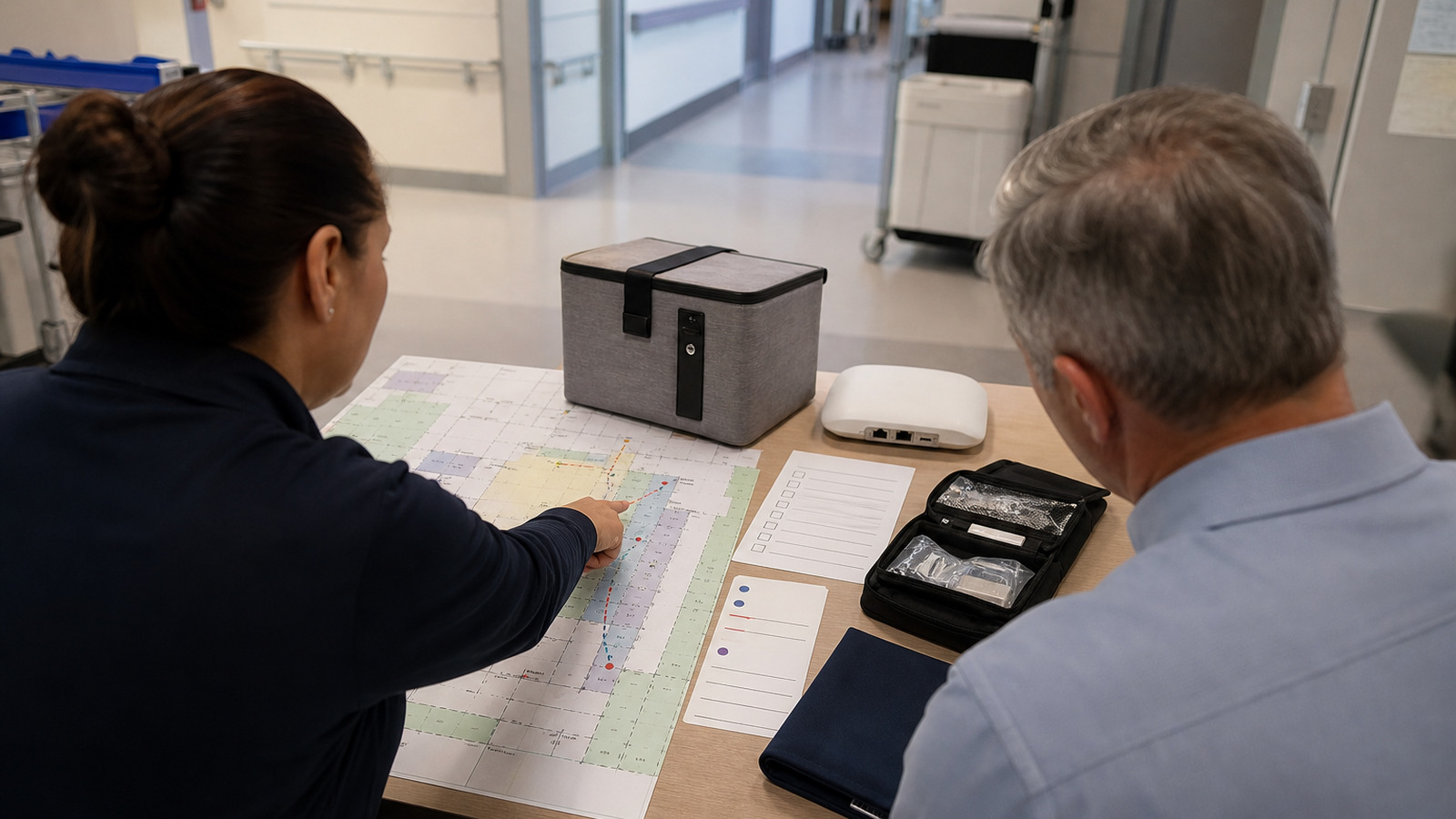
A useful hospital delivery robot cost estimate starts with the work, not the machine. Before comparing proposals, define the delivery flows, operating hours, floors, payload controls, staff handoffs and exception coverage that the service must support. That gives finance and operations teams a common baseline for evaluating hospital AMR logistics solutions.
Total cost of ownership (TCO) is the full cost of obtaining, integrating, operating, supporting and eventually changing or retiring a solution over a defined evaluation period. It is not the same as a robot price, monthly fee or first-year budget.
Start with one operating baseline
Write a one-page technical and operational baseline before requesting prices. Record the origin and destination of each workflow, item class and containment, routine versus urgent demand, operating window, floor and elevator dependency, release and receipt steps, charging strategy, manual fallback, and the people responsible for exceptions.
GAO's cost guide recommends defining the estimate's purpose and scope, setting a technical baseline, documenting assumptions, testing sensitivity and risk, and updating estimates with actual costs. The same discipline makes robotics proposals more comparable even though the GAO guide is not a robotics pricing standard.
Use a complete cost stack
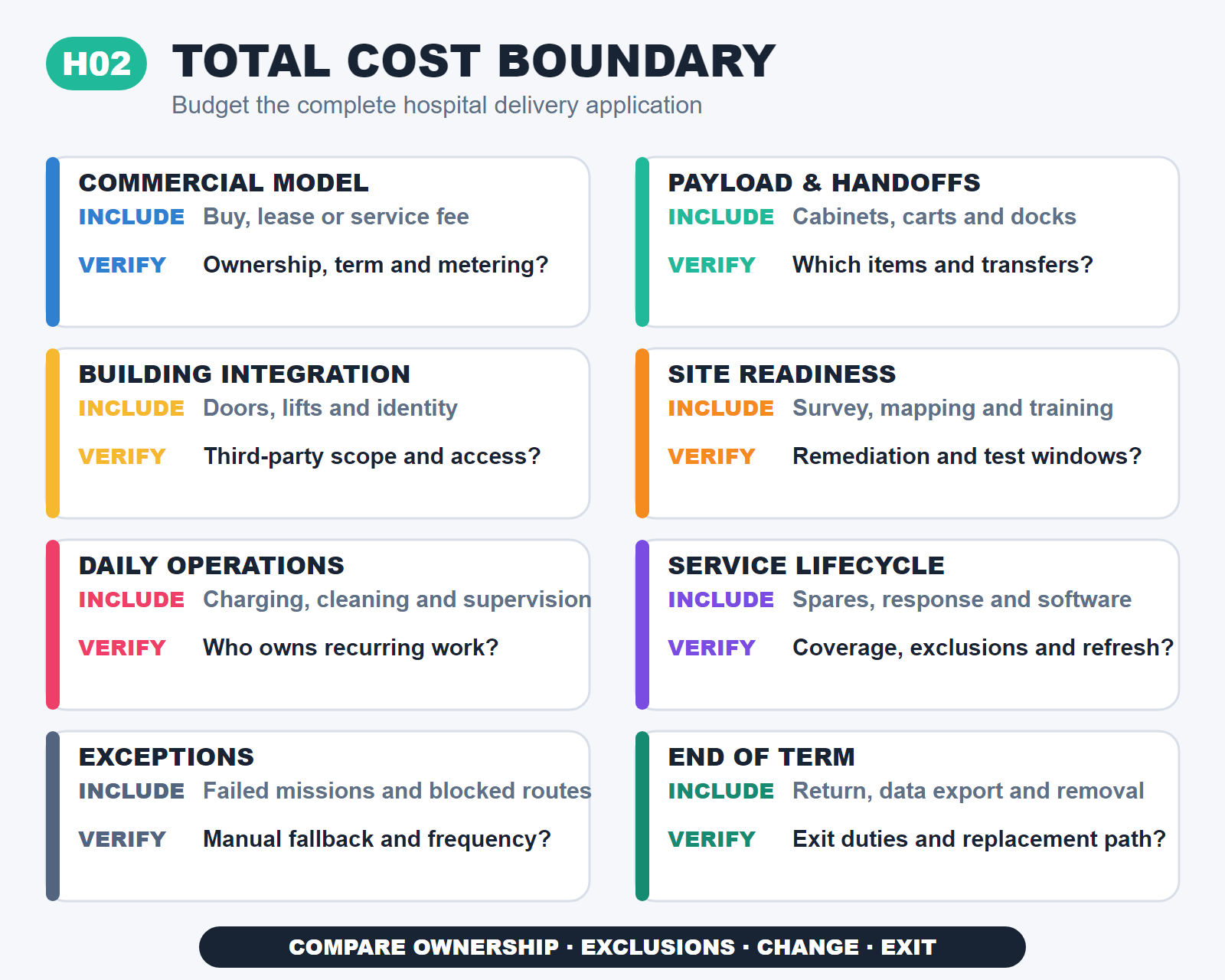
Scroll horizontally to compare all columns.
| Cost layer | What to request | Typical uncertainty to expose |
|---|---|---|
| Commercial access | Purchase, financing, lease or service fee; included robots and capacity; term | What is owned, returned, refreshed or metered |
| Payload and workflow equipment | Secure cabinets, carts, bins, docking or transfer equipment | Which item classes and handoffs are actually supported |
| Building and digital integration | Doors, elevators, access control, dispatch, identity, Wi-Fi and interfaces | Existing-system compatibility and third-party work |
| Site readiness and commissioning | Survey, mapping, route remediation, testing, training and cutover | Construction, network remediation and testing windows |
| Operations | Charging, consumables, supervision, cleaning, storage and workflow administration | Who performs each recurring task and when |
| Service and lifecycle | Monitoring, preventive maintenance, spares, response, restoration, software and refresh | Coverage hours, exclusions and end-of-support risk |
| Exceptions and continuity | Manual fallback, failed missions, blocked routes and unavailable infrastructure | Frequency is unknown until measured in the target workflow |
| End of term | Removal, return, data export, decommissioning, residual value and transition | Exit obligations and replacement dependency |
Build the model without pretending uncertainty is zero
A practical model can use this structure:
TCO = one-time implementation + recurring fixed costs + usage-based costs + expected exception/continuity costs + end-of-term costs.
Use the same evaluation period, currency, tax treatment and demand scenario for every proposal. Keep assumptions visible. If a cost is unknown, show it as an unpriced line with an owner and validation date instead of burying it inside a contingency percentage.
A 2026 single-site feasibility study of 122 non-urgent hospital medication missions found that higher elevator utilization was associated with more failures and longer delivery time. That result should not be copied into another hospital's forecast; it shows why elevator congestion, operating windows and fallback labor belong in the assumptions and sensitivity tests.
Normalize the commercial model
A purchase quote, a lease and a monthly service offer can allocate the same risks to different parties. Compare them with the current guide to purchase, lease and Robotics-as-a-Service structures, then restate each proposal in the same worksheet:
- included hardware, payloads, software, integrations and capacity;
- one-time and recurring charges;
- usage allowance, overage unit and measurement source;
- service hours, spares, travel, consumables and escalation;
- customer responsibilities and third-party costs;
- term, renewal, indexation, change and exit conditions.
Keep benefits separate from costs
Do not subtract an assumed benefit from TCO and call the remainder a price. Build a separate benefit model using the robot ROI and TCO model. Measure affected trips, staff time, service levels, error or delay categories and other outcomes in the target workflow. Released staff time is not automatically a cash saving, and available robot capacity is not realized throughput.
A 2024 qualitative hospital study concluded that the observed delivery robots still needed human support in a complex and unpredictable environment. Include dispatch, loading, receipt, exception handling, cleaning and service coordination instead of modelling the workflow as unattended by default.
Run sensitivity before choosing a proposal
At minimum, test a downside, base and upside case for demand, usable operating hours, number of routes, elevator delays, integration effort, support coverage, mission exceptions, software or hardware refresh and contract exit. The important output is not one payback number; it is the set of assumptions that can reverse the decision.
What procurement should require
- a versioned scope and technical baseline;
- a line-item cost structure tied to that scope;
- a responsibility matrix for hospital, provider and third parties;
- acceptance tests and measurement sources;
- service definitions, exclusions and continuity arrangements;
- change, renewal and exit terms;
- a process for replacing forecast values with actual operating data.
The result is a defendable comparison that can be updated after a pilot or deployment. It is not a universal hospital robot price.
Sources and scope
This guide combines the cited primary sources with an editorial decision framework. It does not quote a market price, promise a result, replace a site assessment, or provide legal, financial, clinical, cybersecurity or safety advice.
- Cost Estimating and Assessment Guide: Best Practices for Developing and Managing Program Costs — U.S. Government Accountability Office
- Integrating Collaborative Robots into a Complex Hospital Setting: A Qualitative Descriptive Study — Delaware Journal of Public Health / PubMed
- Feasibility of autonomous medication delivery robots considering elevator utilization in high-traffic hospital environments — DIGITAL HEALTH / SAGE
Related planning: First confirm which hospital logistics workflows fit AMRs; the workflow boundary determines which cost inputs are relevant.
Take the next step
If the workflow, route, handoffs and operating window are defined, use them to start a site-specific cost and fit discussion: Assess your hospital logistics workflow.

Iven Wang
Iven Wang is the Co-Founder of Warpify Robotics, specializing in the commercialization and deployment of robotic solutions. With a background in electrical engineering and product management, he works with manufacturers, integrators, and enterprise clients across industrial inspection, security, logistics, and Robotics-as-a-Service.
Subscribe to our newsletter today
Get practical robotics deployment insights, case studies, and planning guidance from Warpify Robotics.