Hospital AMR Safety, Infection Control and Egress Planning
A site-specific hospital AMR planning framework for cleaning, route controls, unobstructed egress, degraded modes and acceptance tests.
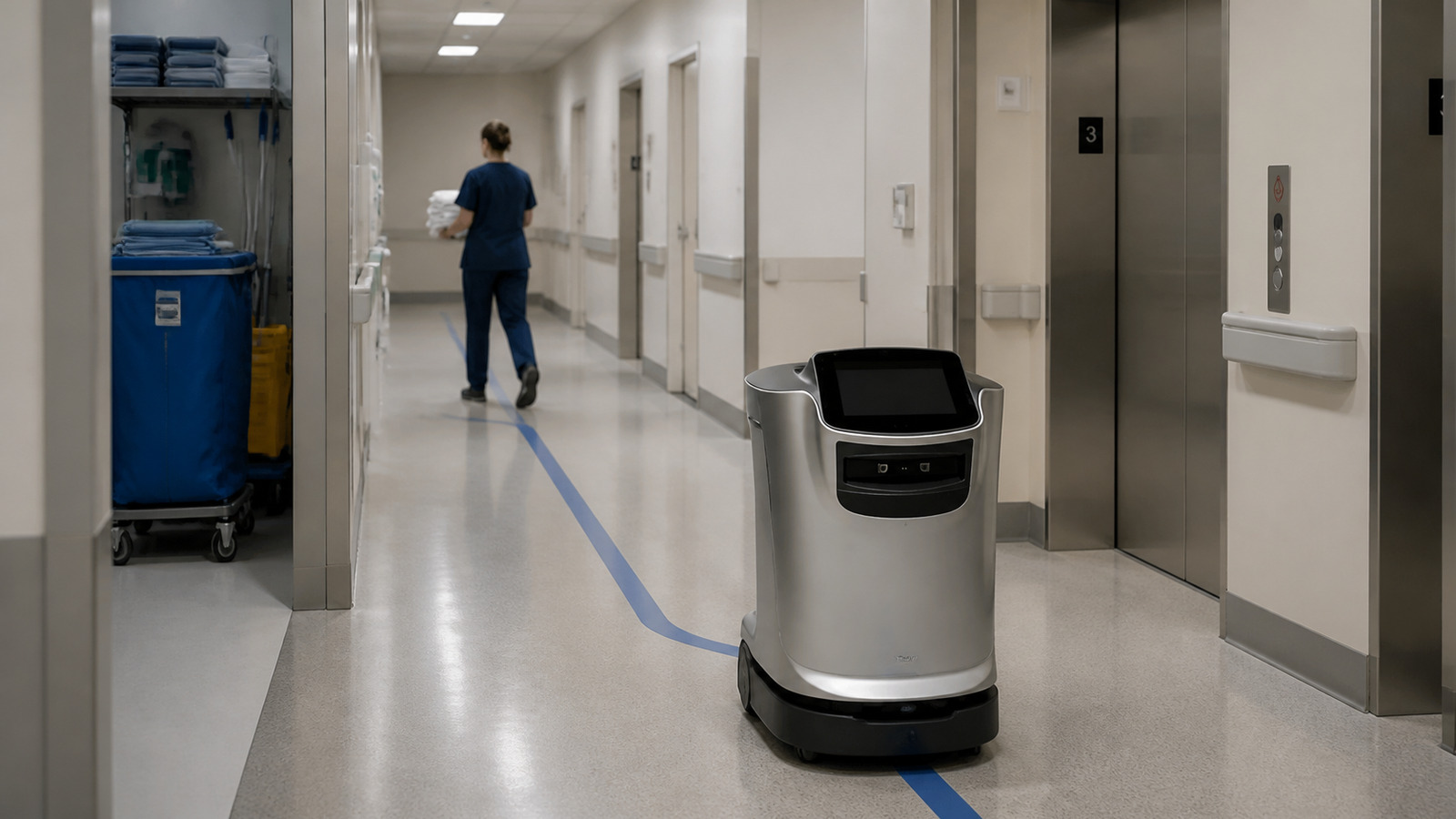
A hospital autonomous mobile robot (AMR) plan is not complete when the route works. The operating model must also protect infection-control procedures, keep exit routes usable and define what staff do when the environment changes. Those obligations sit with the hospital and its qualified advisers; a robot supplier can support the assessment but cannot replace it.
This guide helps infection prevention, facilities, safety and operations teams turn those concerns into site-specific requirements and acceptance evidence. It is educational planning material, not clinical, safety or legal advice.
Use one shared route risk assessment
Start with the actual workflow: pickup, payload, route, dwell points, doors, elevators, charging, cleaning, handoff and exception recovery. Walk it during representative shifts with the people who own environmental cleaning, fire and life safety, security, facilities and the receiving department.
Do not treat a corridor as a constant-width line on a map. Record parked equipment, linen and waste movements, isolation practices, cleaning windows, visitor peaks, emergency response patterns, blind corners, floor transitions and temporary works. The assessment should state what condition was observed, who owns it and what will trigger a new review.
Define the infection-control boundary
CDC environmental-cleaning guidance emphasizes risk-based procedures and defined responsibility for shared and noncritical equipment. For an AMR, the hospital should decide which surfaces are touched, which spaces the platform may enter, what payload containment is required and whether routes or equipment must be separated by risk category.
Build the cleaning method from manufacturer instructions for use and hospital policy. Specify approved products, dilution if relevant, surface compatibility, required wet contact time, cleaning sequence, frequency, personal protective equipment, recordkeeping and action after a spill or contamination event. If a chemical damages a sensor window, seal or coating, a theoretically strong cleaning process can create a new operational risk.
Scroll horizontally to compare all columns.
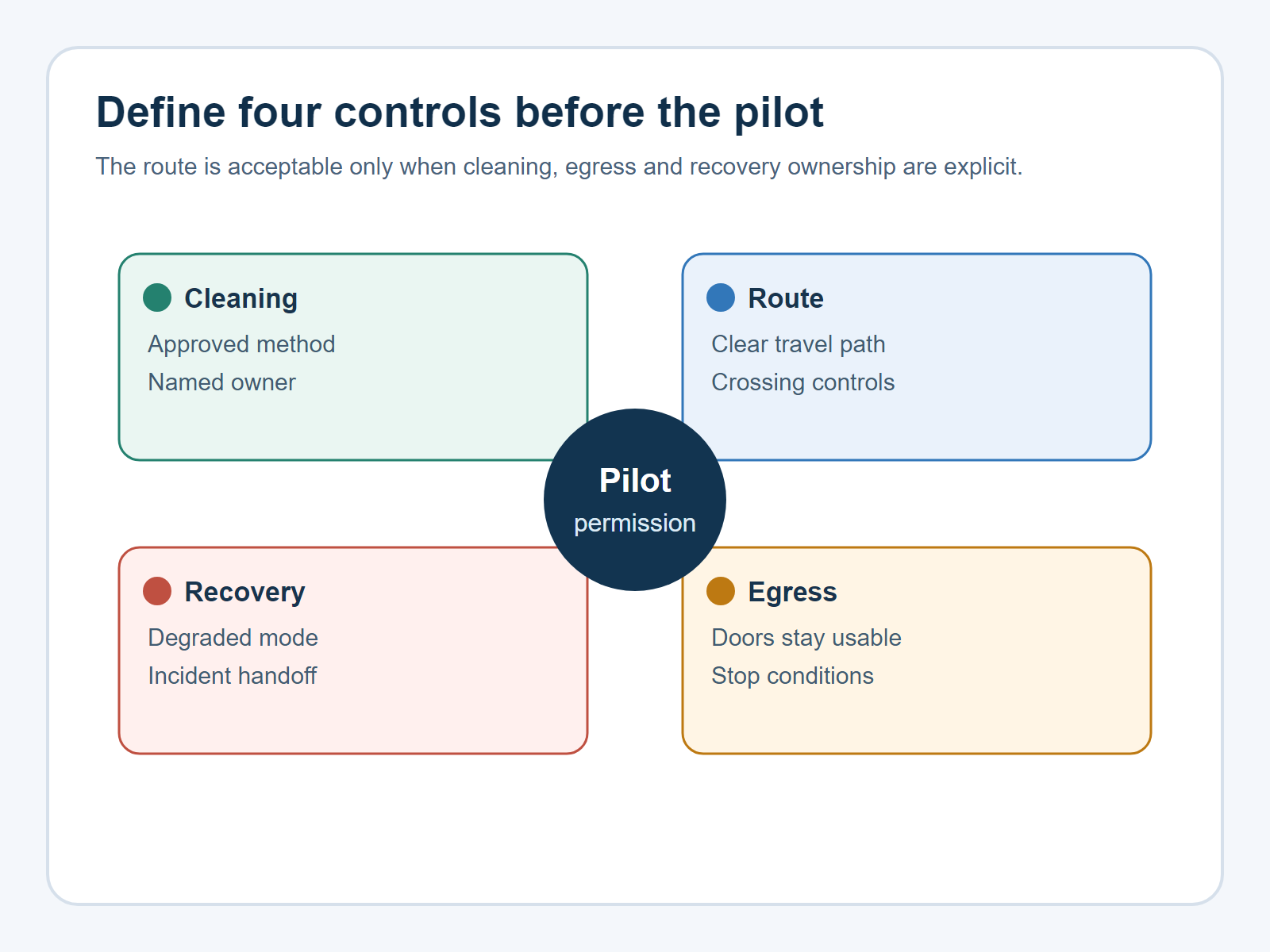
| Control area | Define | Acceptance evidence | Owner |
|---|---|---|---|
| Cleaning | Method, product, frequency and record | Observed procedure and compatibility confirmation | Infection prevention / EVS |
| Route | Permitted zones, waits and temporary restrictions | Shift-based route walk and exception test | Facilities / operations |
| Egress | Clearance, parking and failed-unit recovery | Measured review and recovery drill | Qualified life-safety owner |
| Incident | Stop, isolate, clean, report and release | Tabletop exercise and completed record | Named incident lead |
Keep egress continuously available
In the United States, OSHA requires exit routes to be free and unobstructed and prohibits placing material or equipment in an exit route, even temporarily. Local building, fire and accessibility requirements may add other duties. The project team should have a qualified person determine which rules apply to the facility and workflow.
Review more than normal travel. Ask where the AMR waits when a door is unavailable, where it stops after a fault, how it behaves when people move against the usual flow and how a disabled unit is removed without blocking a route. Charging, staging and service positions need marked, governed locations outside required egress and clinical work zones.
Test degraded conditions: network loss, closed fire doors, elevator recall, crowded corridors, temporary barriers, unavailable destinations and loss of localization. The safest response may be a controlled stop, retreat or staff recovery depending on the approved risk assessment. That behaviour must be defined before the pilot.
Design cleaning and recovery into the shift
A cleaning policy without time, tools and ownership will fail operationally. Decide who takes the unit out of service, who cleans it, where the task happens, who verifies completion and how it is released. Provide supplies at the point of work and train backup personnel. The cleaning log should identify the unit, time, method, operator and any exception without capturing unnecessary patient information.
Apply the same discipline to spills, suspected contamination and exposure to restricted areas. The robot should not quietly resume work after an event that requires assessment. Define isolation status, notification, data preservation, technical inspection and clinical or infection-prevention clearance as separate steps.
Turn the plan into acceptance tests
Acceptance should combine document review, observation and challenge tests. Confirm approved routes and zones, demonstrate the cleaning procedure, inspect the parking and charging locations, run representative traffic, create an obstruction, simulate an unavailable destination and recover a failed unit. Record conditions and deviations rather than relying on a pass/fail checkbox.
Set stop criteria before live operation. Examples include an egress obstruction, an unapproved zone entry, damaged containment, use of an unapproved cleaning product or repeated staff workarounds. A stop is not automatically a failed project; it is a governed signal to investigate, correct and retest.
Maintain the controls after launch
Routes and policies change. Review controls after software changes, construction, departmental moves, infection-control updates, new payloads, new shifts or a meaningful incident. Track training currency and inspect physical staging areas. A monthly review of exceptions can reveal gradual drift before it becomes normal practice.
Warpify's hospital AMR logistics approach starts with workflow and responsibility. Use it with our hospital integration guide, then assess your hospital workflow with the appropriate internal stakeholders.

Iven Wang
Iven Wang is the Co-Founder of Warpify Robotics, specializing in the commercialization and deployment of robotic solutions. With a background in electrical engineering and product management, he works with manufacturers, integrators, and enterprise clients across industrial inspection, security, logistics, and Robotics-as-a-Service.
Subscribe to our newsletter today
Get practical robotics deployment insights, case studies, and planning guidance from Warpify Robotics.