Hospital AMR Integration: Elevators, Doors, Wi-Fi and Access Control
A practical integration framework for hospital AMRs across elevators, doors, Wi-Fi, access control, dispatch, cybersecurity and fallback operations.
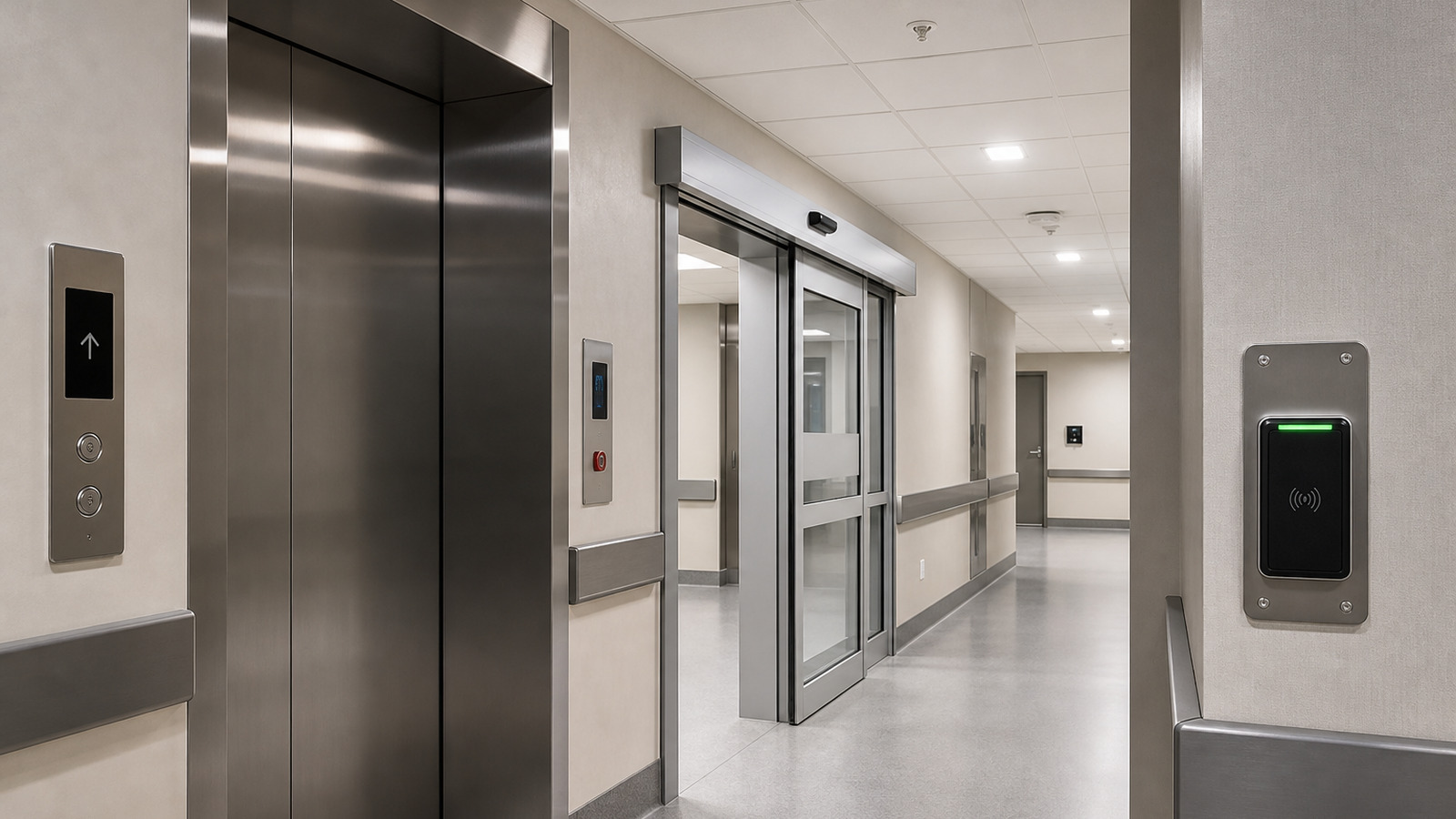
Multi-floor hospital autonomy is an integration outcome, not a robot feature. A workable design connects the delivery workflow to building systems, wireless coverage, device identity, access rules, dispatch, monitoring and manual fallback. Start with the target route and the current hospital AMR logistics solutions context, then assign every interface to an owner.
The goal is not to make every building system robot-controlled. It is to define the minimum safe and operable interaction, the evidence that proves it, and the degraded mode when a dependency is unavailable.
Integration starts with the workflow
Use the robot deployment checklist to record origins, destinations, payload and handoffs before opening an interface discussion. For each route, identify:
- which doors, elevators and access zones are encountered;
- which systems request, authorize, execute and confirm each action;
- which network paths and identities are required;
- what the robot should do on timeout, denial, obstruction or emergency;
- who can monitor, override, recover and audit the event.
Create an interface register
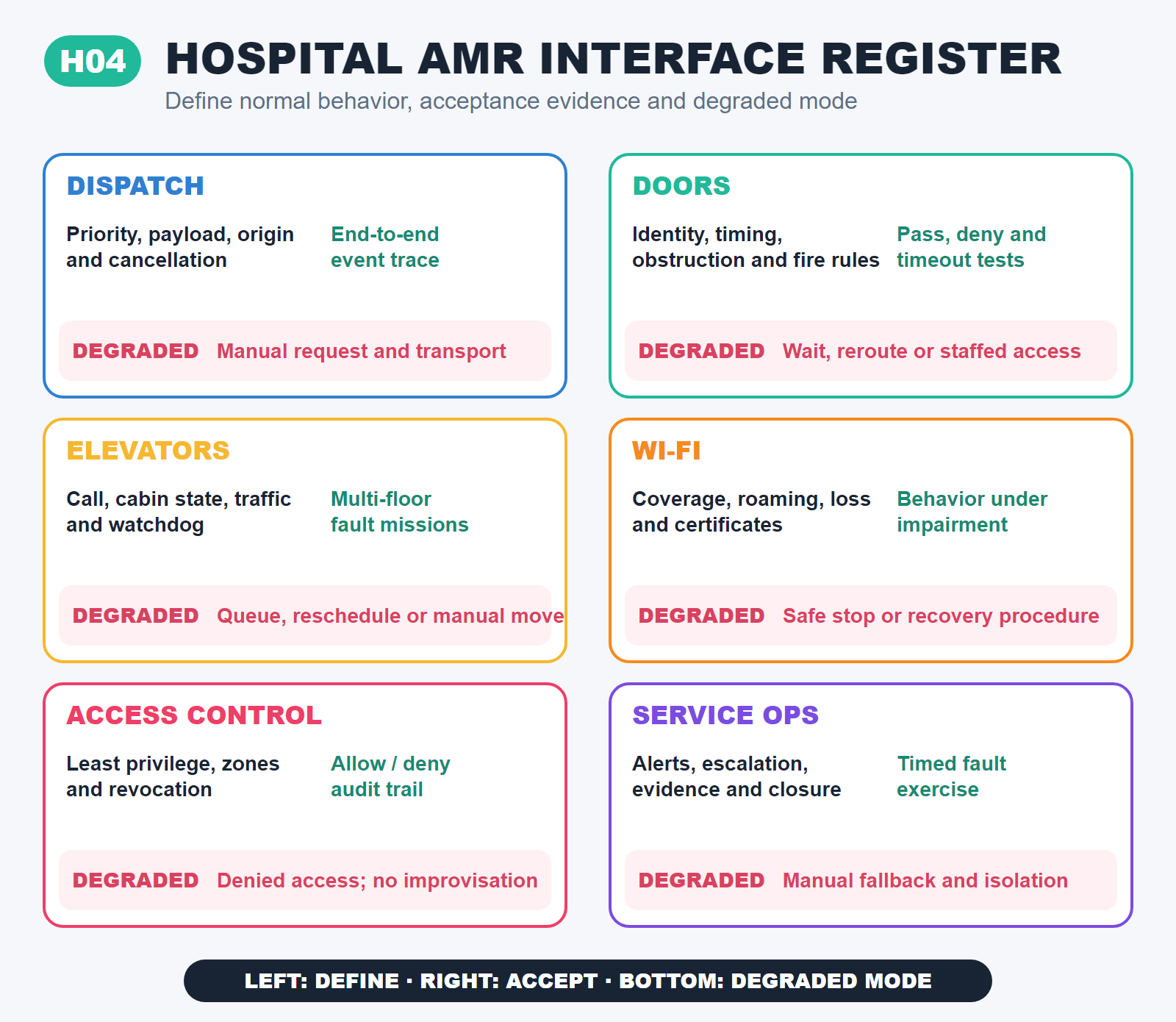
Scroll horizontally to compare all columns.
| Interface | Define | Acceptance evidence | Degraded mode |
|---|---|---|---|
| Dispatch/workflow | Request, priority, payload, origin, destination, cancellation and completion | End-to-end event trace for normal and cancelled tasks | Manual request and transport path |
| Door | Identity, command/state, timing, obstruction, access rules and fire behavior | Authorized passage plus denial and timeout tests | Wait, reroute or staffed access |
| Elevator | Call, allocation, floor, cabin state, occupancy, boarding, exit and watchdog | Multi-floor missions under realistic traffic and faults | Queue, reschedule or manual transport |
| Wi-Fi/network | Coverage, roaming, latency/loss tolerance, segmentation, certificates, DNS/time and monitoring | Route survey and application-level behavior under impairment | Safe stop, local autonomy or recovery procedure |
| Access control | Robot/device identity, least privilege, credentials, zones, schedules and revocation | Allow/deny audit trail and credential lifecycle test | Denied access without unsafe improvisation |
| Operations/service | Alerts, remote support, local response, escalation, evidence and closure | Timed fault exercise with named owners | Manual fallback and service isolation |
Doors and elevators need state, not just commands
Open-RMF provides one open technical example of coordinating robot traffic, tasks, lifts and doors across fleets and building systems. It is a useful architecture reference, not proof that a hospital's existing lift, door controller or robot is compatible.
Specify state transitions: requested, authorized, moving, open, occupied, entered, exited, released, denied, timed out and faulted. Define who owns the controller, adapter, network path, testing window, certificate, log and change. For elevators, include cabin dimensions, usable space, door timing, passenger and cart interference, priority rules and fire-service behavior.
A 2026 single-site hospital study found that elevator congestion affected delivery success, delay and staff workload in the evaluated non-urgent medication route. Use that finding to justify local measurement. Collect occupancy, wait, boarding, obstruction and mission-delay evidence across the planned operating window; do not copy the study's result into a different facility.
Engineer Wi-Fi for the application
A coverage heat map alone does not prove that the robot, fleet manager and building interfaces will behave correctly while roaming. Test the actual application across route transitions, including packet loss, latency, brief disconnection, authentication, certificate renewal, controller restart and congested periods.
NIST's WLAN guidance treats wireless security as a lifecycle responsibility covering client devices, access points and switches from design and deployment through maintenance and monitoring. The hospital, network owner and solution team should agree who owns device onboarding, configuration, monitoring, change control, incident response and retirement.
Treat the robot as an identity, not a trusted appliance
NIST's zero-trust guidance emphasizes device health, identity, risk-based access, micro-segmentation, monitoring and logging instead of trusting a device merely because it is on an internal network. Apply the principle proportionately: inventory the robot and its services, authenticate device and service identities, grant only required access, separate management and operational paths where appropriate, rotate credentials, log decisions and define revocation.
Access control should answer four questions: Which device is requesting what resource? For which workflow and time window? Under which policy? What evidence is retained when access is allowed or denied?
Specify emergency and degraded modes
Review the current AMR safety standards guide with qualified safety and facilities reviewers. Define behavior for fire alarm, emergency power, elevator recall, blocked egress, network loss, access denial, controller fault, low battery, lost localization and manual intervention. The response may be wait, stop, move to a permitted holding point, return, reroute or transfer to people; it must be designed and tested for the specific site.
Commission in layers
- Validate interface contracts in a controlled environment.
- Test each door, elevator, network zone and access rule independently.
- Run end-to-end missions in low-traffic windows.
- Add realistic people, carts, delays, denials and faults.
- Exercise monitoring, local response, remote support and manual fallback.
- Record acceptance evidence, open risks, configuration versions and owners.
Do not call the integration production-ready because one normal route completed. Acceptance needs repeatable normal behavior, bounded failure behavior and a support model that hospital teams can operate.
Sources and scope
This guide combines the cited primary sources with an editorial decision framework. It does not quote a market price, promise a result, replace a site assessment, or provide legal, financial, clinical, cybersecurity or safety advice.
- Open-RMF Demonstrations — Open-RMF project / Open Robotics
- SP 800-153: Guidelines for Securing Wireless Local Area Networks (WLANs) — National Institute of Standards and Technology
- Implementing a Zero Trust Architecture — National Institute of Standards and Technology
- Feasibility of autonomous medication delivery robots considering elevator utilization in high-traffic hospital environments — DIGITAL HEALTH / SAGE
Take the next step
Bring the route, building systems, network zones, access rules and fallback requirements into a cross-functional assessment: Assess your hospital integration scope.

Iven Wang
Iven Wang is the Co-Founder of Warpify Robotics, specializing in the commercialization and deployment of robotic solutions. With a background in electrical engineering and product management, he works with manufacturers, integrators, and enterprise clients across industrial inspection, security, logistics, and Robotics-as-a-Service.
Subscribe to our newsletter today
Get practical robotics deployment insights, case studies, and planning guidance from Warpify Robotics.