Ultimate Robot Deployment Checklist: Site, Safety & Setup
Use this robot deployment checklist to review autonomous mobile robot (AMR) site requirements, safety responsibilities, infrastructure, and integration steps.
A robot deployment checklist should prove that a defined workflow can operate safely, reliably and supportably at a real site. It should cover the robot and payload, people, routes or workcells, building and software interfaces, charging, service, exceptions, training and change control.
This checklist is a planning aid. It does not replace the manufacturer's instructions, a project-specific risk assessment, applicable standards, competent engineering or the site owner's legal and safety responsibilities.
Assign owners before site work begins
Name one owner for the workflow, operations, safety, facilities, IT or cybersecurity, integration, service and commercial acceptance. Record who can approve a route or program change, stop the system, restore manual operation and accept the final result.
Use the robotics solution assessment to freeze the initial task, payload, operating window, environment, interfaces and success criteria before selecting hardware.
Review the complete readiness boundary
Scroll horizontally to compare all columns.
| Readiness area | Questions to close | Acceptance evidence |
|---|---|---|
| Workflow and payload | What moves or is manipulated? What is excluded? Who prepares and receives it? | Approved process map, payload definition and exception list |
| Site and route | Are dimensions, floor conditions, slopes, crossings, doors, lifts, lighting, weather and traffic recorded under operating conditions? | Survey, route or workcell map and constraint log |
| Safety | Which hazards, protective measures, validation tests, signs, procedures and change triggers apply? | Risk assessment, validation record and accountable approvals |
| Power and charging | Is capacity, protection, ventilation, clearance, fire response, access and recovery defined? | Facilities sign-off and charging-area test |
| Network and security | Are coverage, latency, segmentation, identity, updates, logging, remote access and offline behavior acceptable? | Coverage survey, architecture review and recovery test |
| Integration | Are machine, conveyor, elevator, door, access-control, fleet, CMMS, WMS or other interfaces versioned and tested? | Interface control document and end-to-end test |
| Operations and service | Who loads, cleans, monitors, troubleshoots, maintains, stocks spares and escalates incidents? | SOPs, training record, service plan and contact tree |
| Acceptance and change | Which tests prove readiness, and what requires reassessment after go-live? | Acceptance matrix, baseline, rollback and change-control record |
Inspect the site under real operating conditions
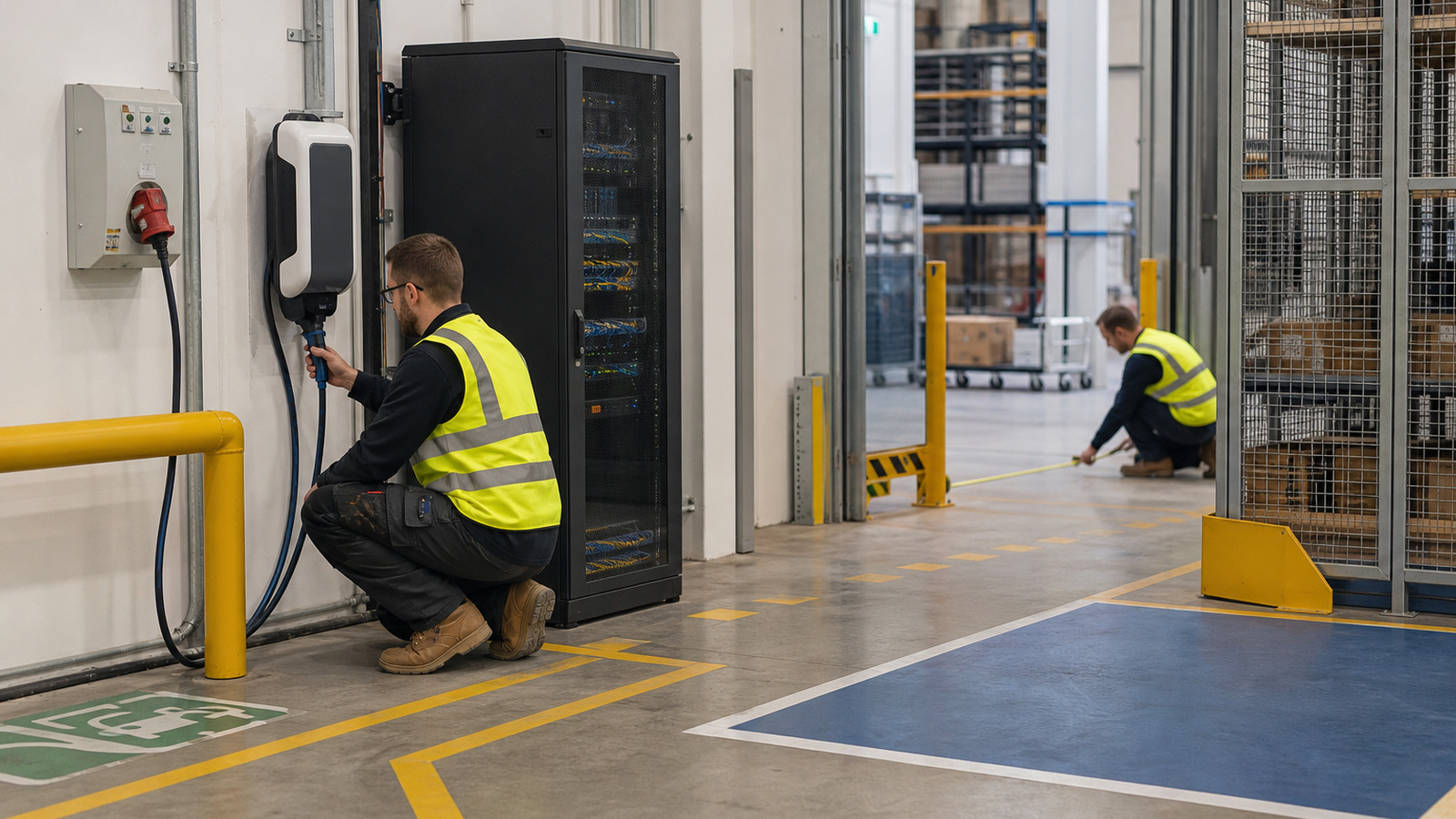
Measure clearances with the payload attached and include turning, stopping, passing and recovery space. Observe the route or workcell during busy periods. Record temporary obstructions, reflective or transparent surfaces, floor transitions, drainage, dust, heat, washdown, wireless dead zones and any emergency or accessible route that must remain clear.
Do not treat a successful empty-site demonstration as an operating acceptance test. Test representative people, traffic, loads, handoffs and failure conditions within the approved safety plan.
Define the safety lifecycle
Identify the applicable robot category, payload and application boundary. Confirm manufacturer information, integration responsibilities, protective measures, stopping and restart behavior, emergency response, lockout or isolation needs, signs and training. The AMR safety standards guide explains how ISO 3691-4 and ANSI/A3 R15.08 can inform industrial mobile robot projects.
A route, payload, speed, software, sensor, workstation or traffic change can alter risk. Define reassessment triggers before go-live.
Test infrastructure and interfaces end to end
For mobile robots, test network coverage, roaming, time synchronization, offline behavior and remote-support controls along the complete route. For every building or software interface, test normal operation, timeout, denial, duplicate command, unavailable system and manual fallback. Preserve logs that let the team reconstruct an incident.
Plan charging, service and recovery
Charging location affects workflow capacity, traffic and recovery. Confirm electrical and environmental requirements from the selected equipment, then define access, housekeeping, inspection and emergency response. Record how a depleted, faulted or immobilized unit is recovered without creating a new hazard.
Service planning should include monitoring, preventive work, spares, response and restoration expectations, customer responsibilities, software support and a route for escalating recurring faults.
Run a bounded commissioning sequence
- Verify installation, configuration and documented versions.
- Test each function in a controlled area.
- Validate hazards and protective measures.
- Test integrations and failure behavior.
- Train operators, supervisors, maintenance and local responders.
- Run representative work with defined observation and stop criteria.
- Compare results with the baseline and close open defects.
- Approve, delay or reject go-live through the recorded acceptance matrix.
Sources and limitations
- ISO 3691-4:2023 — Driverless industrial trucks and their systems
- A3 industrial robot standards catalogue, including ANSI/A3 R15.08
- U.S. OSHA robotics safety resources
Confirm the applicable edition, jurisdiction and system category with qualified reviewers.
Prepare the deployment gate
Use the checklist to identify what is ready, what needs evidence and what blocks go-live, then request a workflow and site-readiness assessment.

Iven Wang
Iven Wang is the Co-Founder of Warpify Robotics, specializing in the commercialization and deployment of robotic solutions. With a background in electrical engineering and product management, he works with manufacturers, integrators, and enterprise clients across industrial inspection, security, logistics, and Robotics-as-a-Service.
Subscribe to our newsletter today
Get practical robotics deployment insights, case studies, and planning guidance from Warpify Robotics.