RaaS Pricing Models: Monthly Fee, Usage and Outcome Structures
A practical framework for comparing monthly, usage-based, outcome-based and hybrid Robotics-as-a-Service pricing without hiding scope or risk.

Robotics-as-a-Service (RaaS) pricing is meaningful only when the fee is tied to a defined workflow, included system, service boundary and measurement unit. Start with the work and risk allocation, then compare the headline numbers inside Warpify's Robotics-as-a-Service model.
NIST defines a service level agreement as a commitment that addresses responsibilities, service scope, expected performance, reporting, resolution and termination. Those definitions belong beside the pricing schedule because a lower fee can simply move integration, downtime, exception or exit responsibilities back to the customer.
Four structures to compare
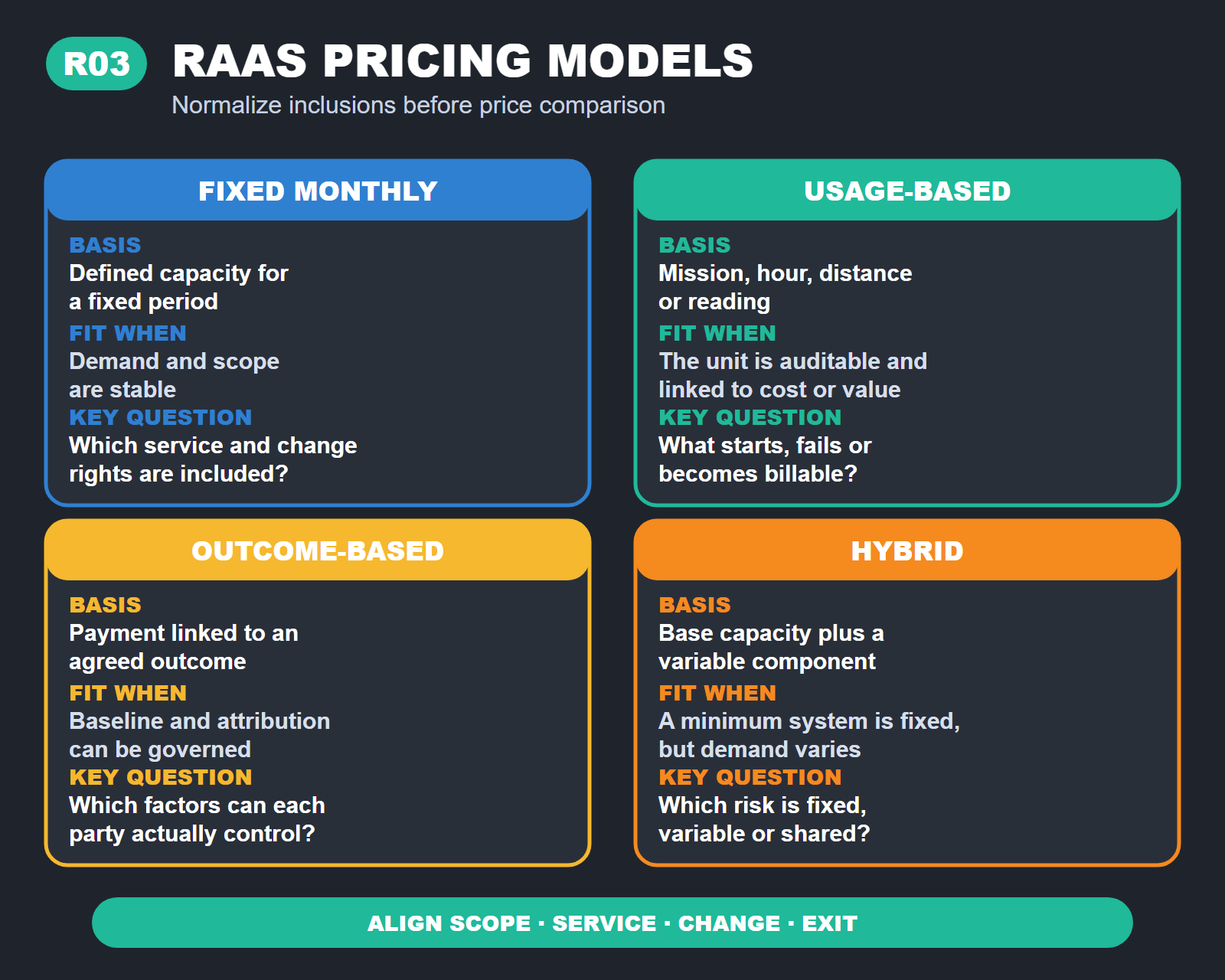
Scroll horizontally to compare all columns.
| Structure | Pricing basis | Can fit when | Main diligence question |
|---|---|---|---|
| Fixed monthly | Defined system and service capacity for a fixed period | Demand and scope are stable enough to size capacity | What capacity, service and change are included? |
| Usage-based | Measured mission, hour, distance, item, reading or other unit | The unit is observable, auditable and related to provider cost/value | What exactly starts, completes, fails or becomes billable? |
| Outcome-based | Payment linked to an agreed business or service outcome | The outcome, baseline, attribution and controllable responsibilities are clear | Which factors can each party control and how are exceptions treated? |
| Hybrid | Base capacity plus usage, service or outcome components | A minimum operating system is needed but demand or value varies | Which risk is fixed, variable or shared? |
These are contract-design options, not claims that the robotics market uses one standard. ISO/IEC 19086-1 says service agreements may vary by provider and customer and does not prescribe one universal SLA structure or set of service objectives. That cloud-specific standard is useful here only as a reminder to compare definitions and scope rather than assume uniform terms.
Fixed monthly: simplicity needs a capacity definition
A monthly fee can simplify budgeting, but the contract still needs a technical baseline. Define the number and configuration of robots, payloads, software, integrations, operating window, included missions or capacity, support, spares, refresh, site work and customer tasks. State what happens when demand exceeds capacity or the workflow changes.
Ask whether the fee changes with additional floors, routes, payloads, integrations, coverage hours, travel, consumables, taxes, currency movement or indexation. "All included" is not a billable definition.
Usage-based: choose a unit the workflow can audit
A usage model needs a measurement contract:
- unit name and business meaning;
- event that starts and completes the unit;
- treatment of cancellations, retries, failed missions and partial completion;
- included allowance, overage rate, minimum and cap;
- system of record, time zone, correction and dispute process;
- retention and access to underlying evidence.
A mission count can be easy to understand yet distort incentives if short and long missions consume very different capacity. Robot hours can be measurable yet ambiguous if waiting, charging, maintenance and blocked time are treated differently. Select the unit after modelling the workflow.
Outcome-based: price only what can be defined and governed
Outcome pricing may align incentives, but it requires a baseline, denominator, measurement window, data owner, exclusions, attribution method, customer responsibilities and change process. Separate provider-controlled service from customer-controlled demand, site access, payload readiness, staffing and downstream decisions.
Do not convert robot capacity into realized throughput or a completed mission into a clinical, production or financial outcome. If multiple systems and teams determine the result, a hybrid structure with measurable service inputs may be easier to govern.
Normalize every proposal
Use the same baseline and the current robot ROI and TCO model:
Comparable period cost = implementation + fixed fees + expected usage charges + customer-retained operating costs + expected exception costs + change/exit costs.
GAO's cost guide recommends a common technical baseline, documented assumptions, sensitivity analysis and updates with actual costs when alternatives are compared. Apply that discipline to a RaaS, purchase and lease comparison without treating any forecast as a guaranteed outcome.
Run three demand and service cases
Test downside, base and upside cases for eligible demand, completed units, operating hours, integration scope, mission exceptions, support coverage, spares, site work, software/hardware refresh, indexation and exit. Show both the customer's total cost and the provider obligations that change in each case.
Questions procurement should resolve
- Which legal entity supplies hardware, software, integration and service?
- What is included, optional, metered, customer-provided or third-party?
- Which events are billable and which are excluded?
- How do service levels, credits and chronic failures affect charges?
- Who owns data, configurations and integrations?
- How can scope, volume and prices change?
- What happens at renewal, early termination, transition and end of support?
Qualified legal, finance, accounting and tax reviewers should evaluate the actual agreement in its jurisdiction. This framework organizes the questions; it does not supply those conclusions.
Sources and scope
This guide combines the cited primary sources with an editorial decision framework. It does not quote a market price, promise a result, replace a site assessment, or provide legal, financial, clinical, cybersecurity or safety advice.
- Cost Estimating and Assessment Guide: Best Practices for Developing and Managing Program Costs — U.S. Government Accountability Office
- Service level agreement (SLA) — CSRC Glossary — National Institute of Standards and Technology
- ISO/IEC 19086-1:2016 Cloud computing — SLA framework — Overview and concepts — International Organization for Standardization
- Cloud Computing: Agencies Need to Incorporate Key Practices to Ensure Effective Performance — U.S. Government Accountability Office
Related planning: Test each pricing structure against the robot SLA definitions and the RaaS responsibility matrix before comparing headline fees.
Take the next step
If you can define demand, service window, integrations, exceptions and operating ownership, use that baseline to compare commercial structures: Assess your workflow and commercial model.

Iven Wang
Iven Wang is the Co-Founder of Warpify Robotics, specializing in the commercialization and deployment of robotic solutions. With a background in electrical engineering and product management, he works with manufacturers, integrators, and enterprise clients across industrial inspection, security, logistics, and Robotics-as-a-Service.
Subscribe to our newsletter today
Get practical robotics deployment insights, case studies, and planning guidance from Warpify Robotics.