Designing Autonomous Inspection Routes, Read Points and Exception Handling
A practical method for defining autonomous inspection routes, measurement read points, data quality, exceptions, acceptance tests and change control.
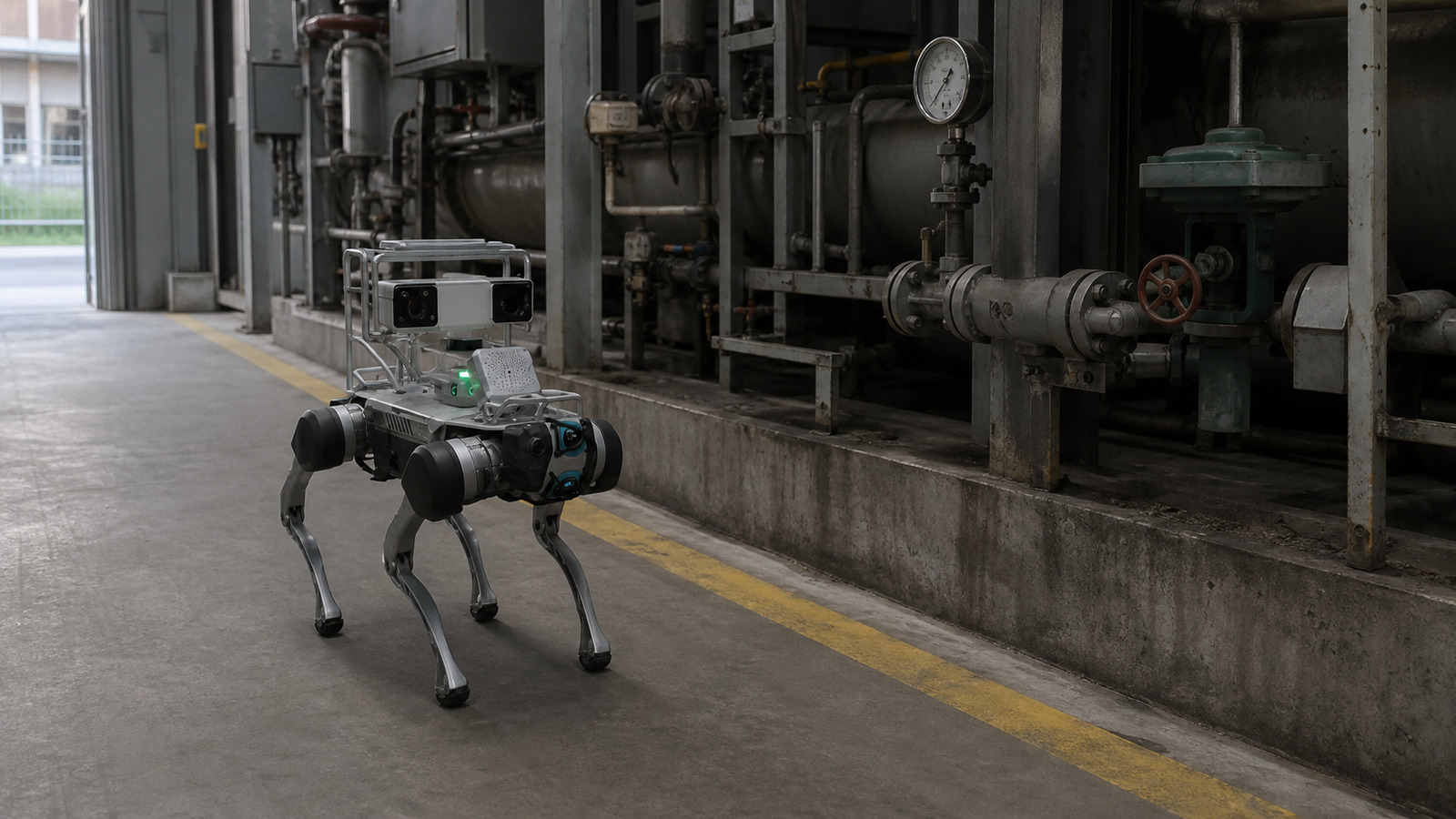
An autonomous inspection route is not a sequence of map waypoints. It is a versioned agreement between reliability, inspection, operations, safety, IT and the robotics system: which assets to visit, what to measure, where and how to read it, what evidence counts, and what happens when the normal mission cannot be completed. That route contract anchors industrial inspection robotics solutions to a real maintenance decision.
Start with the existing manual round and the decision it supports. Preserve the asset hierarchy, measurand, limits, review and escalation logic before changing how data is collected.
Build a route graph around assets and decisions
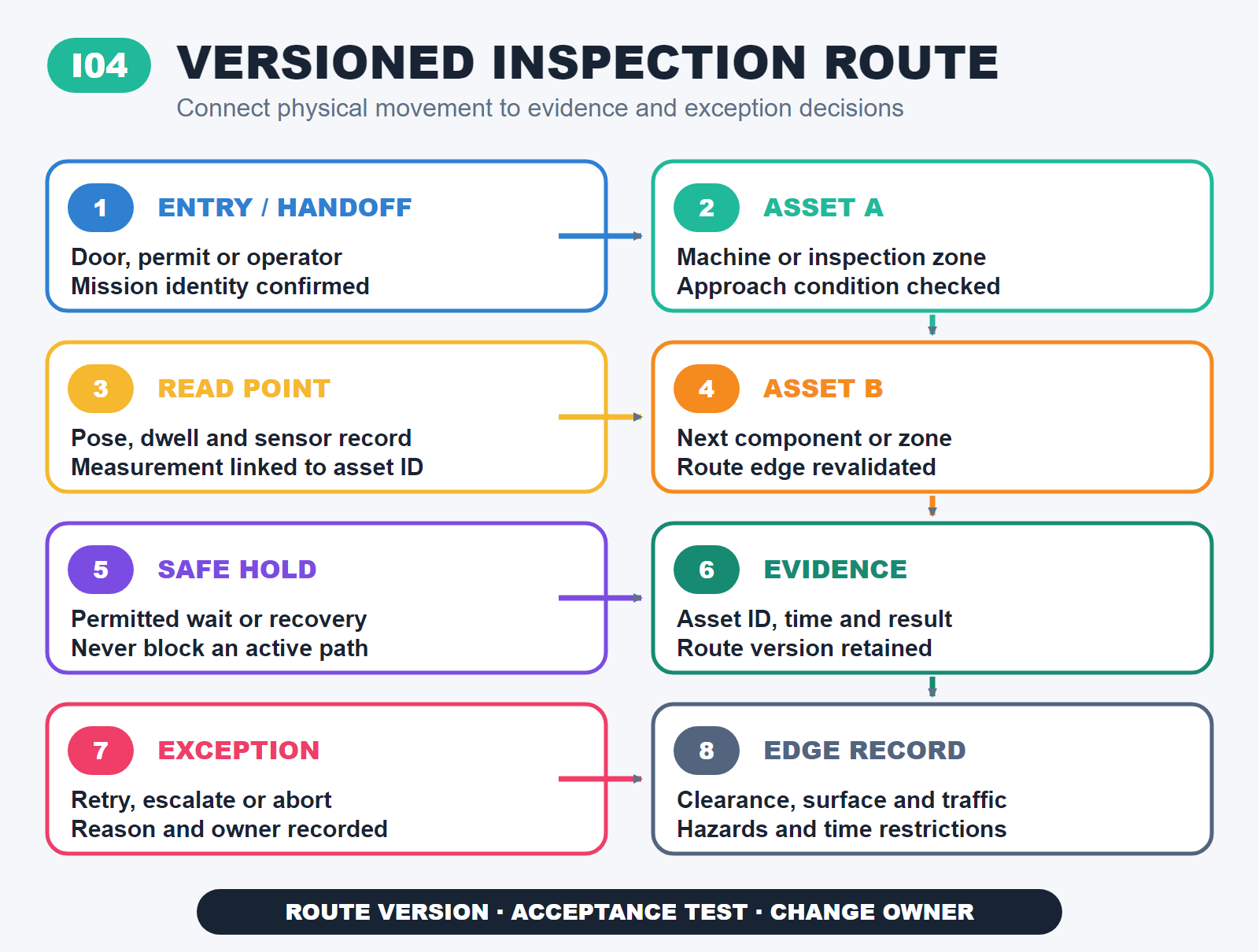
Use the current industrial inspection deployment guide to map access and operating constraints. Represent the route as connected nodes and edges:
- asset nodes identify the machine, component or inspection zone;
- read-point nodes define the measurement position and evidence;
- handoff nodes cover doors, gates, lifts, charging or operator actions;
- safe holding nodes define permitted wait or recovery locations;
- edges record direction, clearance, surface, traffic, slope, hazards and time restrictions.
Version the graph. A moved barrier, new machine, changed access rule or altered sensor mount can invalidate a previously accepted route.
Specify each read point as a measurement task
Scroll horizontally to compare all columns.
| Field | Question to answer |
|---|---|
| Asset identity | Which asset and component does this record belong to? |
| Measurand | What physical or visual condition is being observed? |
| Payload/configuration | Which sensor, lens, range, calibration and protective hardware apply? |
| Approach and pose | Where must the robot stop; at what orientation, height and distance? |
| Environment | Which lighting, temperature, vibration, steam, dust, background or access conditions matter? |
| Acquisition | How long to dwell; how many samples; what focus, field of view or stabilization is required? |
| Quality gate | What makes the reading valid, invalid or uncertain? |
| Decision and evidence | Who reviews it, which rule is applied, and what record is retained? |
NIST's manufacturing monitoring work emphasizes sensing, data infrastructure, analytics, metrics, and verification and validation as foundations for trusted diagnostic decisions. A robot reaching the waypoint is therefore only one part of acceptance.
ISO 13374-1 establishes general guidance for software that processes, communicates and presents machine-condition monitoring and diagnostic information. Use that boundary to keep acquisition, transformation, context, decision and presentation traceable even when the robot vendor, sensor platform and maintenance system are different.
Separate navigation, read and diagnostic outcomes
A mission can navigate successfully and still produce an invalid read. It can collect a valid observation that is never attached to the right asset. It can generate an alarm that no one reviews. Define separate evidence for:
- route completion and travel behavior;
- read-point arrival and pose tolerance;
- sensor acquisition and data-quality checks;
- asset/time/configuration association;
- review, decision, escalation and closure.
NIST IR 8177 illustrates that robot evaluation can separate job execution time, travel time, position accuracy, repeatability, energy and network behavior instead of relying on one aggregate success number. Choose a small set of route-specific measures with clear definitions and denominators.
Design the exception taxonomy before autonomy
Scroll horizontally to compare all columns.
| Exception family | Examples | Required decision |
|---|---|---|
| Navigation | Blocked edge, localization loss, unsafe clearance, changed surface | Retry, reroute, wait, stop or recover |
| Read point | Occlusion, glare, blur, out-of-pose, contaminated sensor | Reacquire, change pose, defer or request human read |
| Asset | Asset missing, moved, isolated, operating in a prohibited state | Skip with reason, stop route or escalate |
| Data/communications | Timestamp, identity, upload, storage or interface failure | Buffer, retry, quarantine or invalidate |
| Safety/site | Alarm, restricted work, spill, traffic or access denial | Enter the approved degraded mode |
| Workflow | Reviewer unavailable, alarm unacknowledged, maintenance system rejected record | Escalate, retain evidence and close manually |
Every exception needs a detector, first response, escalation owner, maximum dwell, manual fallback, evidence record and closure code. Do not let an operator invent a recovery step during a hazardous or time-sensitive event.
Build the acceptance plan in layers
- Validate asset IDs, payload configuration and data flow off the route.
- Accept each read point under controlled environmental conditions.
- Accept route segments, transitions and holding locations.
- Run end-to-end missions in representative operating windows.
- Inject blocked paths, invalid reads, network loss and access denial.
- Exercise review, alarm, escalation, manual fallback and service recovery.
- Compare evidence to the current manual process and decision need.
Use the deployment readiness checklist to assign site, safety, integration and operating owners. Acceptance should end with a go, revise or stop decision for the defined route and version.
Operate the route as a controlled configuration
Record route version, map version, robot software, payload, calibration, asset registry, access rules, thresholds and reviewer workflow. Trigger review when the facility, equipment, route, payload, software, network or inspection method changes. A route that once worked is not permanently valid.
Related planning: Convert the accepted route demand into an inspection robot fleet-sizing model that accounts for travel, charging, exceptions and recovery.
Sources and scope
This guide combines the cited primary sources with an editorial decision framework. It does not quote a market price, promise a result, replace a site assessment, or provide legal, financial, clinical, cybersecurity or safety advice.
- Monitoring, Diagnostics and Prognostics for Manufacturing Operations — National Institute of Standards and Technology
- ISO 13374-1:2003 Condition monitoring and diagnostics of machines — General guidelines — International Organization for Standardization
- NIST IR 8177: Metrics and Key Performance Indicators for Robotic Cybersecurity Performance Analysis — National Institute of Standards and Technology
- Industrial Robot Systems and Industrial Robot System Safety — U.S. Occupational Safety and Health Administration
Take the next step
Bring a current route, asset list, measurement needs and exception log into a site-specific assessment: Assess an inspection route.

Iven Wang
Iven Wang is the Co-Founder of Warpify Robotics, specializing in the commercialization and deployment of robotic solutions. With a background in electrical engineering and product management, he works with manufacturers, integrators, and enterprise clients across industrial inspection, security, logistics, and Robotics-as-a-Service.
Subscribe to our newsletter today
Get practical robotics deployment insights, case studies, and planning guidance from Warpify Robotics.