Inspection Robot Fleet Sizing: Route Frequency, Coverage and Redundancy
A transparent inspection-fleet sizing method based on route demand, usable capacity, concurrency, configuration, service, evidence flow and resilience.

Inspection robot fleet sizing is a capacity and resilience problem, not a rule of thumb. The right starting point is the work: which routes must run, how often, in which operating windows, with what sensor dwell, and what happens when a route, robot, charger, network or reviewer is unavailable.
Build the demand model before requesting a fleet quote. Connect it to the existing industrial inspection robotics solution, site constraints and evidence workflow. A platform can have enough theoretical runtime yet still miss the required inspections because travel, charging, blocked routes, data upload, maintenance and exception recovery consume the operating window.
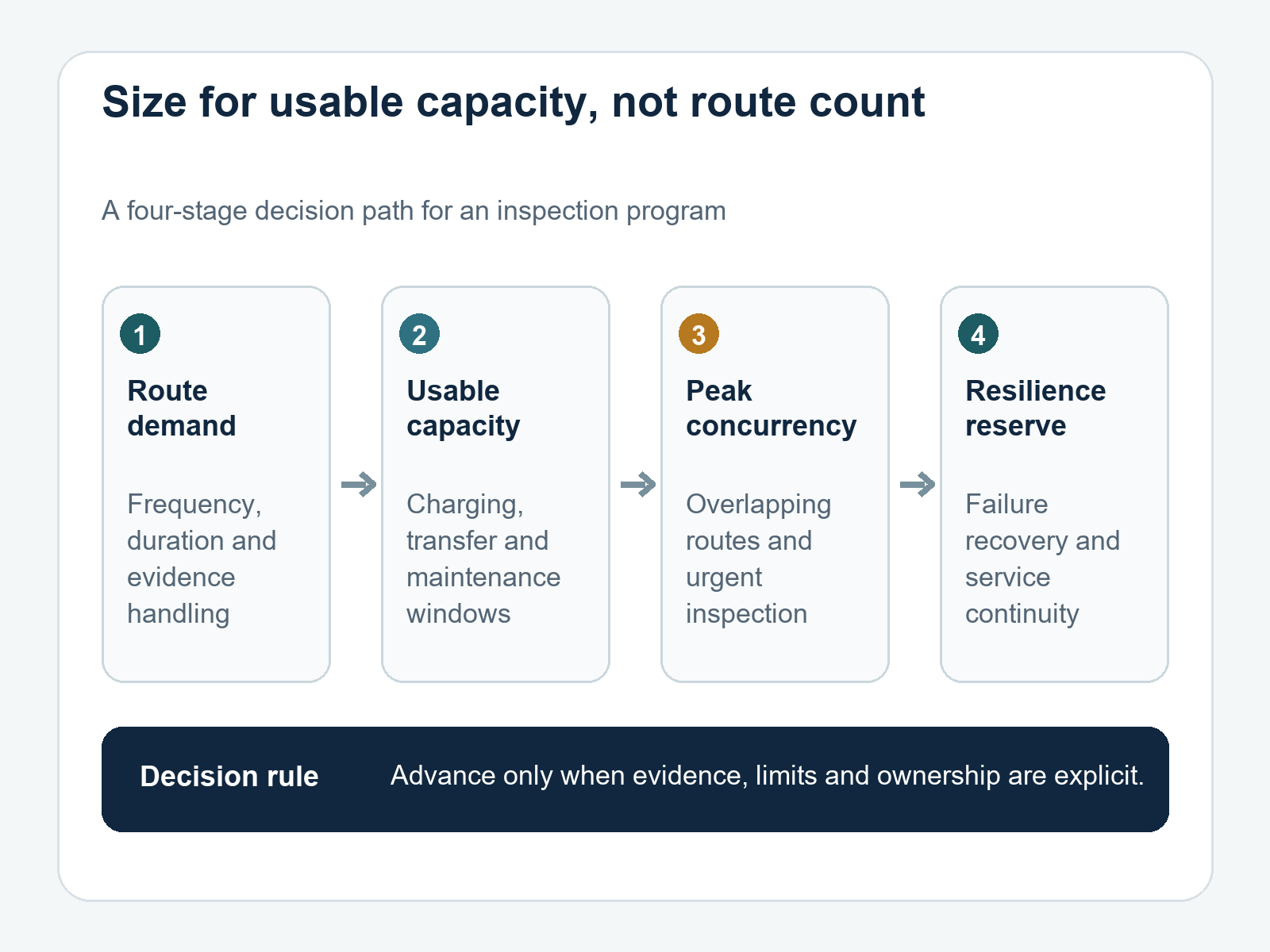
Convert the inspection program into route demand
List every proposed route and version. For each, record the assets and read points, required frequency, allowable start window, route travel time, sensor dwell, door or lift handoffs, data-transfer needs and human-dependent steps. Use representative measurements from the site rather than brochure speed or battery figures.
A simple daily workload model is:
Route demand = travel + read-point dwell + handoffs + data handling + expected exception time.
Sum that demand only across routes that can share the same robot configuration. A thermal route and a gas route may require different payloads, approvals or calibration states. Treat a configuration change as real work with time, tools, verification and risk—not as zero-time flexibility.
Keep route time and usable capacity separate
Define an operating period such as a shift or day. Estimate usable capacity per robot from validated mission time, charging and docking, planned service, required inspections, software or data tasks, and the site’s allowed operating windows.
A planning equation can be expressed as:
Base robots = eligible route demand ÷ usable robot capacity.
Round the result up, then test it against concurrency and recovery. This modelled scenario is an editorial planning method, not a measured result or performance promise. Every input should be measured, quoted with its source, or labelled as an assumption.
Do not apply a generic utilization target. A high average utilization may leave no room for route variation or faults. A low average may be intentional when inspections occur in narrow, overlapping windows.
Model concurrency, not just total hours
Two hours of demand spread across a day is different from two hours that must occur during the same process window. Place routes on a timeline. Mark access windows, high-traffic exclusions, equipment operating states, environmental constraints and review deadlines.
Ask:
- Which routes must run at the same time?
- Which routes need the same payload or certified configuration?
- Can a delayed route move to another window without losing decision value?
- Can robots safely share charging, doors, lifts, narrow paths and network coverage?
- Do data review and maintenance teams have matching capacity?
The fleet must satisfy the peak feasible schedule, not only the daily total.
Separate five capacity layers
- Mission capacity: travel, sensing, handoffs and safe holds.
- Energy capacity: validated mission energy, reserve, docking and charging.
- Configuration capacity: payload, calibration, cleaning and approval state.
- Service capacity: inspection, preventive maintenance, repairs and spares.
- Evidence capacity: upload, processing, human review, alarm acknowledgement and closure.
A bottleneck in any layer can cap the program. Adding robots does not fix a single charger, a reviewer backlog, poor wireless coverage or an asset registry that cannot accept the records.
Use measured performance categories
NIST’s current mobile-robot performance work emphasizes task efficiency, task-completion quality and assurance alongside mobility and tracking. Its earlier robotics metrics work also illustrates the value of separating job execution, travel, energy and network measures rather than relying on one aggregate result. For inspection operations, build a small metric set around the actual decision.
Useful pilot measures may include:
- eligible routes completed within their windows;
- valid read points acquired on the first attempt;
- travel, dwell, handoff and recovery time by route;
- energy used and reserve at mission completion;
- dock success and time unavailable for charging;
- exceptions requiring remote or on-site intervention;
- review queue age and alarm closure time.
Define denominators. “Ninety percent success” is ambiguous unless the team knows whether it refers to missions, route segments, read points, uploads, alarms or maintenance decisions.
Add resilience deliberately
Base capacity answers the normal case. A production plan also needs a resilience policy. Identify credible failures: robot unavailable, charger offline, payload awaiting calibration, route blocked, network degraded, operator unavailable or critical inspection added.
Choose a response for each:
- move the route within its valid window;
- assign it to a compatible robot;
- use a manually executed fallback;
- defer with an approved risk decision;
- hold a spare robot or spare payload;
- stop the affected inspection program.
A blanket “one spare robot” rule may be too much or too little. Tie redundancy to route criticality, repair time, configuration compatibility and fallback feasibility.
Run three planning scenarios
Use downside, base and upside scenarios. The downside case should include slower route execution, more reacquisitions, reduced operating windows and longer maintenance. The base case should use representative pilot evidence. The upside case may test improved routing or review flow, but should not be used as the only procurement basis.
For each scenario, show route coverage, missed windows, robot utilization by activity, reviewer workload and fallback demand. The objective is not maximum robot use; it is reliable delivery of valid inspection evidence.
Know when the fleet model is not ready
Do not size the fleet from an asset count alone. Pause when routes and read points are undefined, sensor dwell is untested, process windows are unknown, charging has not been validated, payload compatibility is unresolved, service times are unavailable or exception handling depends on unassigned people.
Use the current industrial inspection deployment guide and robot TCO model to connect fleet size with site readiness and commercial assumptions.
Related planning: Build each fleet scenario from a controlled inspection route, read-point and exception design rather than from nameplate runtime alone.
Sources and scope
This article provides a transparent planning method. It does not quote a product runtime, utilization target, staffing reduction, ROI or Warpify deployment outcome.
- Mobility Performance of Robotic Systems — National Institute of Standards and Technology
- NIST IR 8177: Metrics and Key Performance Indicators for Robotic Cybersecurity Performance Analysis — NIST
Take the next step
Bring route versions, operating windows, pilot times and fallback rules into a scenario review: request an industrial inspection assessment.

Iven Wang
Iven Wang is the Co-Founder of Warpify Robotics, specializing in the commercialization and deployment of robotic solutions. With a background in electrical engineering and product management, he works with manufacturers, integrators, and enterprise clients across industrial inspection, security, logistics, and Robotics-as-a-Service.
Subscribe to our newsletter today
Get practical robotics deployment insights, case studies, and planning guidance from Warpify Robotics.