How a Malaysian Hospital Released 38 Staff-Hours per Day With Four Hospital AMRs
This case study documents a real Warpify customer deployment in Malaysia. Identifying details are withheld; four hospital AMRs completed 216 daily missions and released approximately 38 staff-hours, while financial results were calculated separately from confidential commercial inputs.
Project at a glance
Scroll horizontally to compare all columns.
| Area | Project summary |
|---|---|
| Facility | 320-bed private tertiary hospital operating across 13 floors |
| Robotic scope | Four hospital logistics autonomous mobile robots serving 11 destination floors plus the central logistics level |
| Approved workflows | Clean linen, routine ward supplies and locked non-controlled medication replenishment |
| Recorded stabilized result | 216 completed missions per day, 96.9% task completion and approximately 38.2 staff-hours released per day |
| Financial result | Modelled first-year cost recovery in approximately 12.6 months; recurring hard-savings ROI of approximately 17.6% |
| Warpify scope | Workflow measurement, fleet sizing, robot and cart selection, site readiness, lift and door integration, infection-control design, training, pilot optimization, KPI governance and commercial modelling |
The business problem was not a lack of effort. Porters, pharmacy assistants, ward attendants and sometimes nurses were spending paid time walking, waiting for lifts and moving routine supplies between departments. The hospital wanted to release that capacity without removing existing roles or assigning clinical judgment to a robot.
Operational context and decision: automate transport, not care
The assessment separated repetitive, schedulable movement from work that needed urgent handling, clinical judgment or stricter controls. Patients, blood products, controlled drugs, infectious specimens, urgent medication, soiled linen, clinical waste and emergency movements stayed outside the robotic workflow.
This boundary mattered more than the robot's maximum payload or speed. A hospital AMR solution has to fit the building, the payload, the lift system, handover ownership, infection-control rules, network coverage and manual fallback.
Baseline workflow and measurement boundary
During the assessment, the project team recorded 486 daily internal material movements. After excluding urgent, irregular, high-risk and low-volume journeys, 223 dispatches per day were classified as suitable for the pilot.
The released-time calculation counted only employee transport time that no longer had to be performed after a completed robotic handoff. Loading, receiving, payload verification and exception work remained human responsibilities.
Constraints, exclusions and responsibilities
Human staff retained payload verification, secure handover, infection-control decisions, exception response and clinical judgment. The robots were limited to approved routes, carts and service windows.
The documented robotic workflow and verified scope
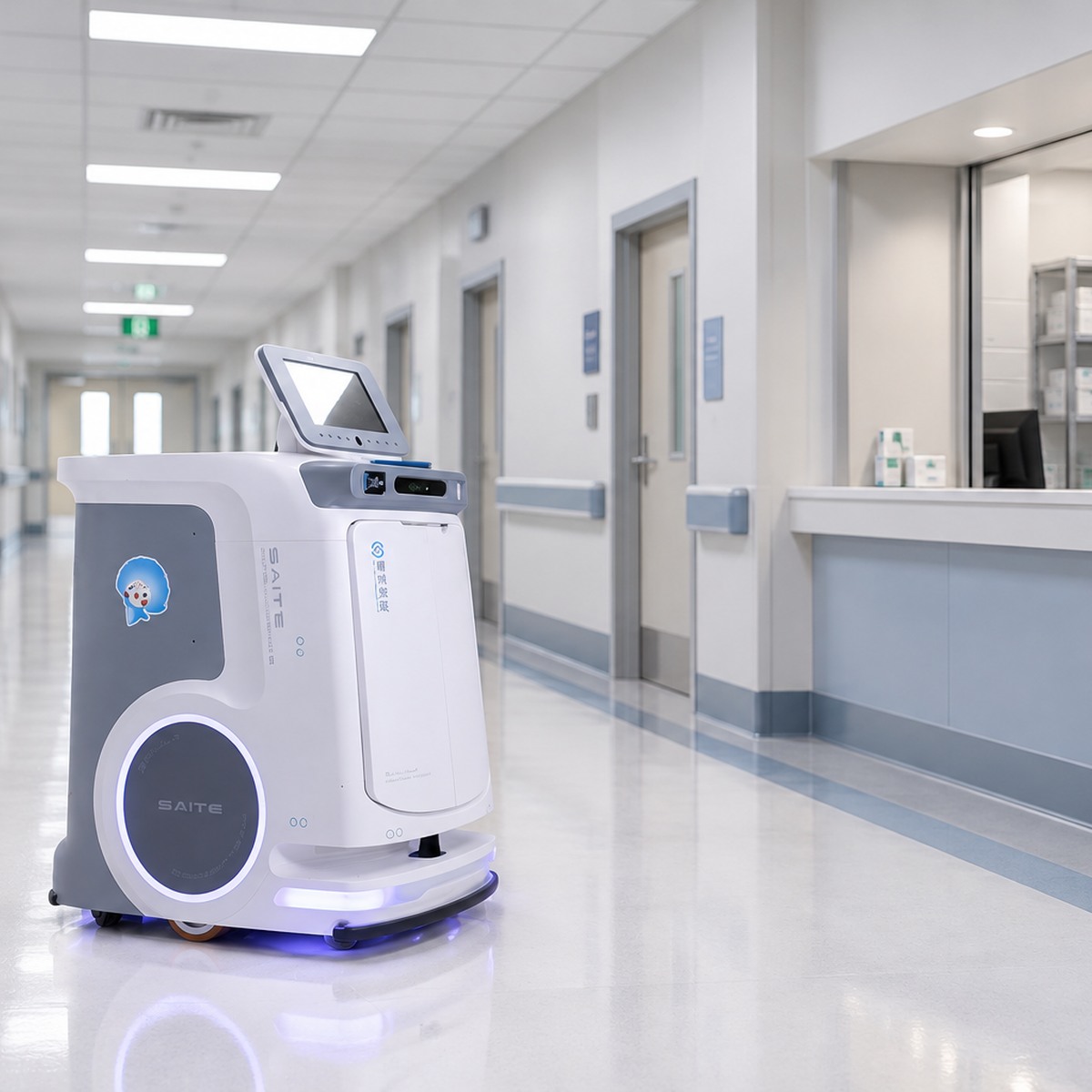
Warpify structured three controlled workflows around a generic hospital-grade under-cart AMR fleet. Public copy intentionally omits the manufacturer, product name, model number and commercial schedule.
- Clean linen: sealed carts moved from clean storage to fixed ward handover points and never entered soiled-linen areas.
- Routine ward supplies: standardized carts carried approved non-urgent consumables using department, cart, destination and timestamp identifiers rather than patient data.
- Medication replenishment: locked carts moved routine non-controlled medication between pharmacy dispatch and authorized ward handover zones. Controlled, urgent, cold-chain and patient-specific exceptions remained manual.
The hospital applied a 180-kilogram operating load cap and used carts no wider than 78 centimetres. Those limits were operating controls for this site, not universal hospital AMR specifications.
What Warpify had to solve beyond robot selection
Lift and corridor capacity
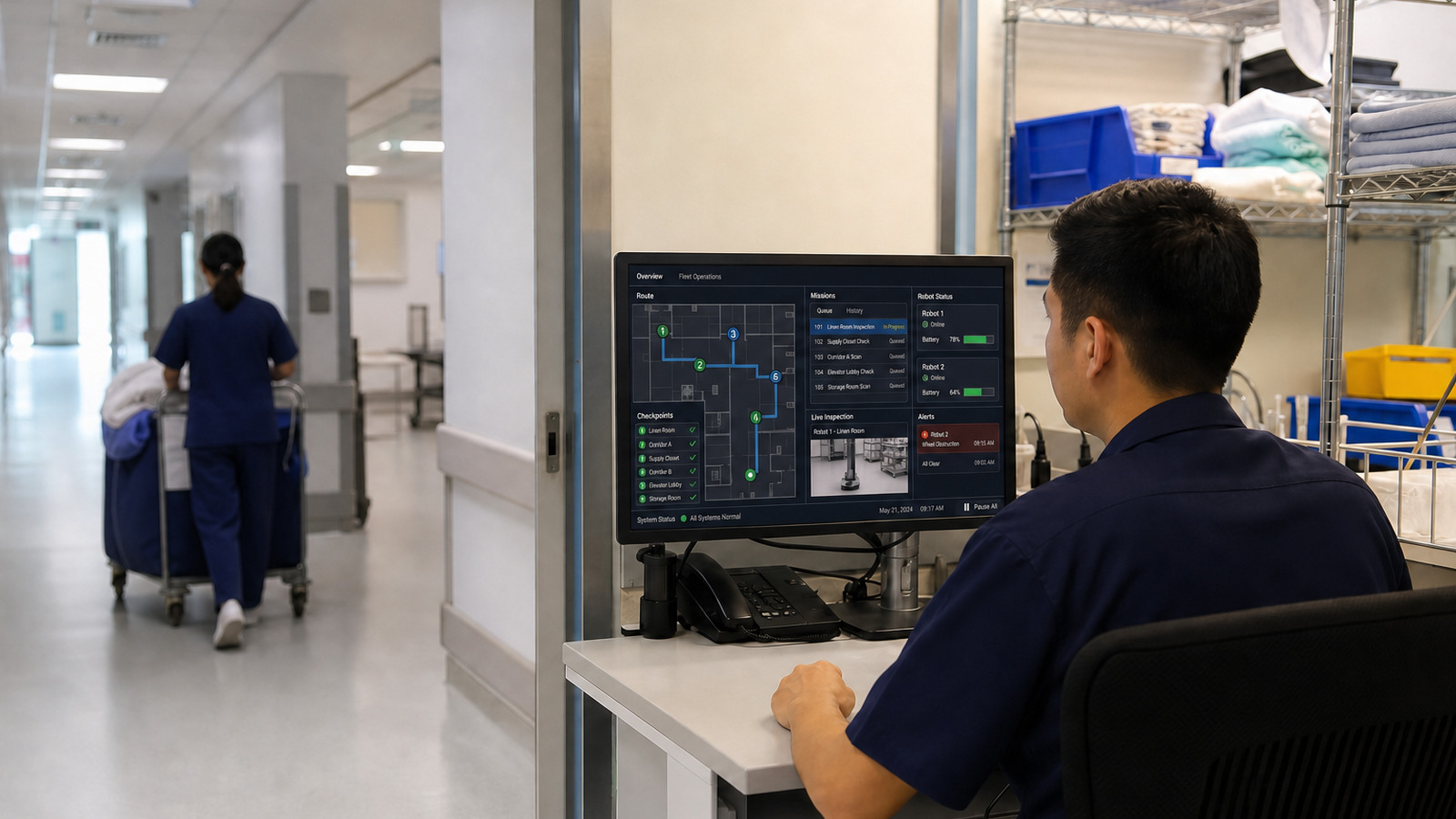
A service-elevator bank was integrated with the fleet manager. Patient transport and emergencies retained priority. Lower-priority missions waited at their origins rather than creating a queue in the lift lobby.
Infection-control ownership
Separate cart classes, cleaning schedules, handover rules and quarantine procedures kept approved clean workflows apart from soiled and regulated streams. Malaysia classifies pathogenic and clinical waste as scheduled waste SW404, so that work remained excluded.
Privacy and cybersecurity
Mission records used operational identifiers and timestamps; patient names and diagnoses were not needed for navigation. Health information is sensitive personal data under Malaysia's Personal Data Protection Act, so data minimization reduced exposure and simplified review.
Manual fallback
Hospital logistics could not stop during a network, lift-control or maintenance event. Staff retained trained manual procedures, and robots moved to defined safe waiting locations during abnormal conditions.
What changed during the 12-week pilot
The pilot included baseline observation, mapping, integration, controlled validation, live shifts and optimization. Early friction became operating evidence:
- Lift-aware dispatch reduced average lift waiting from 6.1 to 3.4 minutes.
- Marked parking bays and route-health checks reduced manual intervention from 4.6 to 1.9 events per 100 missions.
- A two-stage receiving confirmation reduced median locked-cart handover waiting from 4.2 to 1.3 minutes.
- Quiet zones and scheduled sound profiles resolved four minor sound-related comments.
Three low-speed contacts occurred during controlled route validation. No injury, load loss or equipment damage was reported. The events led to larger clearance margins and revised parking rules rather than being omitted from the account.
Recorded operational results
Scroll horizontally to compare all columns.
| Metric | Result | Status |
|---|---|---|
| Completed missions | 216 per day | Project-recorded; checked by the approving reviewer |
| Task completion | 96.9% | Verified calculation from 216 completed of 223 attempted missions |
| Staff time released | Approximately 38.2 hours per day | Verified calculation from checked project inputs |
| On-time routine delivery | 82% to 95% | Project-recorded; checked by the approving reviewer |
| Unplanned nurse retrieval trips | 41 to 13 per day | Project-recorded; checked by the approving reviewer |
| Fleet availability | 98.1% during the service window | Project-recorded; checked by the approving reviewer |
How the 38 staff-hours were calculated
216 completed missions per day 脳 10.6 employee minutes released per completed mission = 2,289.6 minutes, or 38.16 staff-hours per day.
Across 365 operating days, the calculation produces approximately 13,928 released hours. The project model allocated 12,950 productive hours to avoid seven planned support hires. The remaining capacity stayed available for exceptions, stock checks, training and faster response; it was not counted as a headcount reduction.
Financial model, formulas and data quality without disclosing the price
The confidential model includes the four-robot Robotics-as-a-Service subscription, fleet software, support, mapping, lift integration, cart engineering, commissioning and training. Exact product pricing and commercial terms are deliberately excluded from public copy.
The model counts only budget-realizable hard savings: avoided planned support hiring and reduced after-hours runner spending. It assigns no cash value to faster nursing response, traceability, lower physical strain, innovation visibility or retained service capacity.
The previously published 12.6-month stabilized payback label is corrected here. The 12.6-month figure includes first-year integration and commissioning, so it is a first-year cost-recovery period, not a steady-state payback.
Sensitivity and break-even conditions
Scroll horizontally to compare all columns.
| Scenario | Hard-savings realization | First-year cost recovery | Recurring hard-savings ROI |
|---|---|---|---|
| Downside | 85% of base | Approximately 14.8 months | Approximately -0.1% |
| Base | 100% of base | Approximately 12.6 months | Approximately 17.6% |
| Upside | 115% of base | Approximately 10.9 months | Approximately 35.2% |
Recurring break-even occurs when approximately 85.1% of the base hard savings are realized. Recovering all first-year cost within 12 months requires approximately 104.7% of the base hard-savings case. This is why the project should be governed through monthly utilization, staffing and service reviews rather than treated as a promise of return.
Outcome drivers and limitations
Mission completion, minutes genuinely released per mission, the hospital's ability to avoid planned hiring, lift integration cost and recurring support scope have the largest financial effect. A hospital with lower transport volume, incompatible lifts, unstable Wi-Fi, unclear infection-control ownership or a high share of urgent payloads may not reproduce this outcome.
The case does not prove that released time becomes cash automatically. It does not price clinical quality, staff retention, incident reduction or brand value. It also does not establish that four robots are appropriate for another 320-bed hospital.
Evidence and sources
The external context uses official Malaysian sources for minimum wage, working hours, employer contribution rules, private-hospital capacity, clinical-waste classification and personal-data obligations, plus the official ISO page for ISO 3691-4:2023. Project-level operational metrics and financial calculations were checked by the approving reviewer; exact project records and commercial terms remain confidential.
What a real hospital site assessment should verify
- Transport demand by hour, department, payload and urgency
- Lift, door, corridor, charging and network compatibility
- Loading, receiving, cleaning and exception ownership
- Manual fallback and emergency priority
- Measured staff touch time and budget that can actually be avoided
- Purchase, financing and RaaS economics using confidential supplier terms
Next step: assess your hospital workflow
See Warpify's Hospital AMR solution scope for the deployment building blocks, then book a hospital AMR feasibility assessment to test workflow fit, site readiness and a confidential business case for your facility.

Iven Wang
Iven Wang is the Co-Founder of Warpify Robotics, specializing in the commercialization and deployment of robotic solutions. With a background in electrical engineering and product management, he works with manufacturers, integrators, and enterprise clients across industrial inspection, security, logistics, and Robotics-as-a-Service.
Subscribe to our newsletter today
Get practical robotics deployment insights, case studies, and planning guidance from Warpify Robotics.