Specimen Transport by Hospital AMR: Packaging, Handoffs and Escalation
A hospital AMR specimen-transport workflow covering packaging boundaries, verified custody, time evidence and exception escalation.
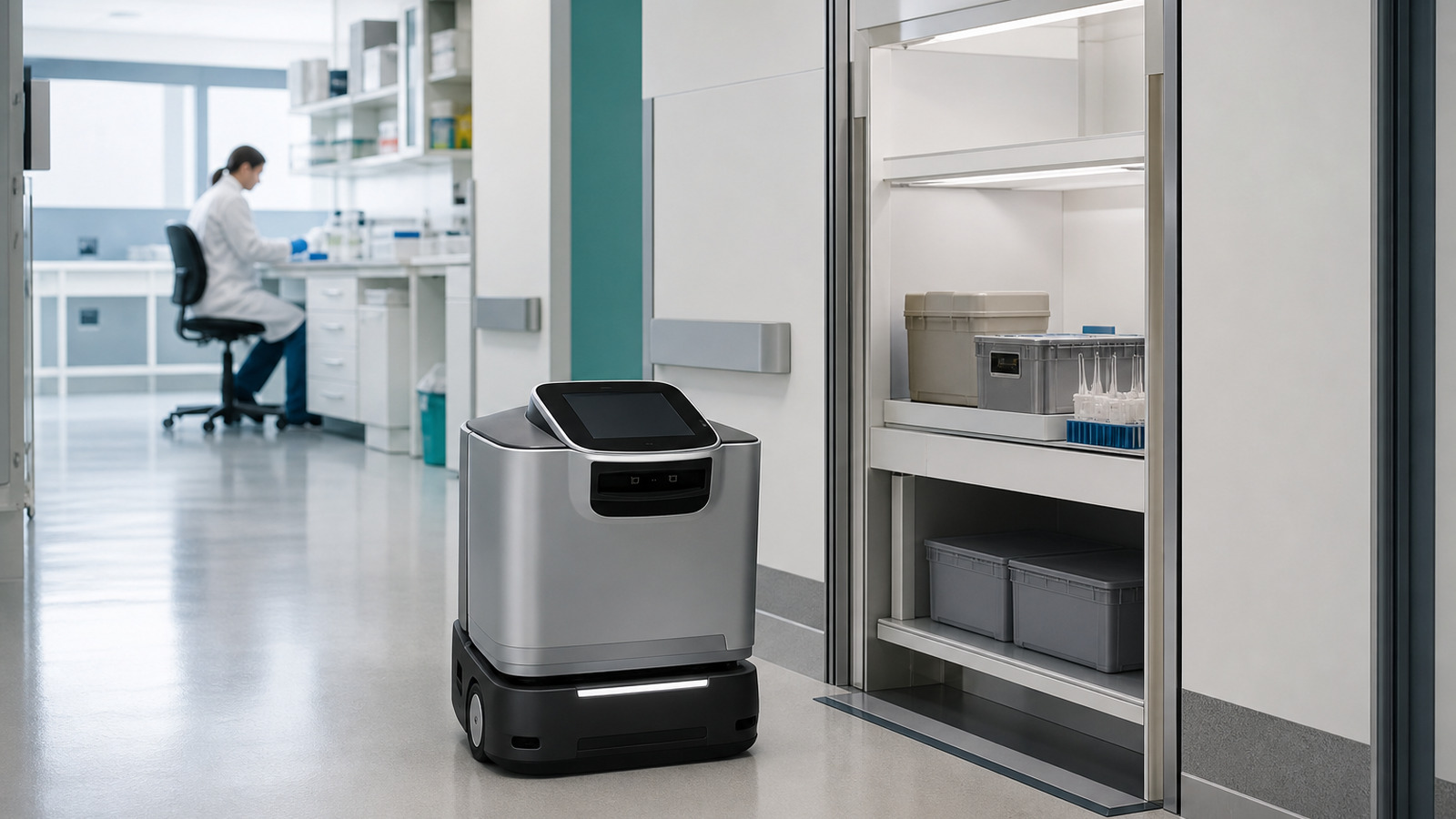
Specimen transport by hospital AMR is a controlled handoff process, not merely a corridor trip. The workflow must preserve approved packaging, specimen identity, custody, elapsed-time evidence and safe exception handling from collection point to laboratory receipt.
The AMR should transport only the specimen classes and containers approved by the hospital’s laboratory, infection-prevention, safety and compliance teams. Applicable packaging, transport and chain-of-custody requirements vary by specimen, hazard, jurisdiction and intended testing. Qualified local review is essential.
Classify the workflow before selecting the robot route
List specimen types, containers, required orientation, temperature or environmental constraints, urgency, maximum acceptable elapsed time and spill or exposure consequences. Define which items are prohibited. A workflow acceptable for routine, sealed laboratory specimens may be inappropriate for regulated or high-risk material.
CDC laboratory guidance emphasizes risk-based safe work practices, while its shipping guidance illustrates that packaging controls depend on classification and transport context. Internal hospital movement is not automatically the same as external shipping, but the same discipline applies: determine requirements before choosing containers or equipment.
Keep packaging responsibility outside the robot
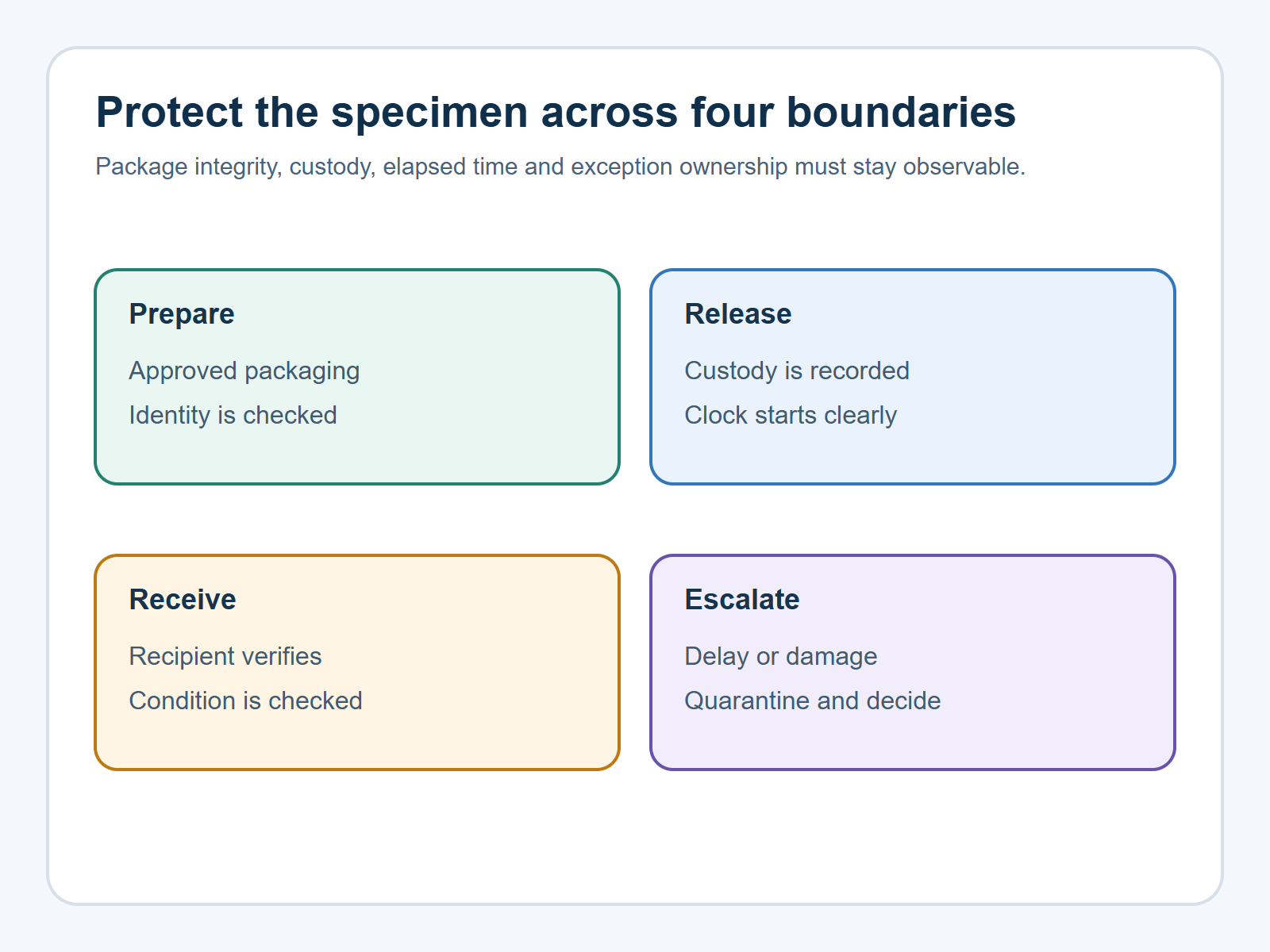
The robot does not make a package compliant. The releasing team remains responsible for using the approved primary container, secondary containment and transport carrier, checking closure and condition, and applying required identification without unnecessary exposure of patient information.
Define how the carrier fits the robot compartment, remains upright where required, is secured against movement and can be cleaned or decontaminated. Validate the complete payload arrangement under representative starts, stops, turns, thresholds and lift movements.
Create explicit custody transitions
At release, verify the authorized request, specimen or carrier identifier, destination, package condition and start time. Record who transferred custody to the transport service. At receipt, an authorized laboratory role should verify the expected delivery, condition, identifier and time before accepting custody.
Some workflows require formal chain-of-custody documentation; others use routine accession and transport records. Do not overstate or understate the requirement. The laboratory and compliance owners should define the evidence appropriate to each specimen class.
Make elapsed time visible end to end
Define the clinically or operationally relevant clock. Collection-to-receipt, release-to-receipt and dispatch-to-arrival are not interchangeable. The AMR platform may observe only part of the interval, so integrate or reconcile timestamps carefully.
Use synchronized clocks and retain event lineage. Monitor queue time before dispatch, travel, destination wait and exception resolution separately. A fast robot cannot compensate for specimens waiting unobserved at either end.
Use a handoff and exception matrix
Scroll horizontally to compare all columns.
| Control point | Verify | If verification fails |
|---|---|---|
| Preparation | Approved container, closure and condition | Do not release; correct or escalate |
| AMR loading | Destination, compartment and custody record | Keep custody with releasing team |
| Laboratory receipt | Expected item, identifier, condition and time | Quarantine or reject per policy |
| System exception | Payload state, location and elapsed time | Secure, notify and use manual recovery |
Plan the failure state before the pilot
Test unavailable recipient, wrong destination, blocked route, robot immobilization, communications loss, compartment failure, exceeded time limit, damaged container, leak or spill concern, and unidentified payload. Use controlled simulations where real exposure would be unsafe.
For each event, define whether the compartment remains closed, who may access it, how the area is protected, which clinical or laboratory role assesses the specimen, how manual recovery occurs and who authorizes restart. Staff must know that operational recovery does not replace exposure or spill procedures.
Protect privacy and limit exposed information
Use the minimum identifiers needed for safe matching. Avoid displaying patient names, tests or destinations openly on the robot or notifications. Control access to logs and link them to clinical records only through approved systems and roles.
Audit records should be useful for reconciliation and investigation without becoming an uncontrolled duplicate clinical record. Define retention, correction and access before deployment.
Accept the service as a complete workflow
Pilot evidence should cover package condition, correct destination, verified receipt, elapsed-time distribution, interventions, exception outcomes, cleaning and decontamination readiness, staff workload and data completeness. Set local acceptance criteria and mandatory controls before testing.
Production permission must name the approved specimen classes, packaging configurations, routes, hours, interfaces and recovery model. Any material change should trigger impact review and targeted retesting.
Use Warpify’s hospital AMR workflow approach with the pilot KPI framework. When packaging and custody owners are aligned, assess your specimen workflow.

Iven Wang
Iven Wang is the Co-Founder of Warpify Robotics, specializing in the commercialization and deployment of robotic solutions. With a background in electrical engineering and product management, he works with manufacturers, integrators, and enterprise clients across industrial inspection, security, logistics, and Robotics-as-a-Service.
Subscribe to our newsletter today
Get practical robotics deployment insights, case studies, and planning guidance from Warpify Robotics.