How to Evaluate a Robotics Partner Program for Your Market
A practical framework for evaluating robotics partner programs across market fit, solution scope, enablement, delivery, service, economics and governance.

A robotics partner program should be evaluated as a delivery and service operating system, not as a badge, catalogue or discount sheet. The central question is whether the program helps your organization convert market access and field capability into repeatable customer outcomes with clear responsibilities. That is the purpose of Warpify's integrator and distributor path.
Good evaluation is two-way. A provider should verify the partner's market, technical and service capability; the partner should verify the provider's solution scope, enablement, supply, support, commercial and governance model.
Use a relationship framework, then inspect the operating detail
ISO 44001 provides a management framework for identifying, developing and managing collaborative business relationships across projects, partnerships, alliances and supply chains. A robotics program does not need to claim ISO certification to benefit from the underlying discipline: define the relationship, governance, value, risks, responsibilities, review and exit before relying on it.
Evaluate eight program dimensions
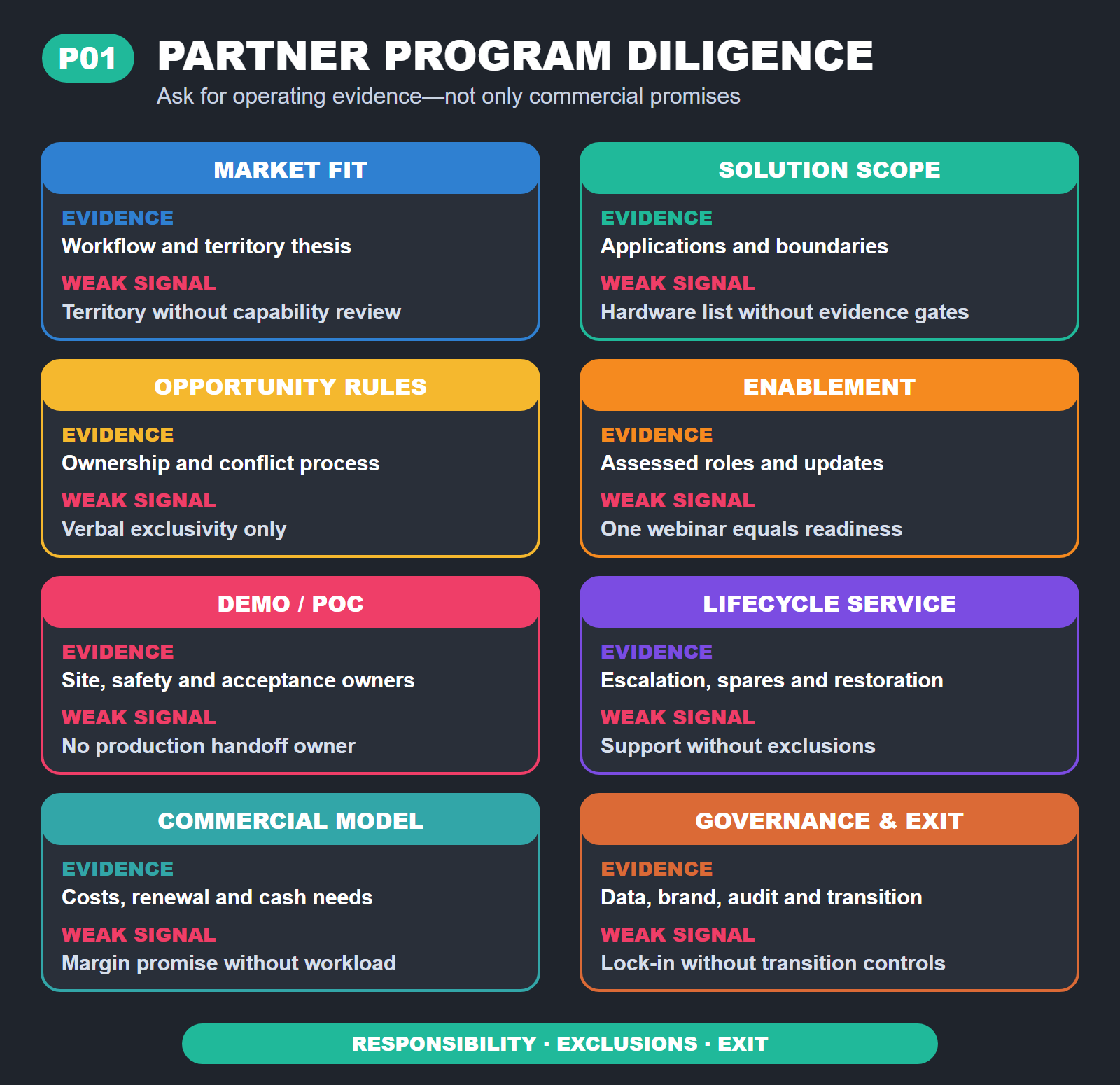
Scroll horizontally to compare all columns.
| Dimension | Evidence to request | Weak signal |
|---|---|---|
| Market fit | Target industries, customer workflows, territory logic, language and regulatory ownership | Territory offered without a market thesis or capability review |
| Solution scope | Supported applications, integration modules, capability boundaries and change process | Hardware list without workflow or evidence gates |
| Opportunity rules | Lead registration, account ownership, qualification, conflict and information-sharing rules | Verbal exclusivity or undefined lead allocation |
| Enablement | Role-based training, assessed competencies, demo access, documentation and update cadence | One sales webinar presented as delivery readiness |
| Demo and POC delivery | Scope, site, integration, safety, data, acceptance and closeout responsibilities | No owner for site readiness or production handoff |
| Lifecycle service | Local/remote boundaries, escalation, spares, restoration evidence and customer communication | "Support included" without coverage or exclusions |
| Commercial model | Discounts or fees, currency, tax, working capital, renewals, service economics and Robotics-as-a-Service operating context | Margin or earnings promise without workload and cost assumptions |
| Governance and exit | Review cadence, data/IP, brand use, compliance, audit, change, termination and transition | Permanent lock-in or broad brand rights without controls |
Test market and service capacity, not only sales reach
The U.S. International Trade Administration recommends evaluating a representative's sales force, territory, product mix, facilities, service capability, marketing approach and performance monitoring. For robotics, extend that checklist to application discovery, commissioning resources, safety and integration partners, remote support, spare-parts handling and coverage outside normal hours.
Ask the prospective provider the same hard questions: Which applications are actually supported? Which integrations are reusable and which are custom? Who owns site assessment, validation, cybersecurity, training and lifecycle support? Which claims and logos may the partner use? What happens when the program cannot support a requested workflow?
Require evidence before granting trust
Trade.gov's due-diligence guidance points companies to market, company and official screening resources. Apply the principle proportionately: verify the legal entity, principal officers, financial and trade references, delivery history, technical staff, facilities, insurance, compliance obligations, conflicts and relevant third parties. Local counsel should review territory, agency, distribution, data, liability, tax, export and termination terms.
Look for a delivery system
NIST's Manufacturing Extension Partnership describes an adoption process that begins with operational assessment and a business case, then connects manufacturers with integrators and vendors and measures results. A credible partner program should make that process executable through briefs, solution boundaries, a deployment readiness checklist, demo/POC gates, acceptance evidence, training and service handoff.
Ask to see artifacts, not only presentations:
- workflow discovery and qualification template;
- capability and non-fit matrix;
- demo/POC charter and responsibility matrix;
- site-readiness and acceptance evidence;
- training competencies and renewal path;
- service escalation, spare-parts and restoration records;
- change, claim, data and brand governance.
Score with gates, not invented precision
Use three decisions for each dimension: pass, conditional with a named gap, or non-fit. Avoid a weighted score that makes a critical service or legal failure disappear inside a high total. Treat safety, capability, legal authority, data rights, service coverage and truthful claims as gates.
Red flags that deserve a pause
- exclusivity before market, capability and service diligence;
- earnings, margin, lead volume or close-rate promises without evidence;
- pressure to sell applications that have not passed capability review;
- unclear ownership of customer data, integrations, demos or installed systems;
- no named technical, deployment or service escalation path;
- training that measures attendance but not competency;
- termination terms that leave customers or the partner without service continuity.
Bring a qualified opportunity into the decision
The strongest program test is a bounded customer workflow. Document the problem, site, stakeholders, payload, interfaces, commercial path and local service expectations. Then ask both sides to explain how the program would qualify, design, deliver, support and govern that opportunity. The gaps will be more informative than a generic partner tier.
Sources and scope
This guide combines the cited primary sources with an editorial decision framework. It does not quote a market price, promise a result, replace a site assessment, or provide legal, financial, clinical, cybersecurity or safety advice.
- ISO 44001:2017 Collaborative business relationship management systems — International Organization for Standardization
- Choosing a Foreign Representative — U.S. International Trade Administration
- Perform Due Diligence — U.S. International Trade Administration
- Robotics and Manufacturing Automation — National Institute of Standards and Technology
Related delivery checks: Review the demo and POC responsibility checklist and the partner training and enablement framework before treating a program as deployment-ready.
Take the next step
If you can describe the target market, customer workflows, delivery capability and service coverage you bring, use those facts to begin a partner-fit discussion: Discuss your market or qualified opportunity.

Iven Wang
Iven Wang is the Co-Founder of Warpify Robotics, specializing in the commercialization and deployment of robotic solutions. With a background in electrical engineering and product management, he works with manufacturers, integrators, and enterprise clients across industrial inspection, security, logistics, and Robotics-as-a-Service.
Subscribe to our newsletter today
Get practical robotics deployment insights, case studies, and planning guidance from Warpify Robotics.