Robotics Partner Training and Certification: What Good Enablement Includes
A practical framework for robotics partner training, assessment, authorization, renewal and field-delivery governance.

A robotics partner program is only useful when it helps a partner deliver consistently after the launch call. Product slides and a completion badge may introduce the offer, but they do not prove that a team can qualify a workflow, control a demonstration, document a risk, diagnose a fault or hand a system to operations.
Good enablement therefore connects training to delivery authority. It defines what a partner may sell, configure, integrate, support and escalate, and what evidence is required before that scope expands. This guide gives integrator and distributor leaders a practical structure for evaluating a robotics partner training or certification program.
Start with delivery outcomes, not course hours
Course duration is easy to count and weak as a readiness measure. Begin with the work a qualified partner must perform. Typical outcomes include discovering a suitable workflow, documenting site conditions, selecting a supported configuration, preparing a safe demonstration, collecting acceptance evidence, training operators and opening a support case with useful diagnostic information.
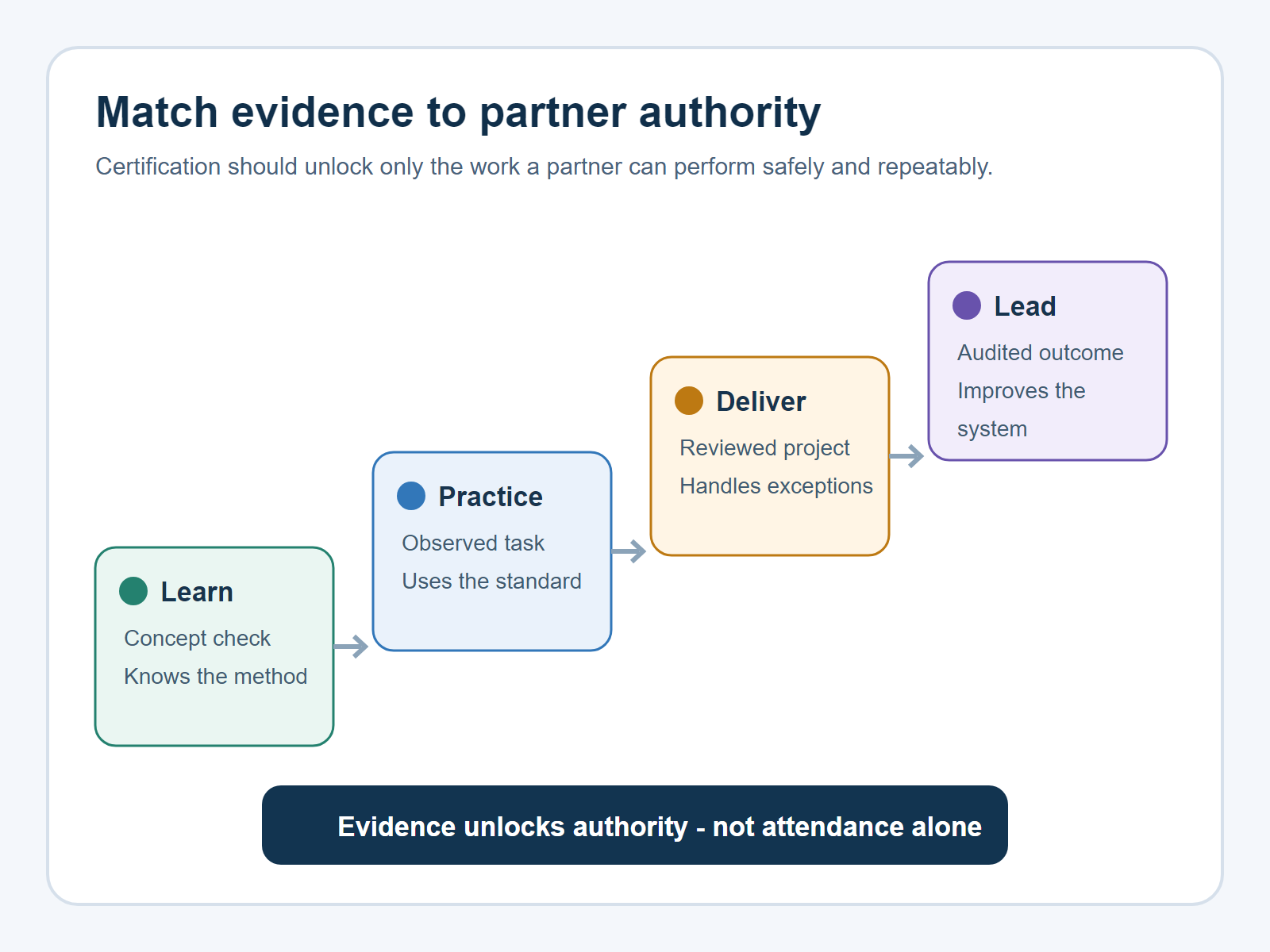
The Association for Advancing Automation's Certified Robot Integrator program illustrates the broader principle: its assessment includes organizational capability, an on-site audit, practical assessment of key personnel and safety training. That does not mean every vendor program should copy an independent certification. It does show why a credible qualification needs observed capability, not attendance alone.
Build an enablement system with six parts
A mature program combines knowledge, practice, assessment and field governance. The exact curriculum depends on the platform and market, but six parts should be visible.
- Opportunity qualification: workflow fit, disqualifiers, site inputs and economic assumptions.
- Solution design: supported configurations, interfaces, constraints and change control.
- Safety and compliance: role-specific instruction, applicable standards and escalation to qualified reviewers.
- Deployment practice: setup, mapping or programming, testing, evidence capture and handover.
- Service readiness: diagnostics, spares, incident severity, remote access and escalation packages.
- Commercial governance: approved claims, proposal boundaries, opportunity registration and renewal rules.
Scroll horizontally to compare all columns.
| Level | Partner may | Evidence | Typical boundary |
|---|---|---|---|
| Foundation | Identify candidate workflows | Knowledge check and discovery exercise | No independent configuration or claims |
| Demo | Run an approved demonstration | Observed setup, safety check and closeout | Approved equipment and scenario only |
| Deployment | Lead defined implementation tasks | Practical assessment and supervised field evidence | Named interfaces and site classes |
| Service | Diagnose and restore supported faults | Fault-isolation assessment and escalation record | Documented access and repair permissions |
Assess performance in realistic conditions
A quiz can confirm vocabulary. It cannot show whether a person will stop when a site differs from the drawing. Practical assessment should require the candidate to interpret an incomplete brief, state assumptions, prepare the system, run a controlled task, handle at least one exception and produce a usable record.
Score observable behaviours with published criteria. For example: did the candidate verify prerequisites, protect the test boundary, distinguish a workaround from a fix, preserve logs and explain the result without overstating it? Use a second assessor for borderline decisions and retain the rubric version. This makes qualification auditable and easier to improve.
Separate individual competence from company capability
A trained engineer does not automatically create a deployment-ready business. The partner organization also needs accountable leadership, appropriate insurance and licensing where applicable, calibrated tools, document control, a support route, coverage for staff turnover and a process for controlled software or configuration changes.
NIST's integration guidance recommends involving the people who own the current process, identifying an internal champion and being honest about available support and bandwidth. Partner enablement should teach the same operating discipline: named customer owners and realistic resourcing are prerequisites, not post-sale details.
Make certification expire for a reason
Authorization should be time-bounded or event-bounded. Products change, safety guidance evolves and trained people move roles. Renewal can combine a short delta course, evidence from recent work, open-issue review and reassessment of higher-risk permissions. A serious incident, repeated documentation failure or work outside approved scope should trigger review before the normal renewal date.
Keep status precise in sales materials. "Trained," "authorized," "certified" and "independently certified" are not interchangeable. Record the person, organization, scope, geography, platform or workflow, issue date, expiry date and any suspension. Customers should be able to understand what the credential actually covers.
Evaluate the program before joining
Ask for the competency map, practical assessment method, assessor qualifications, pass and appeal rules, renewal policy and change-notification process. Confirm who owns customer acceptance, safety review, integrations, data access, first-line support and warranty decisions. Then inspect the tools partners receive: discovery templates, supported-configuration records, test plans, claim guidance, escalation forms and release notes.
A good program makes responsible delivery easier and unsupported promises harder. It gives capable partners a path to greater authority while preserving clear boundaries for the customer, integrator and platform provider.
Take the next step
Warpify works with integrators and distributors around qualified opportunities, deployment responsibilities and service readiness. Review the partner-program evaluation guide, the demo and POC responsibility checklist, and the multi-brand integration framework. Then use our Partner application route to discuss a qualified opportunity.

Iven Wang
Iven Wang is the Co-Founder of Warpify Robotics, specializing in the commercialization and deployment of robotic solutions. With a background in electrical engineering and product management, he works with manufacturers, integrators, and enterprise clients across industrial inspection, security, logistics, and Robotics-as-a-Service.
Subscribe to our newsletter today
Get practical robotics deployment insights, case studies, and planning guidance from Warpify Robotics.