Robot Demo and POC Responsibilities: A Partner Delivery Checklist
A responsibility checklist for robot demos and POCs covering workflow, site, system, integration, safety, data, operations, acceptance and closeout.
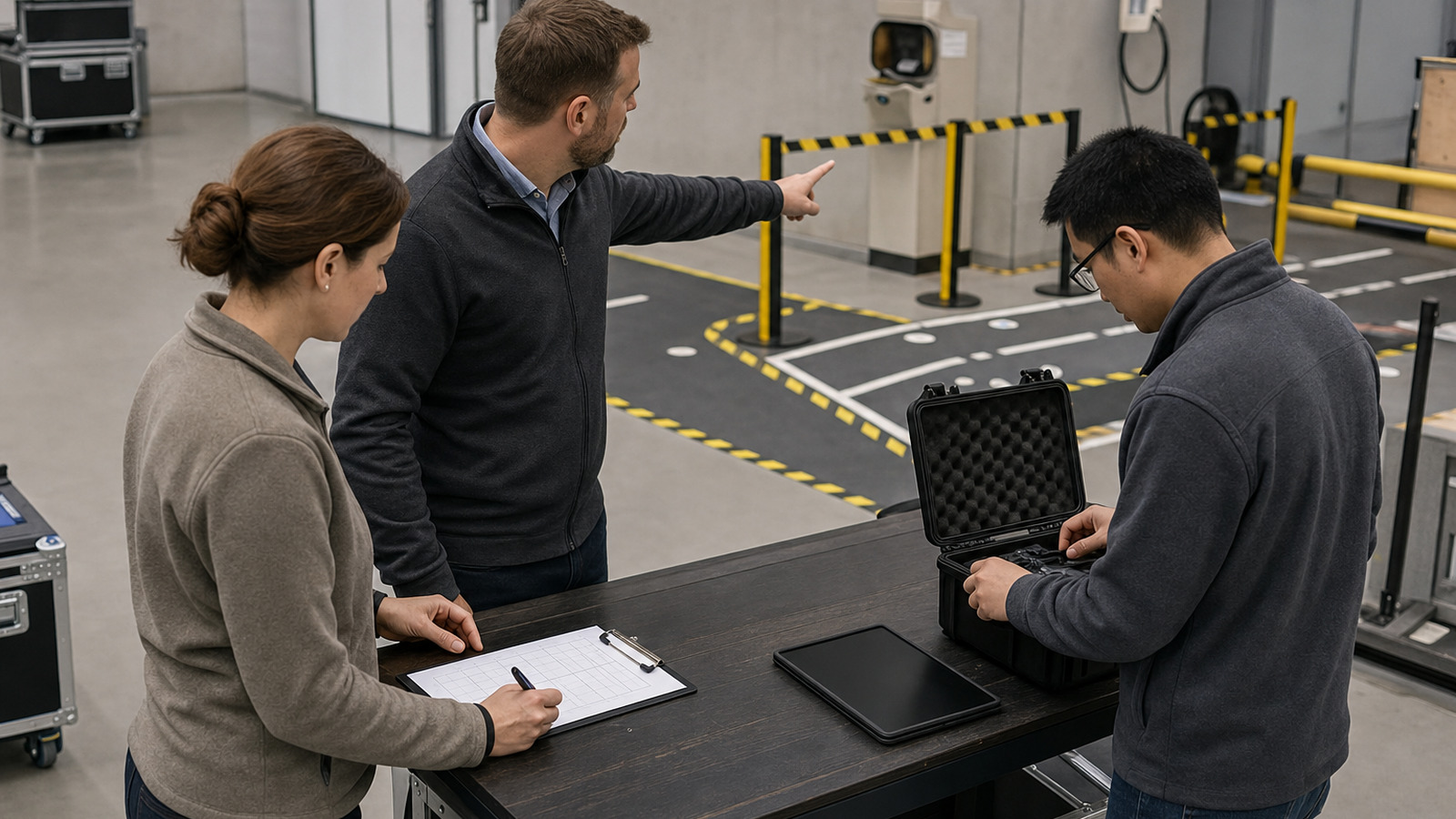
A robot demo should answer a narrow capability question. A proof of concept (POC) should answer whether a defined workflow can meet agreed acceptance conditions in a representative environment. Neither should begin with equipment shipment and a vague request to "show what it can do." Partners using Warpify's partner delivery path need a written charter, owners, evidence and closeout decision before work starts.
Separate demo, POC, pilot and production
Scroll horizontally to compare all columns.
| Stage | Primary question | Evidence boundary |
|---|---|---|
| Demo | Can a capability be shown under controlled conditions? | Demonstration only; not site or production proof |
| POC | Can the defined workflow and interfaces meet bounded acceptance tests? | Representative scope, configuration and conditions |
| Pilot | Can the operating model perform over a meaningful observation window? | Versioned site, users, exceptions, support and denominators |
| Production | Can the service be operated, supported, governed and changed at the required scale? | Approved production configuration and lifecycle controls |
Use the current workflow-first assessment to keep the stage tied to a buyer decision. A successful demo does not prove site fit, and a short POC does not prove long-term service performance.
Set the entry gate
Do not schedule the activity until the parties have approved:
- customer problem, workflow and decision to be made;
- scope, location, dates, participants and allowed operating window;
- robot, payload, software and configuration identity;
- site, network, power, access, safety and integration readiness;
- data, privacy, image, logo and confidentiality rules;
- success, failure, stop and change criteria;
- manual fallback, incident response and equipment custody;
- evidence owner, review meeting and closeout deliverables.
The deployment readiness checklist can supply the site gate. NIST's robotics research program stresses the need for test methods and metrics when emerging technologies are selected, integrated and evaluated in dynamic manufacturing environments.
Assign responsibilities by workstream
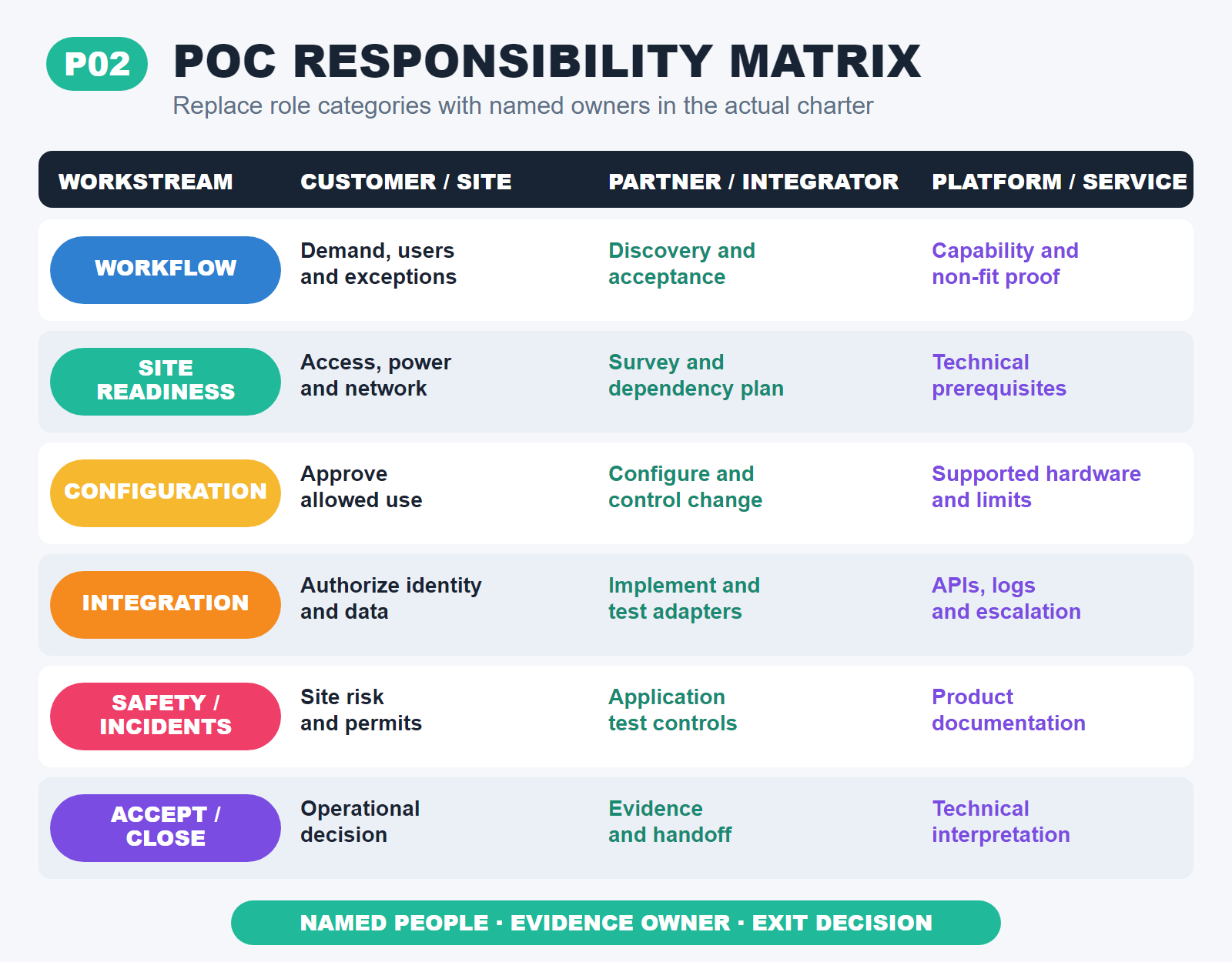
Scroll horizontally to compare all columns.
| Workstream | Customer/site owner | Partner/integrator | Platform or service provider |
|---|---|---|---|
| Workflow | Current process, demand, people, exceptions and decision owner | Discovery, scope, fit and acceptance translation | Capability and non-fit evidence |
| Site readiness | Access, power, network, building systems and work controls | Survey, dependency plan and readiness evidence | Technical prerequisites |
| System/configuration | Approve allowed use and custody | Configure, document and control changes | Supply supported hardware/software and limits |
| Integration/data | Authorize interfaces, identities and data rules | Implement/test adapters and evidence flow | Provide supported APIs, logs and escalation |
| Safety and incidents | Site risk owner, emergency rules and permits | Application review, briefing, test controls and incident lead | Product documentation and technical support |
| Execution | Process users and observers | Test conductor, log and daily review | Remote or on-site support as contracted |
| Acceptance | Business and operational decision | Evidence package and recommendation | Technical interpretation within scope |
| Closeout | Data retention, site restoration and next decision | Equipment return, findings, gaps and handoff | Account/configuration closure |
Use named people in the actual charter. "Partner" and "customer" are categories, not accountable owners.
Engage current process owners
NIST MEP guidance recommends engaging the people who own the current process, naming an internal champion and beginning with a bounded implementation. Include the operators who know irregular work, maintenance and facilities teams who manage dependencies, IT/security owners, and the manager who can make the go/revise/stop decision.
The internal champion should not become the default owner for every missing responsibility. Keep technical support, site work, operational response and business acceptance separate.
Test the application, not the robot in isolation
OSHA's system boundary shows why a robot application review must include controllers, sensors, end effectors and surrounding equipment rather than the robot alone. A material-handling test should use the intended payload interface and transfer method. An inspection test should use the required sensor payload, read geometry, data path and reviewer workflow.
Run normal, boundary and failure scenarios. Examples include demand peaks, blocked paths, payload not ready, access denial, communication loss, invalid read, low battery, user absence and service escalation. Stop conditions should be pre-agreed and visible to the test conductor.
Use an acceptance matrix
For every criterion record definition, denominator, test method, data source, owner, threshold or decision rule, exclusions, observation window and result status. Avoid a single "success rate" that mixes navigation, handoff, data and business outcomes. Label unresolved evidence as not yet verified and retain failed scenarios.
Control changes
If the route, payload, robot, software, network, integration, workflow, operating window or acceptance rule changes, record the change and decide which tests must be repeated. Do not silently tune the test until it passes and report only the final configuration.
Close with one decision
The closeout should state go, revise and retest, stop, or defer for a named dependency. It should include the tested configuration, evidence, exceptions, open risks, production gaps, cost implications and next authority. Remove equipment, close temporary access, transfer data and return the site to the agreed state.
Sources and scope
This guide combines the cited primary sources with an editorial decision framework. It does not quote a market price, promise a result, replace a site assessment, or provide legal, financial, clinical, cybersecurity or safety advice.
- How to Make Your First Robot Integration a Success — National Institute of Standards and Technology, MEP guest guidance
- Performance of Emerging Technologies for Robotics — National Institute of Standards and Technology
- Industrial Robot Systems and Industrial Robot System Safety — U.S. Occupational Safety and Health Administration
- ISO 44001:2017 Collaborative business relationship management systems — International Organization for Standardization
Related delivery checks: Confirm the program boundary with the robotics partner-program guide, verify role readiness through partner enablement, and document integration ownership with the multi-brand integration guide.
Take the next step
If you can define the customer workflow, site, responsibilities and acceptance boundary, bring the opportunity into a partner delivery discussion: Discuss a qualified robot opportunity.

Iven Wang
Iven Wang is the Co-Founder of Warpify Robotics, specializing in the commercialization and deployment of robotic solutions. With a background in electrical engineering and product management, he works with manufacturers, integrators, and enterprise clients across industrial inspection, security, logistics, and Robotics-as-a-Service.
Subscribe to our newsletter today
Get practical robotics deployment insights, case studies, and planning guidance from Warpify Robotics.