Restaurant Delivery Robot Case Study: 104 Minutes Reclaimed Daily
This real Warpify customer deployment is anonymized, with identifying details withheld. It recorded 104 service minutes released daily and 97.6% task completion.
The decision: Could a delivery robot take repetitive kitchen-to-dining-room transport out of the service team's peak workload without weakening guest-facing hospitality?
Warpify designed the human-robot workflow, selected and configured a suitable commercial delivery robot, mapped the occupied site, trained 18 employees and ran a six-week pilot across real lunch and dinner peaks. During the stabilized phase, the deployment recorded approximately 104 service minutes released per day and a 97.6% task-completion rate. The confidential-cost model produced a 7.8% first-year hard-savings ROI; service improvements and customer curiosity were assigned no cash value.
Project at a glance
Request a restaurant robot site-readiness assessment if your team is evaluating a similar transport workflow.
Operational context: peak service had become a transport operation
The restaurant's service model depended on menu explanation, recommendations and attentive tableside interaction. Management did not want to replace servers, and the project did not include a headcount-reduction target.
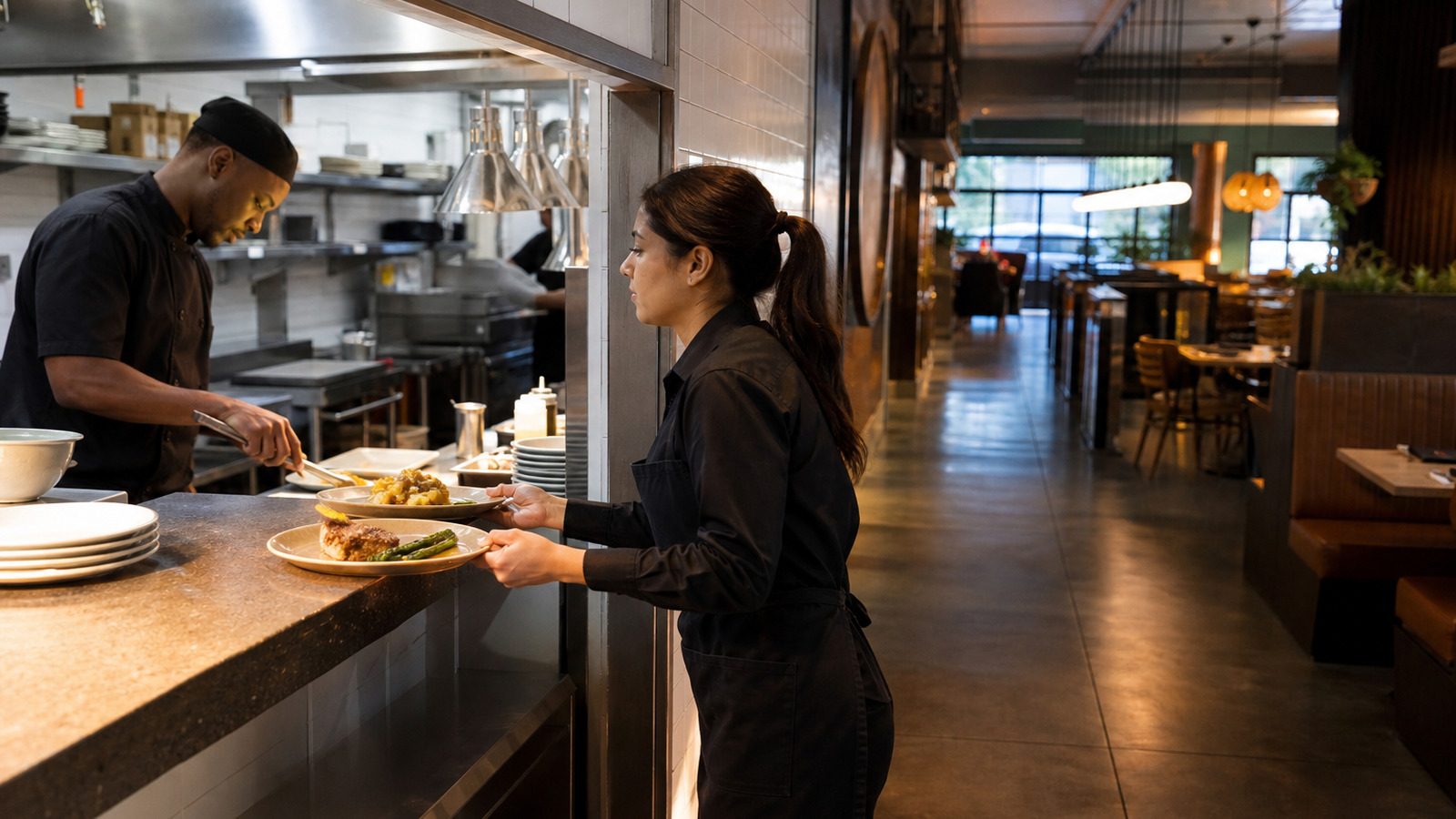
The constraint was repetitive transport. During compressed peaks, servers and food runners moved continuously between the kitchen pass, dining zones, beverage station and dish-return area. When the kitchen completed several orders together, staff availability at the pass and at the table did not always line up.
That mismatch produced four operating effects:
The operating objective was therefore to automate a movement, not a job title. This direction is consistent with the National Restaurant Association's 2024 research, in which 69% of surveyed operators said restaurant technology would augment rather than replace human labour. Review the association's report.
Baseline workflow and measurement boundary
Warpify measured the occupied restaurant rather than relying on an empty floor plan. The assessment covered pulled-out chairs, guests and children crossing routes, staff carrying hot food, cleaning activity, temporary obstacles, blind corners and handoff readiness.
Approximately 45% of movements remained manual. These included stairs, urgent dishes, unstable loads, allergen-sensitive exceptions, special tableside presentation and any task outside the approved route or load rules.
Constraints, exclusions and responsibilities
Stairs, urgent dishes, unstable loads, allergen-sensitive exceptions, special presentation and any route or load outside the approved operating envelope remained with trained employees. The restaurant team retained responsibility for dish verification, food safety, guest communication, loading, handoff and exception response.
The documented robotic workflow
Warpify treated the selected robot as a mobile transport workstation, not an autonomous server.
The product model is intentionally not disclosed. The selection decision was based on payload and tray geometry, occupied-route clearance, turning behaviour, battery duty, cleanability, support and safe recovery—not brand recognition.
Deployment assumptions and verified scope: the six-week pilot
The first three weeks established the baseline, mapped routes, configured handoff points and trained the team. Weeks four and five tested live operation during service peaks. Week six compared stabilized performance with the baseline and set continuation gates.
Waiting fell after dispatch required a ready receiver
Early in the pilot, the robot could reach a handoff zone while the assigned server was still helping another table. A pre-dispatch confirmation reduced average handoff waiting from 2.4 minutes to 0.9 minutes.
Batch rules reduced underloaded cycles
Some employees initially sent the robot with only one tray in use. Fixed tray assignments and batch-dispatch rules reduced underloaded cycles from 31% to 12%.
A controlled one-way passage stabilized a blind corner
The narrow back-of-house turn produced stop-and-go movement when staff or chairs entered the operating envelope. One-way priority, a lower speed zone and a small furniture move reduced manual interventions from 4.8 to 2.4 per 100 cycles.
Ownership solved missed charging
Three pre-dinner checks in week three found incomplete charging. The restaurant assigned cleaning and charging to a named closing role with manager verification. No further missed-charge event was recorded during the pilot.
Minor problems remained visible
Two low-severity tray spills occurred during controlled commissioning; neither caused injury, property damage or guest disruption. During live service, one guest asked the robot to yield. Staff paused the task and resolved the request without a complaint escalation.
Measured and calculated results
How the 104-minute result was verified
The result follows directly from completed daily cycles and released staff time per completed cycle:
52 completed cycles × 2.0 released staff minutes = 104 minutes per day.
The batching cross-check also reconciles:
Across 360 operating days, 104 minutes equals 624 released hours per year. Project records classified 510 hours as avoided incremental peak scheduling and 114 hours as reinvested service capacity. The 114 hours were not counted as cash savings.
A price-hidden financial model
The public model keeps the first-year solution cost and customer labour rate confidential. Both are indexed rather than displayed:
If the annual first-year fee is paid up front, simple recovery occurs at approximately 11.1 months: 100 ÷ 107.8 × 12. If the service is billed monthly, “payback” is not the clearest description; the relevant test is whether monthly verified hard savings exceed the monthly fee after stabilization.
This distinction prevents a recurring Robotics-as-a-Service (RaaS) contract from being described as though it were necessarily an up-front capital purchase.
Sensitivity and break-even
The commercial margin is positive but narrow. The base case breaks even only if at least 92.7% of projected hard-savings value is realized. That threshold is calculated as 100 ÷ 107.8.
The highest-sensitivity input is not robot speed. It is whether released time becomes an avoided, budgeted labour cost. If staffing schedules do not change, the restaurant still gains service capacity, but the hard-savings ROI falls.
Outcome drivers: what could change the result
Servers made fewer repetitive transport trips and had more time for table checks, beverage service, menu explanation and recovery. The kitchen pass gained a visible dispatch discipline. Managers gained cycle, waiting, blockage, intervention, charging and exception data. New employees received clearer ownership for loading, receiving, cleaning, charging and fallback.
Those benefits may affect service quality, employee workload, table turns, upselling or customer perception, but the base ROI assigns them a cash value of zero until the restaurant can connect them to a verified profit-and-loss outcome.
Risks, limitations and non-fit conditions
Evidence boundary
Operational figures are attributed to the anonymized project's records. Calculated values are reproducible from the stated operating inputs or from confidential commercial inputs held outside the public article. Industry and regulatory sources provide context; they do not prove this customer's results.
The International Federation of Robotics reported more than 42,000 hospitality robots sold in 2024, down 11% year over year, and states that its service-robot statistics are based on a supplier sample. Adoption therefore does not establish suitability for a particular restaurant. Review the World Robotics 2025 summary.
What a real site assessment should verify
Warpify's workflow-first assessment method, robot ROI framework and commercial-model overview explain how these decisions fit together.
Next step: assess the workflow, not a model number
Bring your movement counts, route constraints, peak periods, staffing plan and service goals into a structured review. Request a restaurant robot site-readiness and payback assessment to define fit, pilot scope, operating responsibilities and a confidential business case.

Iven Wang
Iven Wang is the Co-Founder of Warpify Robotics, specializing in the commercialization and deployment of robotic solutions. With a background in electrical engineering and product management, he works with manufacturers, integrators, and enterprise clients across industrial inspection, security, logistics, and Robotics-as-a-Service.
Subscribe to our newsletter today
Get practical robotics deployment insights, case studies, and planning guidance from Warpify Robotics.