Visual Inspection Robots: Gauge Reading, OCR and Validation
Validate robot gauge reading and OCR through capture quality, read-point definitions, error analysis and human review rules.
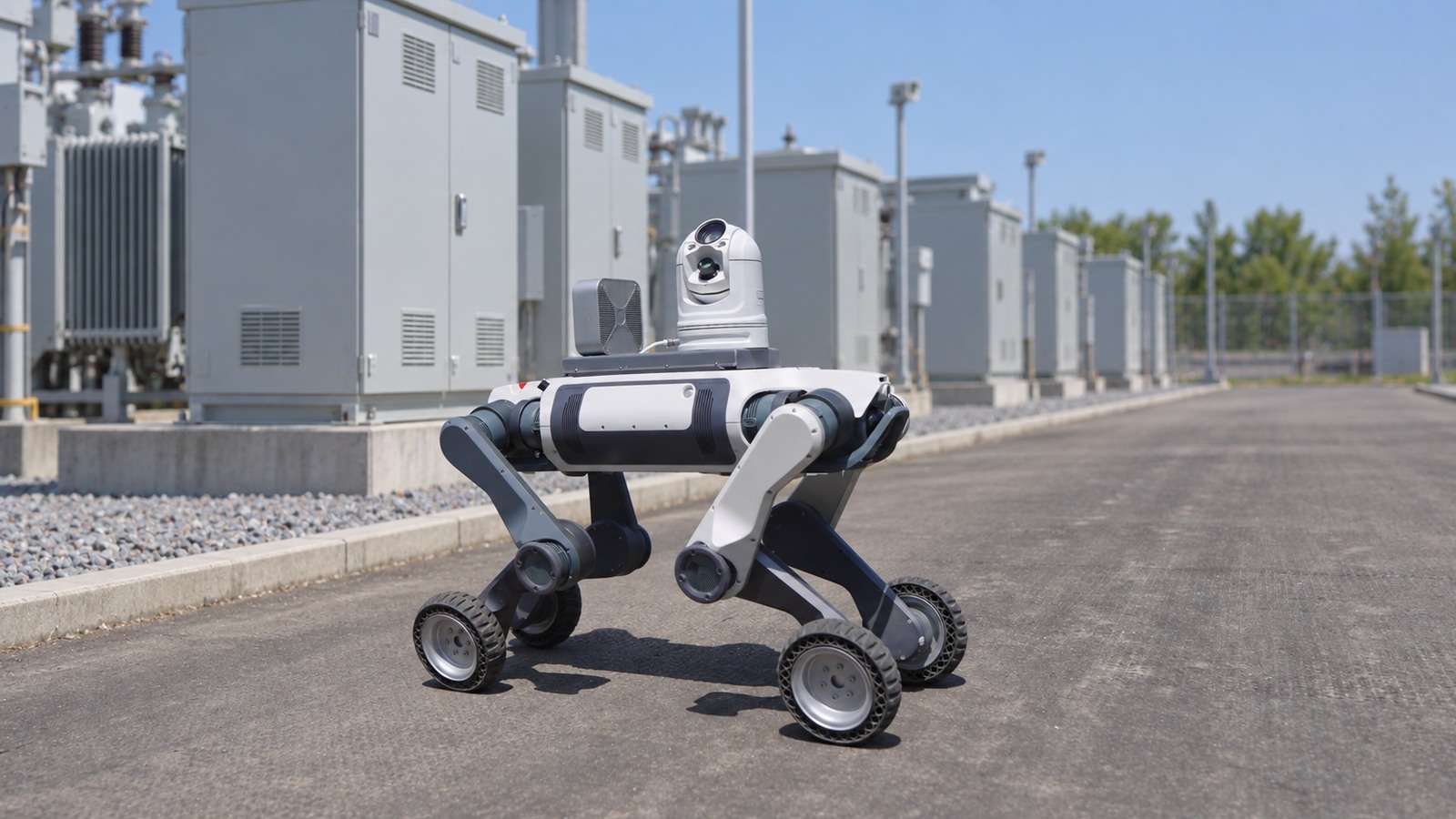
A visual inspection robot is useful when its observations can support a maintenance decision reliably enough for the intended task. Reading a gauge once is a demonstration. Repeatedly identifying the correct instrument, capturing a usable image, interpreting it and handling uncertainty is an inspection workflow.
Optical character recognition (OCR) converts visible text into machine-readable characters. It does not, by itself, establish which asset was observed, whether a decimal point or unit was correct, or whether the reading requires action. Keep those checks distinct when evaluating industrial inspection robotics.
Define the read-point contract
For every target, record the asset identifier, instrument type, unit, scale or display format, allowed viewpoint, operating range, capture frequency and decision owner. Identify whether the task is numeric reading, indicator-state recognition, label identification or visual condition review.
Separate a gauge’s engineering unit from the digits visible in an image. A correct number associated with the wrong unit or asset can still be an unusable result. Record how the system verifies identity and what it does when the expected target is absent or replaced.
Keep conditions outside scope explicit. A closed panel may hide the target; condensation may obscure a window; a display may show multiple pages. Do not promise coverage until the actual target and viewing conditions have been evaluated.
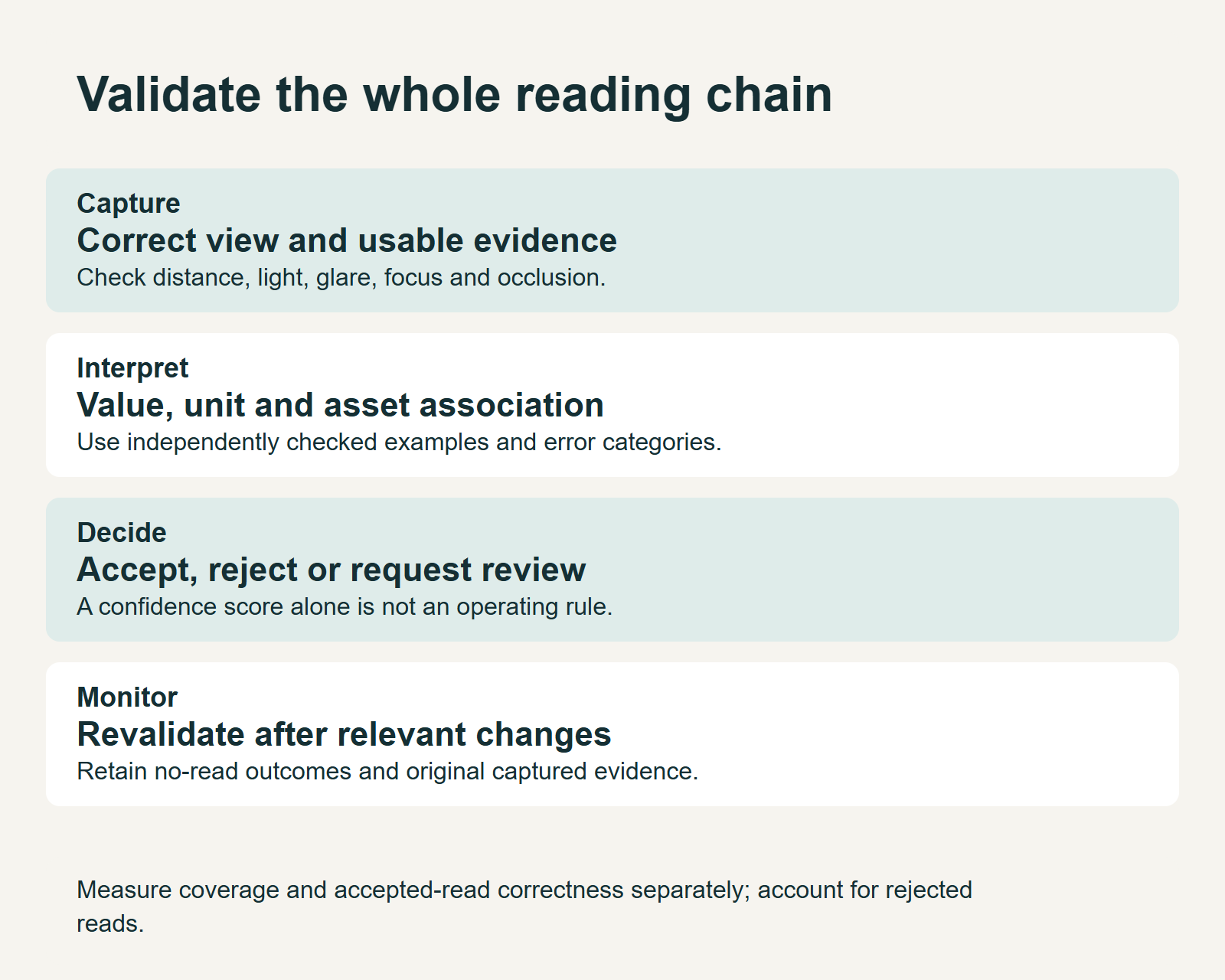
Validate capture before interpretation
Assess viewpoint, distance, focus, exposure, glare, shadow, motion and occlusion. For an analog gauge, an oblique view can complicate interpretation. For a digital display, refresh behavior, reflections and missing segments can affect the captured image. These are test variables to examine for the selected camera and instrument, not universal accuracy estimates.
Record the robot pose, camera settings and payload configuration with each validation sample. A successful close handheld photograph does not establish what a moving robot-mounted camera can capture from the approved route.
DEEP Robotics’ power-inspection material describes image acquisition and recognition functions in its solution. Treat that as a manufacturer capability description. Site acceptance still requires evidence from the actual instrument population and operating conditions.
Separate the stages that can fail
Use an explicit pipeline: locate the target, confirm identity, capture, check quality, interpret, check plausibility, and route the result. Preserve each stage’s status. A downstream system should be able to distinguish no image, wrong target, unreadable image, uncertain interpretation and accepted reading.
Avoid filling a missing value with the last good reading unless the receiving system clearly represents it as historical. Keep the timestamp of observation separate from the time the result was processed or delivered. This prevents a stale value from appearing current.
The inspection integration guide explains how observations can connect to maintenance and historian workflows without losing asset identity or exception meaning.
Build an independent evaluation set
Have qualified inspection personnel establish the reference readings and acceptable interpretation rules. Include representative instrument types and difficult conditions, not only images that the system reads easily. Keep development samples separate from the held-out acceptance set, and identify repeated images of the same target so they do not masquerade as independent coverage.
NIST’s AI Risk Management Framework describes documented testing, evaluation, verification and validation, with measures relevant to deployment context. Apply that principle to the site’s visual-reading task. The method proposed here is not a NIST certification or a guarantee of inspection accuracy.
Record ambiguous reference cases as ambiguous. Forcing a single ground-truth value where specialists disagree can conceal a limitation of the task itself.
Report errors by consequence
Measure exact asset association, usable-image coverage, numeric error within the agreed tolerance, missed exceptions, false alerts and rejected reads. Keep the denominators explicit. Reporting accuracy only on accepted readings can hide a system that rejects much of the required work.
An illustrative acceptance set of 200 required observations might produce 170 accepted readings (160 correct and 10 incorrect) and 30 explicit no-reads. Coverage would be 85 percent, while correctness among accepted readings would be 160 divided by 170, about 94.1 percent. Correct accepted readings across all required observations would be 80 percent. None of those numbers alone determines fitness.
This arithmetic example is invented for explanation and is not a product benchmark. The customer must define tolerable error by consequence and decide which outputs require human confirmation. An overall average should not conceal failure on a critical instrument class.
Make uncertainty actionable
Define an escalation route for no-read, inconsistent value, unexpected unit, asset mismatch and low-confidence interpretation. State whether the system retries, requests human review, creates an exception record or returns the task to an existing inspection method. Test those paths with authorized, controlled examples.
Do not treat the model’s confidence value as a measured probability of correctness without appropriate calibration evidence. Choose thresholds using the acceptance data and the intended consequence, then review their performance in operation.
Retest when the accepted conditions change
Track changes to camera, lens, firmware, model, instrument face, lighting, route pose and interpretation rules. Determine which changes require targeted regression testing or renewed acceptance. Preserve the previous version and evidence so a deterioration can be investigated.
Bring a read-point register, representative authorized images and the proposed decision thresholds to an inspection assessment. The goal is a bounded visual-reading service with visible uncertainty and a responsible response path.
The numerical example is an illustrative scenario using editorial assumptions, not measured deployment performance.
Sources and scope
- NIST AI RMF: Core functions — Measurement and risk management principles; not certification or proof of an OCR product accuracy.
- DEEP Robotics: Power inspection applications — Manufacturer description of inspection applications and sensors; no guaranteed site outcome.

Iven Wang
Iven Wang is the Co-Founder of Warpify Robotics, specializing in the commercialization and deployment of robotic solutions. With a background in electrical engineering and product management, he works with manufacturers, integrators, and enterprise clients across industrial inspection, security, logistics, and Robotics-as-a-Service.
Subscribe to our newsletter today
Get practical robotics deployment insights, case studies, and planning guidance from Warpify Robotics.