Fixed Detectors, Portable Meters and Mobile Gas Robots in an Oxygen Plant
Compare fixed detectors, personal meters and mobile robot readings in an oxygen plant. Use a worksheet to identify observation gaps.
Assign each oxygen monitoring device a job and check what happens between observations. A fixed detector observes its installed location during service. A personal monitor can track conditions near a worker when the procedure calls for one. A mobile robot can take supplemental readings at selected points on its rounds. The right question is whether each device can inform its assigned action within the time the plant allows.
Map the event before mapping the devices
Choose a scenario from the site hazard review. For example, an oxygen line release may enrich a local area. Nitrogen or another gas can displace oxygen under different conditions. Enrichment raises fire risk and deficiency creates an asphyxiation hazard. Both scenarios call for attention to air movement, likely release locations and the people who could be affected. Similar-looking utility bays can require different sensing arrangements. EIGA guidance on oxygen-enriched atmospheres · EIGA guidance on oxygen-deficient atmospheres
Start with the action owner and when they need information. A fixed detector might signal a release only if it reaches the sensing point. Personal monitoring follows the wearer and supports actions defined by the plant’s procedure. A mobile reading is tied to the stop and sampling interval. Consider detector health and availability as well as the physical coverage. An instrument in maintenance, a worker who has left the zone and a robot rerouted around a blocked stop each change what is observable.
Build a coverage worksheet by scenario
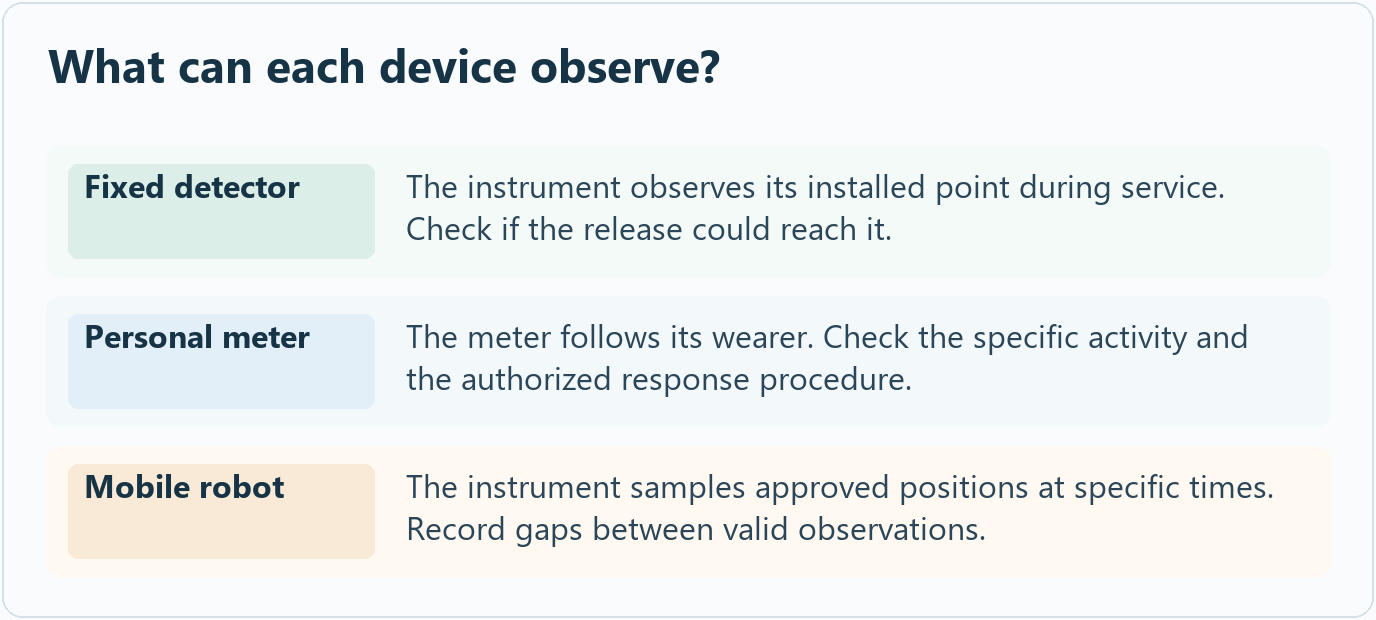
Record each monitoring role
- Fixed detector. Enter installed point, operating status, which release could reach it and expected alarm recipient.
- Portable or personal meter. Enter the wearer or authorized user, purpose, inspection or entry procedure, and whose exposure or location is represented.
- Mobile robot round. Enter robot stop and inlet position, expected revisit window, sample availability, review recipient and fallback on a missed point.
Example at an oxygen-service manifold
- Fixed detector. For an oxygen-service manifold, check whether the fixed location covers the scenario defined by site review.
- Portable or personal meter. For work near the manifold, record the applicable worker procedure and how a reading is acted on.
- Mobile robot round. For the adjacent service aisle, record the reason for sampling there and the action the result could support.
Example of a short release between rounds
- Fixed detector. For a short release between rounds, check available fixed evidence and follow-up under the site procedure.
- Portable or personal meter. Record presence at the relevant time and the applicable instrument record.
- Mobile robot round. Mark the interval as unobserved by the robot unless there is a valid sample covering the event.
In the industrial gas plant case study, the robot route connects selected observation points near process equipment. Use it to see how a mobile observation can be assigned to a location. Placement and safeguards at another plant depend on its hazard review and approved controls.
Check how long a point can go unobserved
In an illustrative scenario, suppose a point is visited at 09:00 and 10:00. A release just after the first valid observation could fall between visits. If the next scheduled stop is missed and the next valid observation is at 11:00, the elapsed time between valid observations is two hours. That interval describes route coverage. It does not predict time to detection. A release could dissipate before the next visit or never reach the inlet position. For a live design, measure the longest gap between valid samples and track missed stops, dwell failures and dispatch delays separately.
The OSHA direct-reading instrument guidance identifies response time, instrument suitability and sampling mode as factors. Add those details to the selected stop, then test the arrangement under the site’s approved conditions. If the plant needs information sooner than a mobile route can feasibly provide it, keep that requirement with the site’s continuous or personal safeguards as applicable. Keep response responsibilities clear under the established plant procedure.
See the robot gas detection planning guide for deployment and instrument questions. For the wider industrial inspection workflow, use this record to define what the robot needs to capture. To plan a facility inspection, bring one release scenario, the observation devices already assigned to it and a route gap you want to evaluate.

Iven Wang
Iven Wang is the Co-Founder of Warpify Robotics, specializing in the commercialization and deployment of robotic solutions. With a background in electrical engineering and product management, he works with manufacturers, integrators, and enterprise clients across industrial inspection, security, logistics, and Robotics-as-a-Service.
Subscribe to our newsletter today
Get practical robotics deployment insights, case studies, and planning guidance from Warpify Robotics.