Gas Detection by Inspection Robots: Hazardous-Area Questions to Resolve First
A safety-led framework for gas-detection robot sensing, sampling geometry, calibration, response time, hazardous-area suitability and alarm handling.

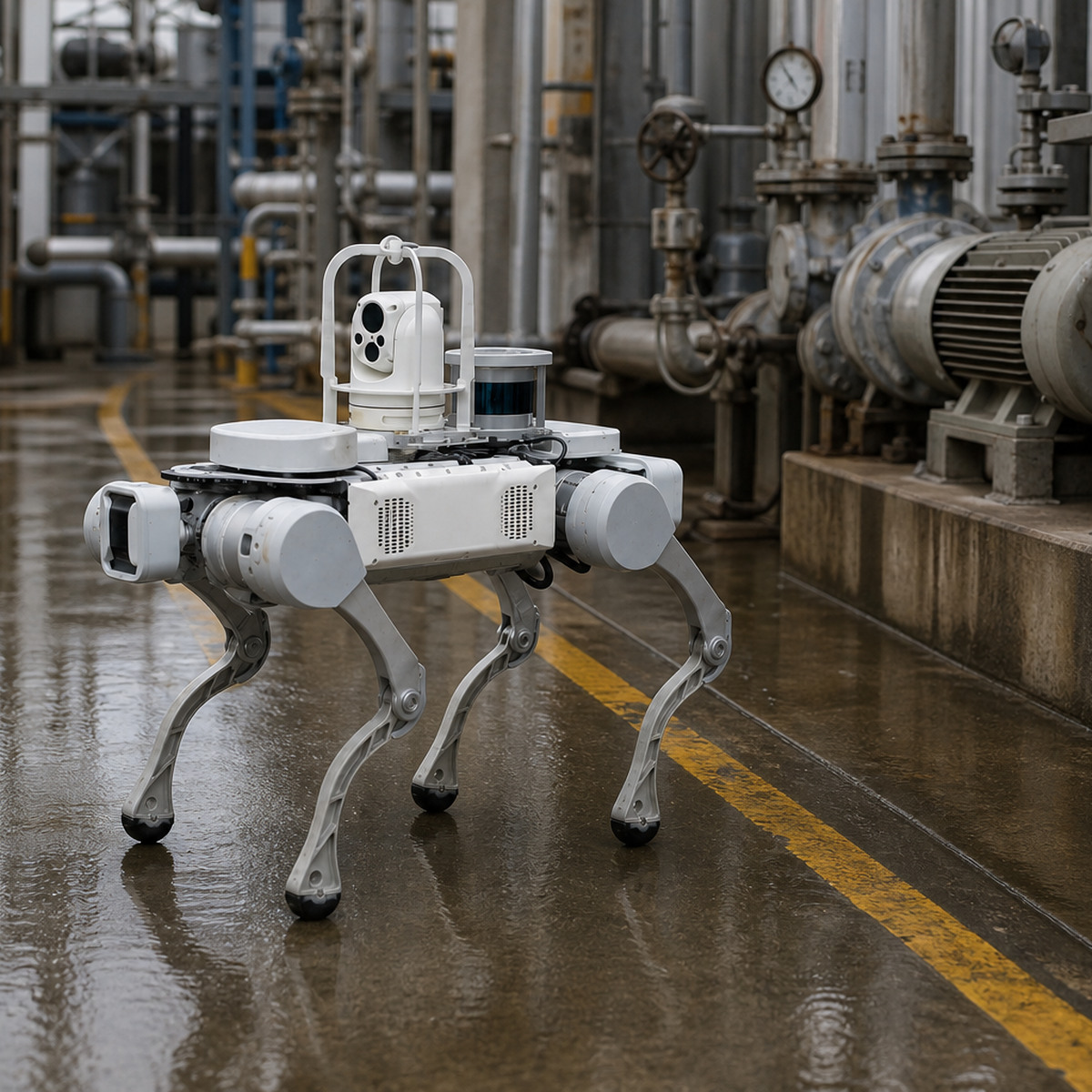
A gas-detection inspection robot can carry sensing into repeatable routes, but mobility does not make the measurement safe, specific or legally sufficient. The buyer decision is whether the configured sensor, sampling method, hazardous-area suitability, calibration process and response workflow can support a clearly bounded task.
Start with the hazard assessment and the existing monitoring program. Then decide what role a mobile system may play within the industrial inspection robotics workflow. It may screen a route, trend ambient readings, investigate a remotely observable area or add evidence around a known process. It should not silently replace required worker-worn monitoring, fixed detection, ventilation, permits or emergency procedures.
Define the gas question precisely
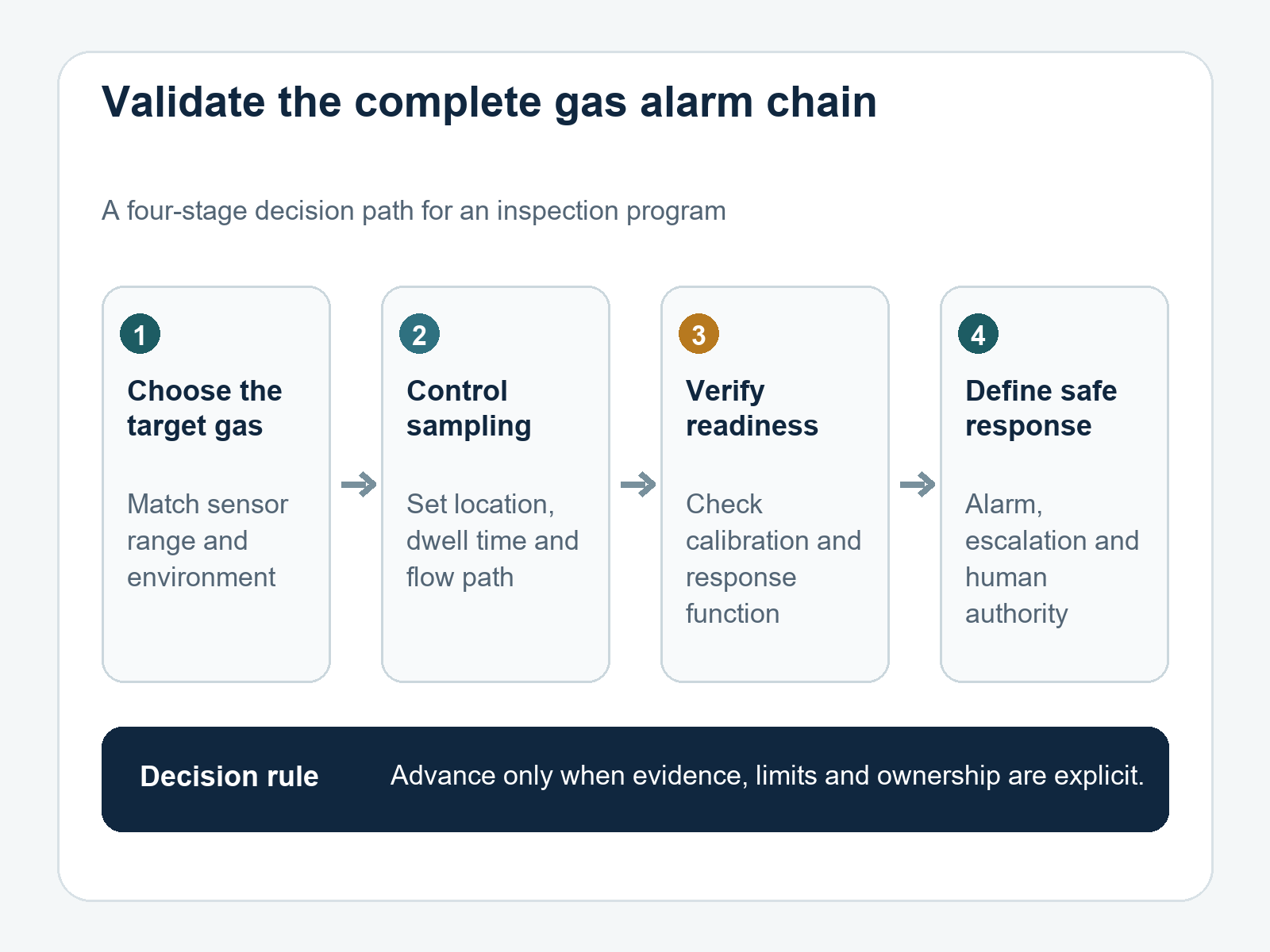
“Detect gas” is not a specification. Identify the substance or hazard class, expected concentration range, response time, cross-sensitivity, environmental conditions, sampling location, required alarm behavior and action. Oxygen deficiency, combustible atmosphere and a specific toxic gas are different measurement problems.
For each route or read point, document:
- target gas or atmospheric condition;
- sensor technology, range and manufacturer-approved use;
- sampling method, inlet height, orientation and pump or diffusion behavior;
- instrument response time and robot dwell time;
- temperature, humidity, pressure, dust, water and interfering-gas limits;
- calibration, bump-test, maintenance and sensor-replacement requirements;
- hazardous-location classification and equipment suitability;
- alarm thresholds, communication path and safe robot response.
A sensor mounted near the robot body may not represent conditions at a worker’s breathing zone, a high or low accumulation point, or inside a stratified space. The sampling geometry must match the decision.
Treat calibration as operating evidence
OSHA’s current guidance on direct-reading portable gas monitors explains that calibration drift changes the relationship between sensor response and the reported value. It recommends following manufacturer instructions, using known test gas to verify response and documenting maintenance and calibration. Temperature, humidity and other workplace conditions can also affect sensor response.
Build those controls into the robot workflow rather than treating the payload as permanently accurate. The operating record should connect the mission with the sensor serial number, configuration, calibration and test status, target gas, route version and environmental conditions. If the instrument fails a test or exceeds its maintenance boundary, the mission should not produce decision-grade gas data.
Match dwell time to sensor response
OSHA’s confined-space atmospheric-testing appendix states that measurements should be taken for at least the instrument manufacturer’s minimum response time. A moving robot can pass through a zone faster than the sensor and sampling line can respond. A map point therefore needs a dwell rule, not only a coordinate.
Account for inlet tubing, pump rate, sample path, robot motion and data update interval. Validate the end-to-end response using a controlled test method approved by the site and sensor manufacturer. Do not infer that a low reading means a clean atmosphere if the system never had time to acquire a representative sample.
Keep gas identity, presence and leak localization separate
Acoustic imaging can help localize some pressurized leaks, while a gas sensor may measure the concentration of a configured target near the robot. These capabilities answer different questions. ANYbotics, for example, documents a configured system that combines an acoustic imaging payload with modular gas detectors. That product example demonstrates that combined mobile sensing is technically available; it does not prove that acoustic output identifies a gas or that a concentration reading locates the release source.
Use separate evidence states:
- an acoustic or process anomaly suggests a possible release;
- a configured gas sensor responds at a recorded location and time;
- a reviewed investigation identifies the likely source;
- the site applies its approved isolation, repair and verification process.
Resolve hazardous-area suitability before route testing
Do not assume a robot or instrument is suitable for a potentially explosive atmosphere. OSHA technical guidance warns users to check the marked Class and Division for electrical devices brought into such areas and not to assume an instrument is intrinsically safe. The applicable jurisdiction, site classification and entire configured system—including battery, payload, connectors, communications hardware and accessories—need qualified review.
If the equipment is not approved for the intended area and condition, redesign the route, sampling method or operating boundary. A remote robot does not remove the ignition hazard created by unsuitable equipment.
Validate the complete alarm chain
Test more than sensor response. The pilot should verify:
- known-gas response and alarm behavior under an approved test method;
- sample timing at stationary and moving route segments;
- asset, location, timestamp and calibration association;
- communication loss, data buffering and duplicate-alert handling;
- robot stop, retreat or safe-hold behavior when an alarm occurs;
- operator acknowledgement, escalation and emergency notification;
- closure evidence after an investigation or maintenance action.
Include invalid cases: expired calibration gas, failed bump test, blocked inlet, depleted battery, lost network, environmental limits exceeded and sensor not approved for the target gas. The safest response may be to invalidate the mission and escalate, not continue collecting uncertain data.
Do not confuse remote inspection with entry authorization
For permit-required confined spaces in U.S. general industry, OSHA requires an employer program and specified testing, monitoring, communications and rescue controls when employees enter. A robot may gather useful preliminary information, but it does not by itself certify acceptable entry conditions or eliminate other physical hazards such as engulfment, mechanical energy or restricted egress.
Have a qualified safety professional determine how robotic data can be used in the site’s program and jurisdiction. Keep worker monitoring and emergency controls independent where required.
Use a go, revise or stop gate
Proceed only when the target gases, sensor capability, sampling geometry, route, equipment classification, calibration method, alarm path and operating ownership are all defined. Revise when the route can work but the sensor placement, dwell or communications need changes. Stop when the robot is unsuitable for the hazardous area, the gas cannot be measured with adequate specificity, or the organization cannot support testing and response.
Related safety boundary: When the task is near or inside a confined space, use the confined-space inspection guide; remote gas readings do not authorize entry or remove rescue obligations.
Sources and scope
This article summarizes U.S. federal guidance and a first-party product example for a general decision framework. Requirements vary by jurisdiction and operation. It is not legal, industrial-hygiene or emergency-response advice and does not document a Warpify deployment.
- Calibrating and Testing Direct-Reading Portable Gas Monitors — U.S. Occupational Safety and Health Administration
- 1910.146 Appendix B: Procedures for Atmospheric Testing — OSHA
- OSHA Technical Manual, Section II, Chapter 3 — OSHA
- Robotic Gas Leak and Presence Detection for ANYmal — ANYbotics
Take the next step
Bring the hazard assessment, gas list, area classification and current monitoring procedure to a scoped review: request an industrial inspection assessment.

Iven Wang
Iven Wang is the Co-Founder of Warpify Robotics, specializing in the commercialization and deployment of robotic solutions. With a background in electrical engineering and product management, he works with manufacturers, integrators, and enterprise clients across industrial inspection, security, logistics, and Robotics-as-a-Service.
Subscribe to our newsletter today
Get practical robotics deployment insights, case studies, and planning guidance from Warpify Robotics.