Confined-Space Robot Inspection: Entry Reduction and Rescue Boundaries
A safety-led method for remote confined-space inspection tasks, atmospheric evidence, hazard limits, robot recovery and human rescue boundaries.
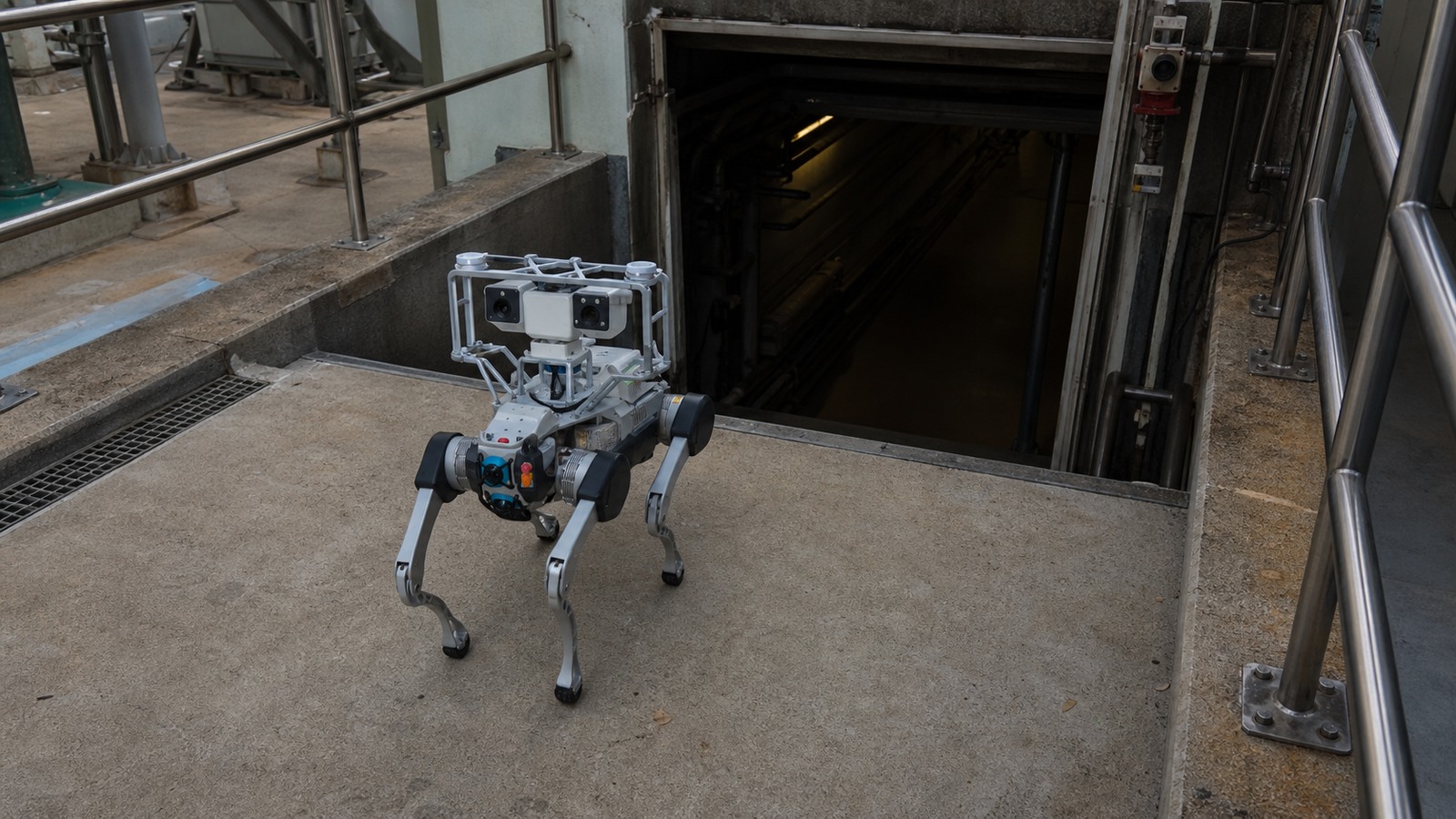
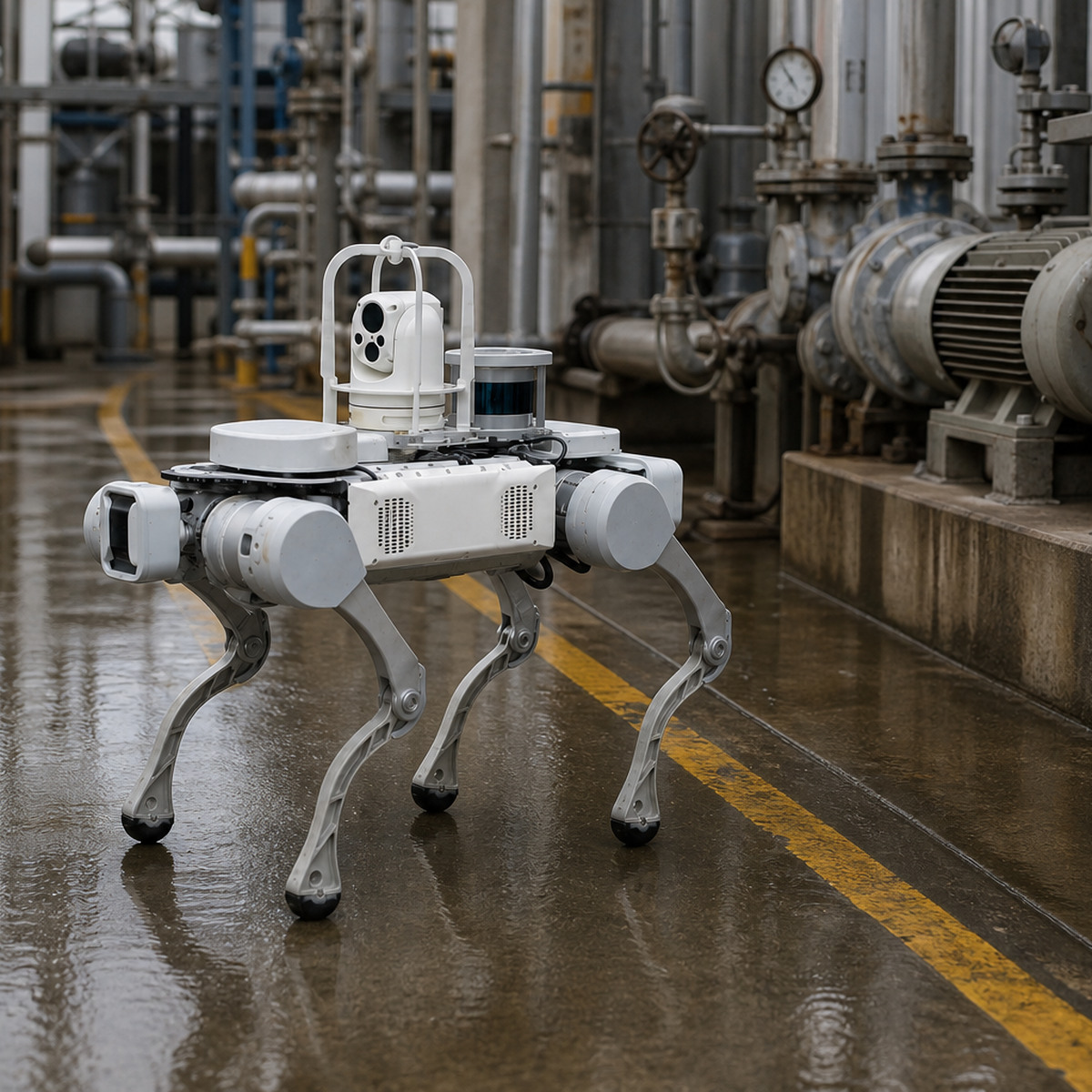
A confined-space inspection robot can collect visual, thermal, acoustic or atmospheric information without a person crossing the opening for some tasks. That can reduce selected entries, but it does not reclassify a space, authorize entry, eliminate non-atmospheric hazards or replace rescue planning.
The decision is whether remote inspection can answer a bounded question while fitting the site’s confined-space program. Start with the space, hazards and required evidence. Then evaluate the industrial inspection robotics workflow as one controlled method within—not outside—the safety system.
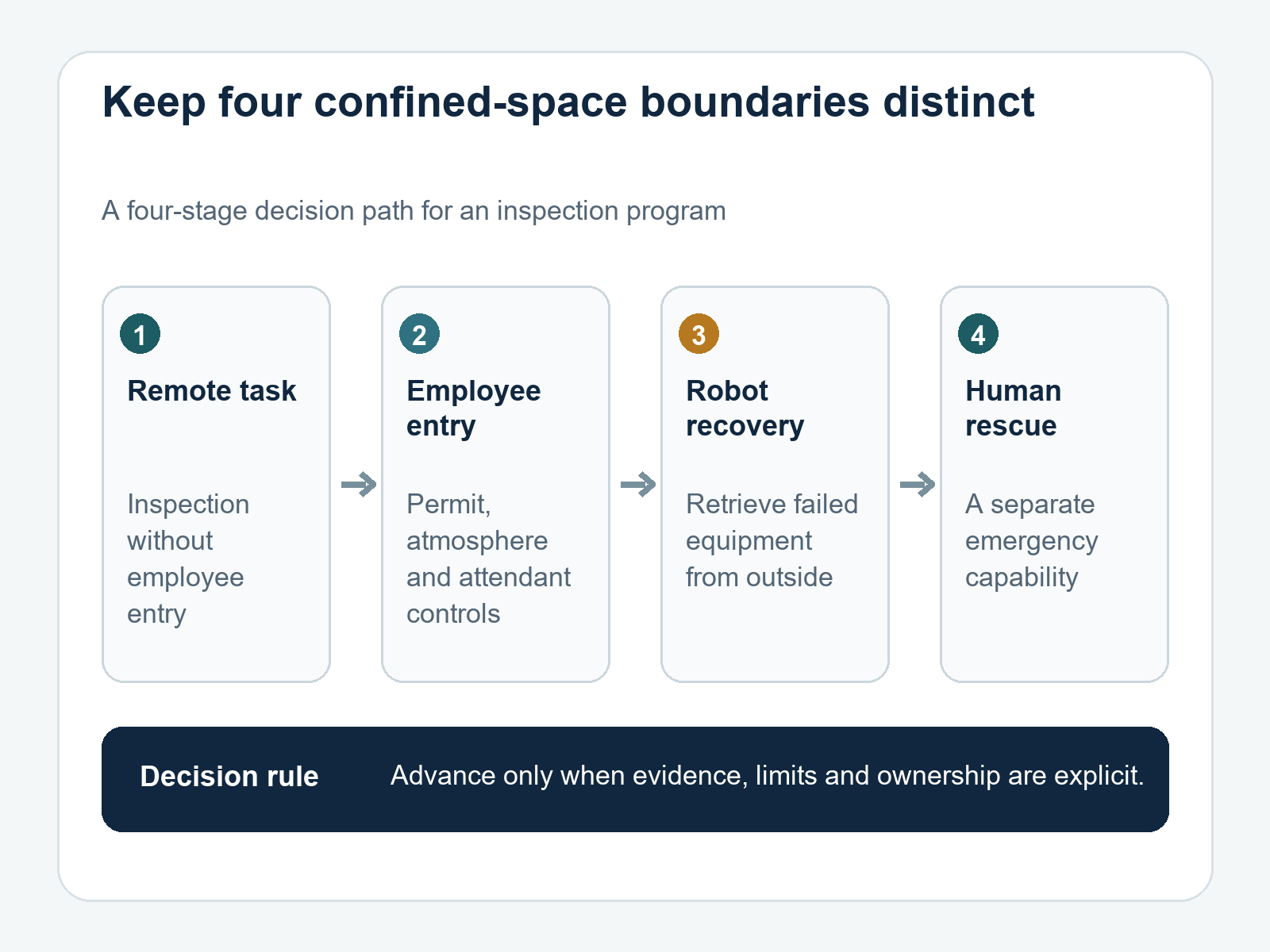
Define entry and the space correctly
Under the U.S. Occupational Safety and Health Administration’s general-industry rule, a confined space is large enough for an employee to enter and work, has limited or restricted entry or exit, and is not designed for continuous occupancy. OSHA defines entry as beginning when any part of a person’s body breaks the plane of an opening.
A robot passing through the opening is not employee entry under that definition. However, a worker leaning through to place, retrieve or free the robot may create an entry. Design deployment, tether, retrieval and recovery so that routine robot handling does not encourage an unplanned human action across the boundary.
Choose tasks that can be completed remotely
Remote inspection may fit tasks such as initial visual observation, route mapping, standing-water checks, visible obstruction assessment, selected thermal or acoustic observations and configured atmospheric sampling. Fit depends on the opening, internal geometry, surface, lighting, communications, contamination, sensor needs and recovery method.
Write a task statement:
- which space and zone are in scope;
- which question the remote inspection must answer;
- which sensors, views and sample locations are required;
- which hazards may affect the robot and people outside the space;
- what evidence is valid, uncertain or incomplete;
- what condition triggers entry, specialist investigation or a stop decision.
Do not treat “robot inspected” as proof that every hazard was found. The payload can only observe what its method, field of view, sample path and route support.
Keep atmospheric testing tied to the program
OSHA’s atmospheric-testing appendix distinguishes evaluation testing from verification of acceptable entry conditions. It requires equipment with sufficient sensitivity and specificity for the hazards that may exist, and measurements taken for at least the instrument manufacturer’s minimum response time. It also addresses stratified atmospheres and sampling progression.
A mobile gas sensor can be valuable, but the site must determine whether its sampling height, inlet, pump, response time and route represent the required zones. Record calibration and test state, sample location, dwell, route version and environmental conditions. A low value from an unrepresentative path is not evidence that the entire space is safe.
For U.S. permit-space entry, OSHA requires testing for oxygen, then combustible gases and vapors, then potential toxic air contaminants in the specified context. Have a qualified safety professional determine how robotic data contributes to—rather than substitutes for—the required process.
Map hazards the robot cannot remove
Remote visibility or atmospheric sensing does not eliminate engulfment, stored energy, inwardly converging walls, mechanical movement, electrical hazards, unstable surfaces, heat, contamination or restricted egress. Build a hazard-to-evidence matrix that states:
- hazard or uncertainty;
- robot sensor or observation that may contribute evidence;
- blind spots and limitations;
- other isolation, testing or control required;
- qualified owner and decision.
If the robot cannot observe a critical area or its communications fail in the relevant geometry, report the inspection as incomplete. Do not infer a safe condition from missing data.
Design robot recovery before deployment
A disabled robot can create a new pressure to enter. Decide before the mission whether it may be abandoned temporarily, retrieved remotely, pulled by a rated tether or recovered only under a separately authorized entry. Consider snagging, sharp edges, contamination, battery hazards, obstruction and the possibility that a tether changes mobility or measurement geometry.
The recovery plan should include:
- approved launch and retrieval position outside the opening;
- maximum allowed reach and no-go zones;
- loss-of-communications and low-energy behavior;
- remote reverse, safe hold and power-isolation options;
- criteria for abandoning the robot;
- authority and procedure for any later human recovery.
No operator should improvise an entry because the equipment is valuable or blocks the opening.
Do not weaken rescue planning
When people enter a permit-required confined space, OSHA’s rule includes requirements for attendants, communications, rescue and emergency services, and retrieval systems where applicable. A prior robot inspection does not remove those obligations. It may improve planning by providing current images or geometry, but rescue capability must still match the identified hazards and space.
Keep robot recovery and human rescue as separate plans. A tether suitable for pulling a small robot is not a personnel retrieval system. A remote video feed is not an attendant. A mapped route is not proof that an incapacitated person can be recovered.
Validate in a representative space
Test the system in a controlled environment that represents the opening, bends, drops, obstacles, surfaces, lighting and communications challenges. Validate:
- launch and retrieval without crossing the entry plane;
- mobility and stability in representative geometry;
- sensor field of view, focus, lighting and sample timing;
- communications and evidence continuity;
- loss-of-link, immobilization and contamination responses;
- clear reporting of inspected, uninspected and uncertain zones.
Then run a site-specific pilot under approved controls. Stop if the robot blocks egress, damages isolation, introduces an ignition or contamination concern, cannot be retrieved as planned, or encourages personnel to cross the opening informally.
Use a decision boundary
A strong outcome may be “remote inspection answered the visual question, so no entry is needed for this task.” Another may be “the robot found a condition that requires a separately planned entry.” Both are valid. The goal is not to claim that confined-space entry has been eliminated; it is to make a documented, task-specific decision with less avoidable exposure where the method supports it.
Use the industrial inspection deployment guide to assess mobility, communications, payload and operating ownership before field use.
Related safety boundary: If atmospheric evidence is part of the task, apply the gas-detection inspection guide without treating robot data as an entry permit or a replacement for required monitoring.
Sources and scope
This article summarizes selected U.S. federal general-industry requirements and provides an editorial robotics workflow. Other jurisdictions and sectors may impose different or additional requirements. It is not legal, safety-engineering or industrial-hygiene advice and does not document a Warpify deployment.
- 29 CFR 1910.146: Permit-Required Confined Spaces — U.S. Occupational Safety and Health Administration
- 1910.146 Appendix B: Procedures for Atmospheric Testing — OSHA
- Calibrating and Testing Direct-Reading Portable Gas Monitors — OSHA
Take the next step
Bring the space inventory, permit program, hazard assessment and current inspection task into a scoped review: request an industrial inspection assessment.

Iven Wang
Iven Wang is the Co-Founder of Warpify Robotics, specializing in the commercialization and deployment of robotic solutions. With a background in electrical engineering and product management, he works with manufacturers, integrators, and enterprise clients across industrial inspection, security, logistics, and Robotics-as-a-Service.
Subscribe to our newsletter today
Get practical robotics deployment insights, case studies, and planning guidance from Warpify Robotics.