Case Study
Aug 4, 2026

Robotic Solar Panel Cleaning for a 12,000 m² Hillside PV Site in Austria

Warpify Robotics helped a confidential Austrian renewable energy operator evaluate robotic cleaning for a 12,000 m² hillside photovoltaic installation, selecting a slope-capable platform and developing a localized workload, labour-cost and controlled-pilot plan.

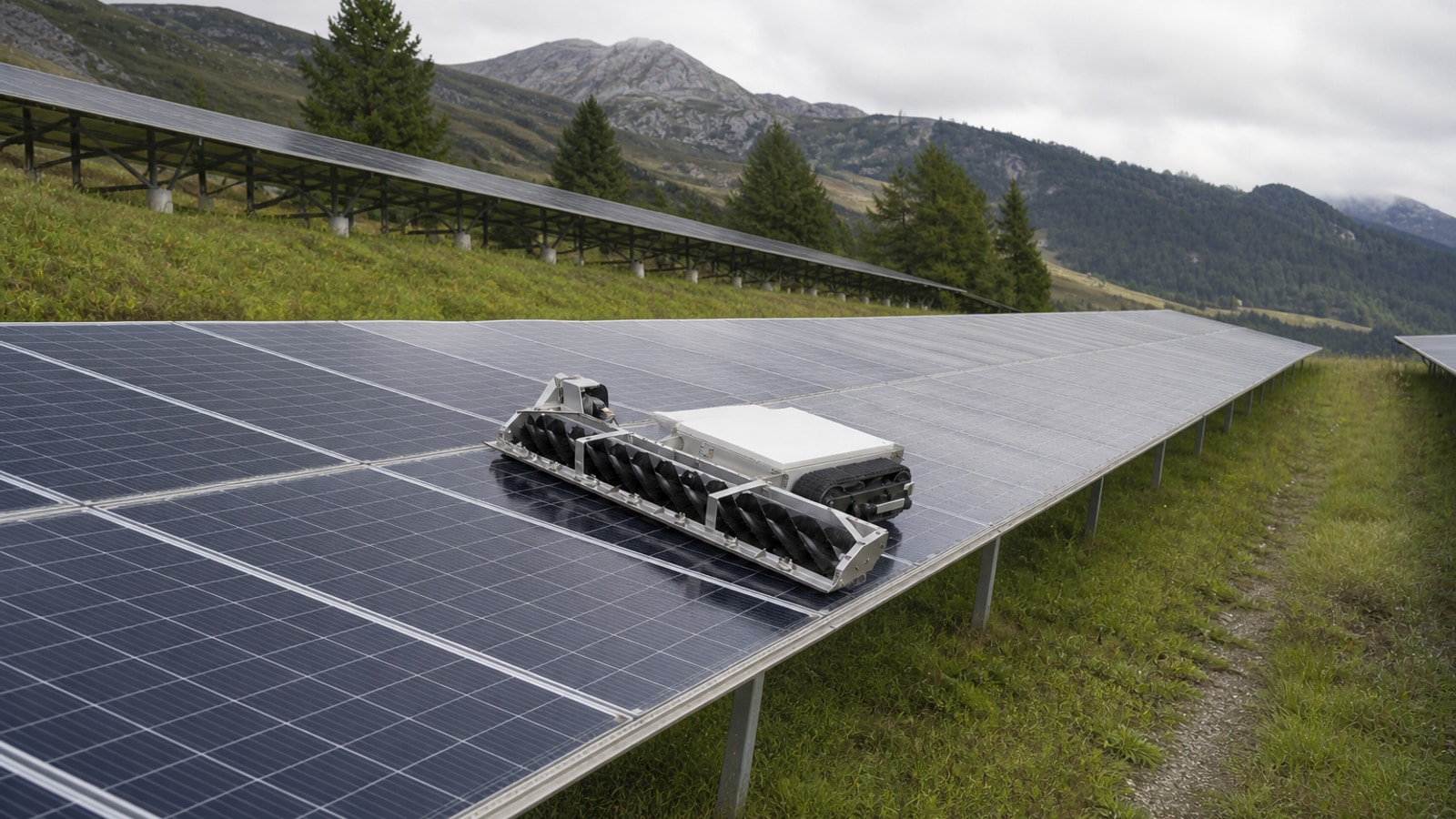
AI-generated wide illustration of a tracked solar panel cleaning robot operating on a hillside PV array in the Austrian alpine foothills.

How Warpify Robotics helped a renewable energy operator turn a complex maintenance requirement into a quantified, pilot-ready robotic cleaning program

Project at a Glance

Scroll horizontally to compare all columns.

Project detail Information
Customer Confidential Renewable Energy Operator
Location Austria
Industry Renewable Energy
Application Photovoltaic module cleaning automation
Site type Hillside solar photovoltaic installation
Cleaning scope Approximately 12,000 m²
Primary module inclination Approximately 20°
Selected platform HXBOT HX-PC-A25 Pro
Project phase Application assessment and controlled-pilot design
Warpify scope Robot selection, workflow engineering, operating model, pilot planning and production-readiness assessment

Executive Summary

A renewable energy operator in Austria engaged Warpify Robotics to evaluate robotic cleaning for approximately 12,000 m² of photovoltaic modules installed across an inclined hillside array.

The customer was not simply looking for a machine that could travel over a solar panel. It needed a complete operating model covering array geometry, module protection, cleaning quality, water handling, battery logistics, human supervision, row-to-row transfers, weather restrictions and safe recovery.

Warpify evaluated the site requirements, compared available cleaning technologies and selected the HXBOT HX-PC-A25 Pro as the preferred platform for a controlled pilot.

The project delivered:

  • A technically matched robot platform
  • A defined human–robot cleaning workflow
  • A three-scenario workload model
  • A localized Austrian labour-cost framework
  • Site-survey and pilot requirements
  • Measurable production-readiness gates
  • A lower-risk basis for future procurement

The customer moved from a broad interest in solar-cleaning robotics to a structured implementation plan with clearly defined assumptions, responsibilities and success criteria.

Base-Case Planning Snapshot

Scroll horizontally to compare all columns.

Planning metric Base-case value
Cleanable surface 12,000 m²
Modelled net throughput 390 m²/h
Robot operating time 30.8 hours
Four-hour operating blocks 8
Estimated operator touch time 14.8 hours
Minimum direct operator-labour benchmark Approximately €300–€340 per cycle

The operating and labour figures above are planning estimates. They are not measured production results and do not include equipment ownership, transport, water, maintenance, insurance, supervision or site-infrastructure costs.

Why This Project Matters

Austria’s photovoltaic market continues to expand rapidly. IEA PVPS’s 2024 national survey reports that the country added 2.51 GW of photovoltaic capacity during 2024, bringing cumulative installations to 9.4 GW DC. Around 500,000 PV systems were operating nationwide, and PV generation supplied approximately 11.4% of national electricity consumption.

As the installed solar asset base grows, so does the need for scalable inspection, vegetation management, fault detection and module-cleaning workflows.

Soiling can include:

  • Dust and airborne pollution
  • Pollen
  • Bird droppings
  • Agricultural residue
  • Biological material
  • Industrial contaminants
  • Uneven deposits around module edges

IEA PVPS estimates that soiling is responsible for an average of 4–7% of global PV energy losses, while emphasizing that cleaning schedules and mitigation methods must be matched to site conditions.

For the Austrian customer, this meant that neither a generic soiling percentage nor a manufacturer’s cleaning-capacity figure could justify the investment. The decision had to be based on the site’s actual contamination, electricity-production data, cleaning costs and operational constraints.

The Customer Challenge

The customer operated a large photovoltaic installation across inclined terrain, where cleaning formed part of the wider asset-maintenance program.

Several characteristics made conventional cleaning difficult to scale.

A Large Cleaning Surface

The project covered approximately 12,000 m² of accessible module surface.

At this scale, cleaning is no longer a simple manual maintenance task. It requires the coordination of personnel, water, access equipment, cleaning tools, quality inspection and weather windows.

Inclined Terrain and Module Rows

The primary module inclination was approximately 20°.

The combination of slope, smooth module surfaces and row edges increased the importance of:

  • Robot traction
  • Controlled braking
  • Stable turning
  • Reliable stopping
  • Safe placement
  • Safe equipment recovery

Variable Array Geometry

The installation included details that could affect robot movement:

  • Module frames
  • Clamps
  • Inter-module gaps
  • Row ends
  • Cable routes
  • Level changes
  • Structural transitions
  • Inaccessible sections

A published obstacle-crossing specification could not establish whether the robot would safely pass every feature at the site.

Dependence on Weather and Site Logistics

The customer also had to coordinate cleaning with:

  • Rain and moisture
  • Frost, ice and snow
  • Wind conditions
  • Water availability
  • Battery charging
  • Robot transfers
  • Operator access
  • Ongoing plant activities

Module and Warranty Protection

Any contact-based cleaning method had to avoid damaging:

  • Module glass
  • Anti-reflective coatings
  • Frames and seals
  • Electrical cables
  • Mounting structures

The customer therefore needed more than a cleaning robot. It needed a repeatable, measurable and safe robotic maintenance process.

The Local Austrian Cost Context

Cleaning Labour

Under Austria’s 2026 collective wage schedule for monument, façade and building cleaning, the minimum gross hourly wage is €13.30 for a special cleaner and €15.12 for a worker who has completed the cleaning-technology apprenticeship examination. The special-cleaning category includes work such as façade, window and machine cleaning, although the exact classification for a solar-cleaning employee depends on the employment arrangement and assigned duties.

The collective agreement also provides holiday and Christmas remuneration, each equivalent to 4.33 weeks or one month of pay. WKO describes Austrian employer payroll on-costs as approximately 29.6% of gross pay. Using those inputs as a simplified planning benchmark produces a direct employer cost of approximately:

  • €20.10 per paid hour for a special cleaner
  • €22.86 per paid hour for a worker with the completed cleaning-technology apprenticeship examination

This still excludes travel, vehicles, tools, protective equipment, supervision, paid non-productive time, insurance and contractor margin.

Applying that minimum direct-cost range to Warpify’s model produces the following operator-labour benchmark:

Scroll horizontally to compare all columns.

Scenario Operator touch time Minimum direct labour benchmark
Downside 24.2 hours €487–€553
Base case 14.8 hours €298–€338
Upside 9.7 hours €195–€222

These figures estimate only the direct labour associated with robot attendance. They are not the total cost of robotic cleaning.

External Cleaning-Service Reference

One Linz-area PV-cleaning provider publicly advertises prices from €4 per m², depending on access, inclination, contamination and safety requirements. Applied mechanically to 12,000 m², that single-provider reference would imply €48,000 per cleaning event.

This is a broad public-market reference—not a comparable quotation for the customer’s site. Large commercial tenders may be priced differently, and the customer’s hillside geometry could either increase or reduce the actual rate.

The comparison nevertheless illustrates why the operator had a legitimate reason to evaluate an owned or service-based robotic model.

Warpify’s Solution

Warpify approached the project as a workflow-engineering engagement, following the same workflow-first principles described in its robotics solution assessment guide—not as a hardware sale.

The work covered five interconnected areas.

1. Application Assessment

Warpify translated the customer’s general interest in automation into a defined application boundary.

The assessment covered:

  • Cleaning area
  • Module inclination
  • Row geometry
  • Contamination types
  • Existing maintenance method
  • Water availability
  • Battery and charging logistics
  • Operator access
  • Seasonal operating conditions
  • Module-protection requirements
  • Support and maintenance needs

2. Technology Comparison

Four primary cleaning methods were considered.

Scroll horizontally to compare all columns.

Technology Advantages Limitations Suitability
Manual cleaning Simple equipment and low entry cost Labour-intensive and difficult to scale Limited
Deployable tracked robot Portable and suitable for segmented arrays Requires placement, transfers and supervision Strongest fit
Permanently installed row robot Supports frequent automated cleaning Requires uniform rows and greater infrastructure modification Limited for this site
Vehicle-scale cleaning equipment Very high throughput Large footprint and strict access requirements Disproportionate

A deployable tracked robot offered the best balance between portability, slope capability, cleaning capacity and infrastructure requirements.

3. Robot Selection

Warpify selected the HXBOT HX-PC-A25 Pro as the preferred controlled-pilot platform.

Published Equipment Specifications

Scroll horizontally to compare all columns.

Specification HX-PC-A25 Pro
Dimensions 1,100 × 880 × 280 mm
Machine weight 40 kg
Published operating angle 0–25°
Nominal cleaning capacity 600 m²/h
Maximum travel speed 15 m/min
Published endurance 4 hours
Cleaning mechanism Dual rotating brushes
Water capacity Up to 10 litres
Operating modes Semi-automatic and automatic
Power source Battery
Protection rating IP65
Published obstacle height 5 cm
Published obstacle width 20 cm

These are manufacturer specifications rather than measured customer-site results.

Why the Platform Was Selected

Slope Capability

The approximately 20° installation angle fell within the platform’s published 0–25° operating envelope.

Because the site was relatively close to the upper limit, Warpify did not treat the specification as proof of compatibility. Traction, braking, turning and recovery still had to be demonstrated on representative rows.

Deployable Form Factor

At 40 kg, the robot was smaller and more portable than vehicle-scale solar-farm cleaning systems.

It could be moved between separate operating zones, subject to a properly designed handling and lifting procedure.

Integrated Cleaning System

The dual-brush configuration supported a repeatable mechanical cleaning process. The integrated water tank reduced reliance on a continuously dragged hose.

The project nevertheless had to measure:

  • Water use per square metre
  • Refill frequency
  • Effectiveness on different contaminants
  • Residue and streaking
  • Brush wear
  • Water-quality requirements

Four-Hour Published Endurance

The stated four-hour battery endurance provided a useful basis for planning multi-block cleaning operations.

Actual endurance could vary according to:

  • Temperature
  • Battery condition
  • Slope
  • Brush resistance
  • Water load
  • Contamination
  • Intervention frequency

Warpify therefore used the endurance figure as a planning boundary rather than a guaranteed field result.

Human-Supervised Automation

The robot could automate travel and brush cleaning while keeping trained personnel responsible for:

  • Inspection
  • Placement
  • Supervision
  • Transfers
  • Water handling
  • Battery logistics
  • Quality control
  • Fault response
  • Recovery

This matched the customer’s requirement for controlled automation rather than immediate unattended operation.

The Designed Robotic Workflow

Step 1 — Prepare the Operating Window

Before work begins, the operator verifies:

  • Dry and ice-free modules
  • Acceptable wind conditions
  • Approved temperature range
  • Battery status
  • Brush and track condition
  • Water supply
  • Communication coverage

Step 2 — Secure the Work Zone

The team establishes safe placement, transfer and recovery areas.

Personnel are kept away from positions where a robot could slide or fall during abnormal operation.

Step 3 — Position the Robot

The robot is placed on an approved module row using the defined handling procedure.

Each materially different row type is validated separately.

Step 4 — Execute the Cleaning Pass

The robot performs the programmed or operator-controlled cleaning movement.

The operator monitors:

  • Direction
  • Traction
  • Braking
  • Edge behaviour
  • Communications
  • Cleaning quality

Step 5 — Inspect the Completed Row

The operator checks for:

  • Residue
  • Streaks
  • Missed areas
  • Incomplete contaminant removal
  • Visible module damage
  • Need for rework

Step 6 — Transfer and Service

The robot is moved to the next approved row.

The operator checks:

  • Water level
  • Battery state
  • Brush condition
  • Track condition
  • Sensor cleanliness

Step 7 — Manage Exceptions

Work stops if the system encounters:

  • Communication loss
  • Unstable traction
  • Unexpected edge behaviour
  • Battery abnormality
  • Track or brush damage
  • Water-system failure
  • Frost, snow or moisture
  • Unsafe wind
  • Module damage

Step 8 — Close the Cleaning Cycle

The team completes a final inspection and records operating data for future planning.

Cleaning-Cycle Operating Model

The manufacturer’s 600 m²/h nominal rate could not be applied directly to the complete installation.

Real operation includes:

  • Turning
  • Placement and recovery
  • Row transfers
  • Water refilling
  • Battery servicing
  • Inspections
  • Minor interventions
  • Cleaning-quality checks

Warpify therefore developed three field-realisation scenarios.

Scroll horizontally to compare all columns.

Scenario Field-realisation factor Net throughput Robot operating time Four-hour blocks Operator touch time
Downside 55% 330 m²/h 36.4 hours 10 24.2 hours
Base case 65% 390 m²/h 30.8 hours 8 14.8 hours
Upside 75% 450 m²/h 26.7 hours 7 9.7 hours

The base model produced a practical planning figure of:

Approximately 30.8 robot operating hours and 14.8 operator-hours for one 12,000 m² cleaning cycle.

This was substantially more useful for pilot planning than the theoretical calculation of 600 m²/h multiplied by four hours.

Safety and Operational Readiness

Austria’s Labour Inspectorate guidance for photovoltaic maintenance requires employers to evaluate the work and apply appropriate fall-protection measures where PV maintenance involves elevated access or fall exposure.

Although the project concerned a hillside array rather than a conventional rooftop system, Warpify applied the same principle: automation should reduce direct exposure without introducing a new recovery or falling-equipment hazard.

The pilot therefore required evidence in six areas, aligned with the broader controls in Warpify’s robot deployment readiness checklist.

Scroll horizontally to compare all columns.

Readiness gate Evidence required
Module compatibility Brush, water and contact-load approval
Motion stability Traction, braking, turning and stopping tests
Cleaning quality Before-and-after inspection and rework rate
Operational capacity Measured area, time, transfers and interventions
Weather boundary Approved wind, moisture, frost and temperature limits
Support readiness Documentation, training, spare parts and response process

EU machinery requirements were also included in the forward plan. Regulation (EU) 2023/1230 applies from 20 January 2027, making documentation, conformity assessment, the supplied configuration and importer responsibilities relevant to any production deployment.

Project Outcomes

The project produced six concrete results for the customer.

1. A Defined Automation Scope

The customer moved from a general enquiry about cleaning robots to a clearly bounded 12,000 m² application.

2. A Matched Robot Platform

The platform was selected against the site’s actual slope, size, geometry and operating requirements—not simply because it had the highest published throughput.

3. A Realistic Workload Model

The customer received three planning scenarios that accounted for real field activities rather than relying only on nominal brush speed.

4. A Localized Labour Framework

Austrian wage, employer-cost and external-service references were incorporated into the commercial evaluation.

5. A Complete Human–Robot Workflow

The project defined which tasks would be automated and which would remain the responsibility of trained personnel.

6. A Lower-Risk Procurement Path

The customer received clear gates separating:

  • Product interest
  • Technical compatibility
  • Pilot acceptance
  • Production readiness
  • Full commercial deployment

Before and After the Engagement

Scroll horizontally to compare all columns.

Before Warpify’s assessment After Warpify’s assessment
Broad interest in robotic cleaning Defined 12,000 m² application
Dependence on vendor specifications Site-adjusted performance scenarios
Unclear operator responsibilities Defined human–robot workflow
Unknown row and slope risks Controlled pilot requirements
No local labour-cost framework Austrian cost benchmarks
Unstructured procurement decision Evidence-based production gates

Next Phase: Replacing Assumptions with Site Data

The controlled pilot is designed to measure:

  • Actual net throughput
  • Operator touch time
  • Water consumption
  • Battery endurance
  • Transfer time
  • Intervention frequency
  • Cleaning-quality acceptance
  • Module impact
  • Equipment availability
  • Weather-related stoppages
  • Before-and-after energy performance

These measurements will allow the customer to build a site-specific robot ROI and total-cost model and calculate:

  • Cost per cleaned square metre
  • Cost per cleaning cycle
  • Labour hours displaced or redeployed
  • Optimal cleaning frequency
  • Energy value recovered
  • Equipment payback
  • Purchase-versus-RaaS economics

Why Warpify Robotics

Warpify Robotics delivers complete robotics application solutions rather than isolated equipment.

Our role can include:

  • Application discovery
  • Site assessment
  • Vendor-neutral platform selection
  • Workflow engineering
  • Integration and customization
  • Pilot implementation
  • Performance validation
  • Operator training
  • Maintenance planning
  • Robotics-as-a-Service

For renewable energy operators, the same deployment framework can support:

  • Thermal and visual PV inspection
  • Autonomous plant patrol
  • Security and perimeter monitoring
  • Vegetation-condition monitoring
  • Predictive-maintenance data collection
  • Multi-robot fleet management

The objective is not merely to place a robot at a site.

It is to build an operating system around the robot that is safe, measurable, supportable and economically justified.

Conclusion

This Austrian project demonstrates how robotics can be evaluated responsibly in a real renewable-energy maintenance environment.

Warpify helped the customer move beyond headline specifications and answer the questions that determine whether automation will work in practice:

  • Can the robot safely operate on the actual array?
  • What level of human supervision is required?
  • How long will a full cleaning cycle take?
  • What site infrastructure is needed?
  • How should success be measured?
  • What evidence is required before procurement?

The result was a quantified, pilot-ready robotic cleaning program tailored to a 12,000 m² hillside photovoltaic installation.

Successful solar-maintenance automation begins with the workflow—not the robot specification.

Plan Your Photovoltaic Robotics Workflow

Planning to automate cleaning, inspection or maintenance at a photovoltaic facility?

Request a Robotics Workflow Assessment to evaluate your site, compare suitable robot platforms and build a measurable deployment and business case.

Evidence Note

This case study describes a real Warpify customer engagement. The customer’s identity and certain commercial and operational details remain confidential.

Customer project inputs, manufacturer specifications, public Austrian market data and Warpify planning estimates have been kept separate. Modelled throughput and labour figures are not represented as measured production results.

Iven Wang, Co-Founder of Warpify Robotics.

Iven Wang

Co-Founder

Iven Wang is the Co-Founder of Warpify Robotics, specializing in the commercialization and deployment of robotic solutions. With a background in electrical engineering and product management, he works with manufacturers, integrators, and enterprise clients across industrial inspection, security, logistics, and Robotics-as-a-Service.

Subscribe to our newsletter today

Get practical robotics deployment insights, case studies, and planning guidance from Warpify Robotics.
Thank you! Your submission has been received!
Oops! Something went wrong while submitting the form.