Solar Panel Cleaning Robot Site Assessment: Geometry, Soiling and Access
Assess solar array geometry, module limits, soiling, access, utilities and operator handling before selecting a panel cleaning robot.
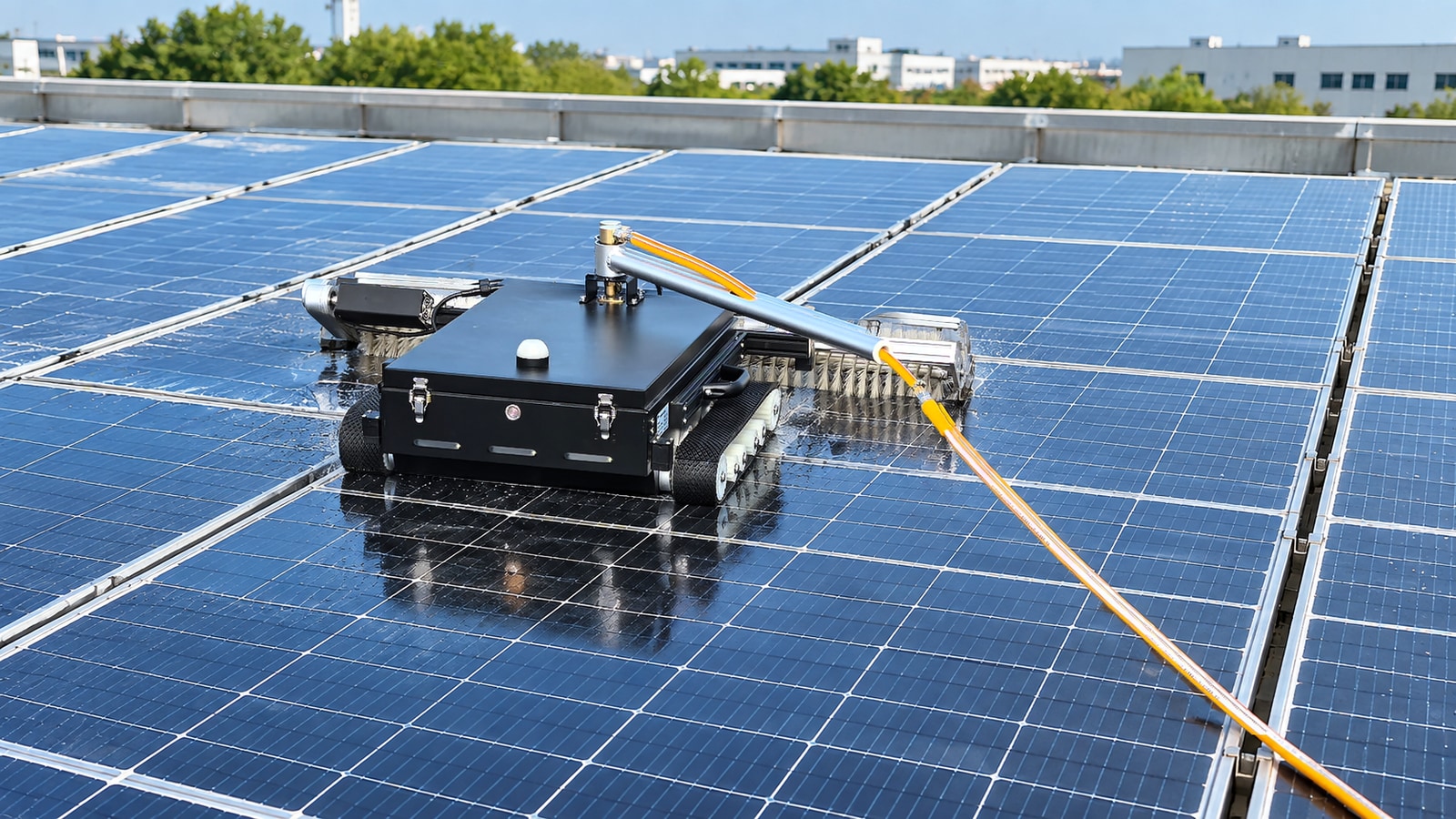
A solar panel cleaning robot site assessment should determine which parts of an array are mechanically compatible, worth cleaning and accessible through a safe operating process. Site capacity alone is a poor basis for selecting a cleaner. Row geometry, module restrictions, soiling patterns and handling effort can change the answer within the same plant.
Begin with the scope of solar panel cleaning robotics: the array sections to be maintained, the current cleaning method and the people who will operate and recover the equipment. Keep rooftop and ground-mounted sections separate when their access and protection requirements differ.
Map the array into compatible sections
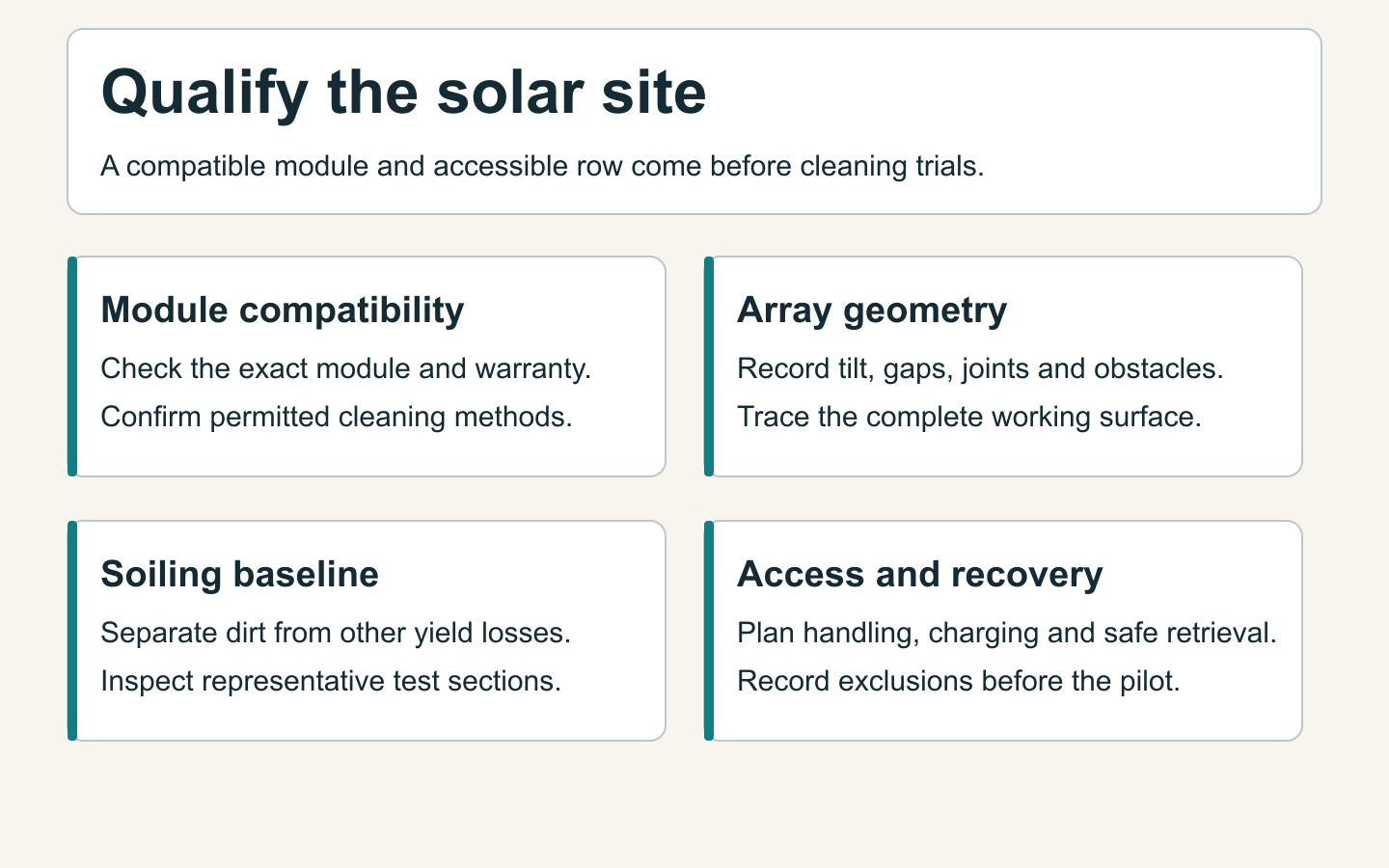
Record module model, dimensions, orientation, row length, tilt, table arrangement, frame height and gaps. Identify mounting clamps, cable paths, damaged modules, protrusions, uneven transitions and row ends. For trackers, document the approved cleaning position and who controls movement during cleaning.
Create a section map that distinguishes compatible areas, areas requiring further measurement and excluded areas. A single photograph of a smooth row does not establish compatibility across the array. Verify the selected cleaner’s documented limits against the measured geometry and its actual installed brush and track configuration.
Ask how the cleaner transfers between rows or tables. If staff must lift or carry it, that handling work belongs in the operating plan and capacity calculation.
Confirm module and mounting constraints before a trial
Obtain the current manual and warranty conditions for the modules actually installed. The Trinasolar Vertex manual reviewed for this guide contains robot-cleaning requirements concerning brush material, scratching and robot weight. Those requirements illustrate why module-specific approval belongs before robot selection; they do not establish compatibility for another module or every Vertex installation.
Ask the module and mounting suppliers to review the proposed loading, contact surfaces, cleaning method and operating conditions. Record the exact robot configuration and any permitted adjustments. A sales demonstration on another array cannot replace this review.
Have the site’s qualified electrical and safety personnel establish the work procedure, access restrictions and stop conditions. Do not infer that a disconnected inverter makes every module or conductor safe to touch.
Characterize soiling instead of assuming a uniform loss
Record the visible contaminants and their locations: loose dust, bird fouling, sticky deposits, vegetation or material from nearby activity. Note seasonal conditions and the site’s existing cleaning history. Different contaminants may need different treatment, so a dry brush demonstration should not be treated as proof for every deposit.
Use available monitoring and inspection records to distinguish soiling from shading, equipment faults and other causes of reduced output. NLR’s System Advisor Model treats soiling as a specific irradiance-loss input. A low generation period does not, by itself, establish the amount that cleaning can recover.
Choose representative sections for a later pilot. Include difficult areas that matter to normal operation, while excluding conditions that have not been approved for a trial.
Check access, utilities and recovery
Identify the storage location, access route, lifting or transport method, charging location and maintenance area. If water is proposed, verify supply quality, pressure, hose routing, drainage and the module manufacturer’s cleaning limits. Confirm the supplier’s exact configuration rather than assuming every cleaning robot needs, or supports, water.
Plan recovery from a stopped machine without creating an unsafe access task. Record who responds, which equipment is required and how affected sections are made accessible. Include roof access, fall protection, electrical hazards and manual handling in the qualified site review.
Measure the complete operating cycle
Observe preparation, placement, cleaning, row changes, replenishment, collection, transport and storage. Record operator involvement by activity. A cleaner’s travel rate is only one part of usable site coverage.
Compare the proposed workflow with the existing method on the same defined area and quality requirement. Keep cleaning quality, labor effort, water consumption, equipment wear and access costs separate. They can move in different directions.
Produce a pilot-ready assessment packet
The packet should contain the section map, measured geometry, module and mounting conditions, soiling observations, utilities, recovery method, operator roles and unresolved items. Name the owner who will resolve each item before testing.
Classify the result as suitable for a bounded trial, suitable with conditions, or unsuitable for the proposed configuration. The next decision is a controlled pilot, followed by a cost model using its measured workflow. Request a solar cleaning assessment with array drawings, module models, current cleaning records and access constraints so the proposal can address the actual site.
Sources

Iven Wang
Iven Wang is the Co-Founder of Warpify Robotics, specializing in the commercialization and deployment of robotic solutions. With a background in electrical engineering and product management, he works with manufacturers, integrators, and enterprise clients across industrial inspection, security, logistics, and Robotics-as-a-Service.
Subscribe to our newsletter today
Get practical robotics deployment insights, case studies, and planning guidance from Warpify Robotics.