USV vs ROV vs AUV: Choose a Platform for Your Surface or Underwater Task
Compare USV, ROV and AUV workflows by mission output, payload, control, launch, recovery and data handoff before selecting a marine robot.

Choose a marine robot by the work location, the evidence or material it must collect, and the way the team will control and recover it. An uncrewed surface vessel, a remotely operated vehicle and an autonomous underwater vehicle solve different parts of that problem. Their names describe platform and operating categories; they do not establish that a particular configuration can complete your mission.
A surface vessel works on the water. An ROV operates underwater with a connection to its topside team. An AUV carries out an underwater mission with its own onboard control. The useful comparison is the complete mission, including positioning, supervision, data handling and recovery.
Begin with an output the asset owner can accept
Write the decision that the mission should support. Examples include locating floating debris for collection, obtaining defined underwater views of an asset, or collecting survey data over a specified area. Keep the required result separate from the preferred machine.
Then define what makes that output useful. Inspection imagery needs an identifiable asset and enough detail for the intended review. A survey needs a defined coverage and data-quality requirement. Debris collection needs a feasible handoff after the material leaves the water. These are different acceptance questions.
Warpify's surface and underwater robotics solutions bring platform, payload, control, deployment, training and support into one mission scope. That scope should name which functions are included and which site inputs or specialist reviews are required.
When the work belongs on the surface
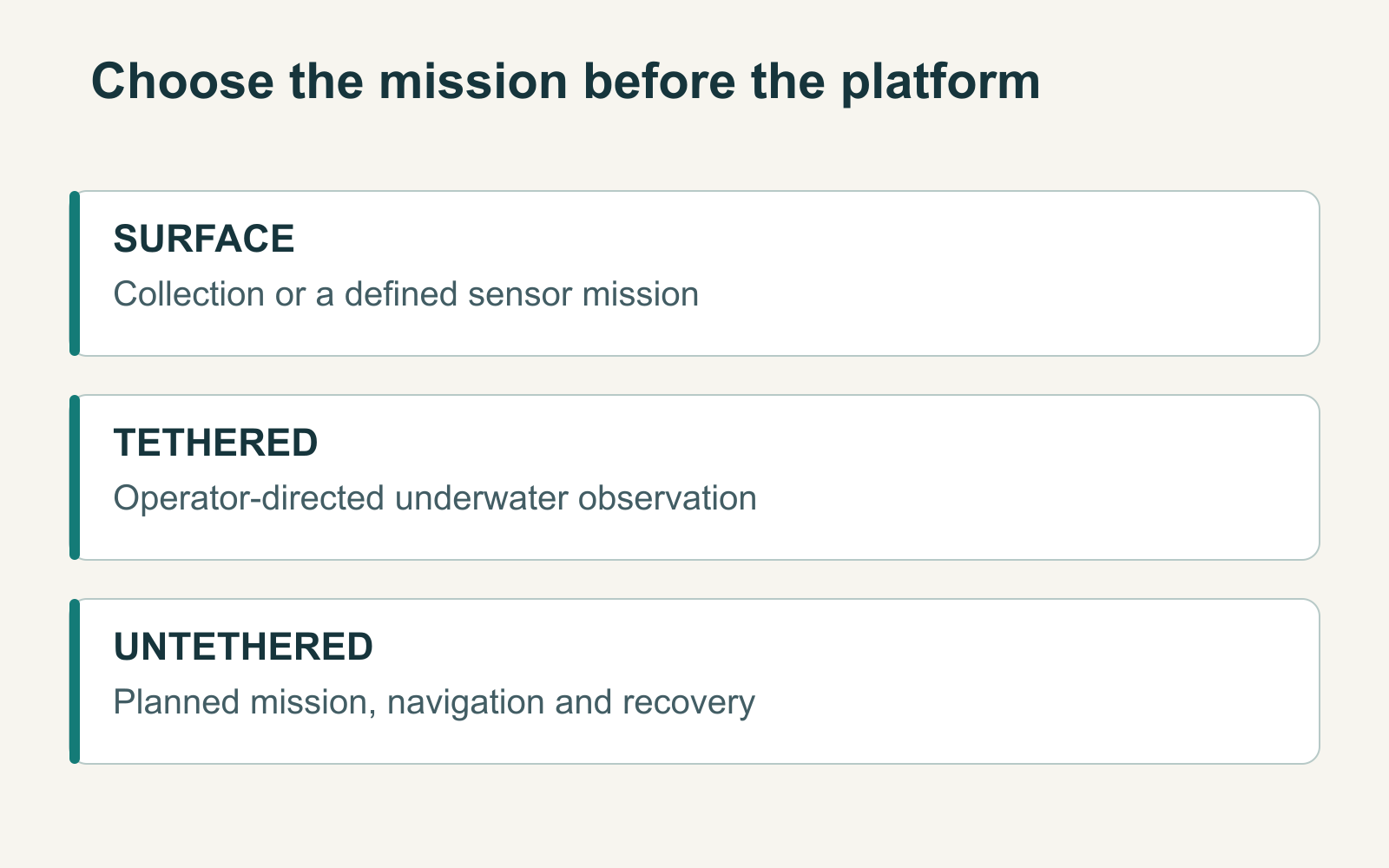
An uncrewed surface vessel, or USV, is a candidate when the platform can remain above water while carrying the required equipment or collecting floating material. Distinguish a survey craft from a cleaner: the useful payload and the operating loop differ.
OceanAlpha presents its SL20 as an inland-water survey platform. Robosea's S-Cleaner information describes a surface-cleaning system. These are examples of separate task configurations, not evidence that one vessel performs every waterway job.
Ask where the craft launches, how it turns and returns, what observations or material it brings back, and who performs the next step. Include shore access and the ability to retrieve it when the planned route cannot be completed.
When an ROV is the stronger starting point
A remotely operated vehicle, or ROV, is worth evaluating when the mission requires underwater observation with an operator actively reviewing and directing the task. NOAA describes ROVs as tether-connected submersible robots that send data, including live video, to the surface.
Treat the tether as part of the operating system. Its route, management and recovery can determine whether a close inspection is workable. A nominal tether length does not describe the distance available after accounting for depth, routing and site obstacles.
Define the observation before selecting a sensor package. A camera can provide a view; a required measurement or defect decision may need additional evidence and specialist interpretation. Confirm the exact configured payload rather than assuming optional equipment is included.
When to investigate an AUV
An autonomous underwater vehicle, or AUV, becomes relevant when a planned underwater mission can be executed with suitable onboard navigation and data collection. NOAA's AUV overview distinguishes these untethered vehicles from ROVs and describes pre-planned missions.
Ask how mission coverage will be verified, when the team can inspect the data, what happens when the plan is interrupted and how recovery is managed. Removing the tether changes the supervision and recovery problem; it does not remove those responsibilities.
Do not choose an AUV simply because the word autonomous sounds more advanced. A short task that needs repeated operator-directed close views may have different requirements from a planned area survey.
Compare the mission around the platform
Use the same questions for every candidate:
- What output is required, and who accepts it?
- Where does the vehicle work relative to the water surface and asset?
- How are position, coverage and data associated with the task?
- Who starts, supervises, interrupts and recovers the mission?
- What happens to the data or collected material afterward?
- Which conditions prevent the mission from proceeding?
Request evidence for the actual configuration and operating conditions. Depth, endurance, positioning, payload capability and communications should be checked together. A maximum from one configuration cannot establish another configuration's performance.
Build a short comparison that leads to a trial
Describe each option as a full method: platform, payload, control, launch and recovery, staffing, accepted output and exclusions. Keep the alternatives comparable by using the same mission boundary and including processing or offloading work.
Use robot pilot acceptance to define what evidence would justify the next step. If the result is still ambiguous, narrow the first trial to the observation or handoff that creates the uncertainty.
Describe your marine task for assessment, including the site, asset, required output and how the team currently performs the work. That gives a solution team a basis for evaluating the correct platform class and delivery package.

Iven Wang
Iven Wang is the Co-Founder of Warpify Robotics, specializing in the commercialization and deployment of robotic solutions. With a background in electrical engineering and product management, he works with manufacturers, integrators, and enterprise clients across industrial inspection, security, logistics, and Robotics-as-a-Service.
Subscribe to our newsletter today
Get practical robotics deployment insights, case studies, and planning guidance from Warpify Robotics.