Mobile Oxygen Monitoring: Build a Sampling-Point Card for Robot Rounds
Build a sampling-point card for mobile oxygen monitoring. Record inlet position, sample timing, configuration, conditions and missed readings.

A useful mobile oxygen reading has an address. Record where the inlet was, how long the instrument sampled, which configuration was used and what the operator should do with the result. A measurement tagged only to a room or route waypoint can be hard to interpret, especially when two rounds passed the same equipment at different heights or under different ventilation conditions.
Start with the question the sample can answer
Pick an observation that supports a decision, such as whether the oxygen concentration at a specified inlet location warrants review under an approved site procedure. Define the relevant operating state and what changes between visits. Air moves through openings, around equipment and with mechanical ventilation. An inlet on one side of a doorway may sample a different part of the space from an inlet on the other side. An oxygen reading is a concentration at the sampling location and time. Confirming a release source or absence of another gas requires evidence for that distinct question. EIGA guidance on oxygen deficiency and oxygen enrichment
Treat the measured location as the sensor inlet, even when the robot position is recorded separately. If a pump and tubing are used, record the actual path and validate the response of that configuration. If the instrument samples by diffusion, record the dwell procedure and check that the inlet remains unobstructed. OSHA’s direct-reading instrument guidance distinguishes these modes and identifies response time as a selection factor. Get the final sample timing and stability rule from the instrument instructions and site validation. OSHA Technical Manual on direct-reading instruments
Make a card the operator can use on every round
- Purpose and owner. The oxygen-related decision, the site procedure that governs it and the role that reviews the result.
- Inlet location. Point ID, description, inlet height and orientation, image or sketch, and the approved robot position.
- Sampling configuration. Instrument and sensor ID, operating mode, inlet or hose configuration, applicable checks and configuration revision.
- Conditions. Time, relevant ventilation status, observable obstructions and any process or access changes.
- Acceptance. Evidence of a completed dwell or sample, a usable value with units, and the status of the instrument and data link.
- Response. Site action on an abnormal, missing or invalid reading. Name the responsible role and required handoff record.
Record the start and end of the sample interval separately from the time the value was uploaded. If sampling ends early, save the run and the reason for the missing value. A later successful reading can close the follow-up, but the earlier gap still matters when reviewing whether the round was complete.
Worked example at a ventilated service bay
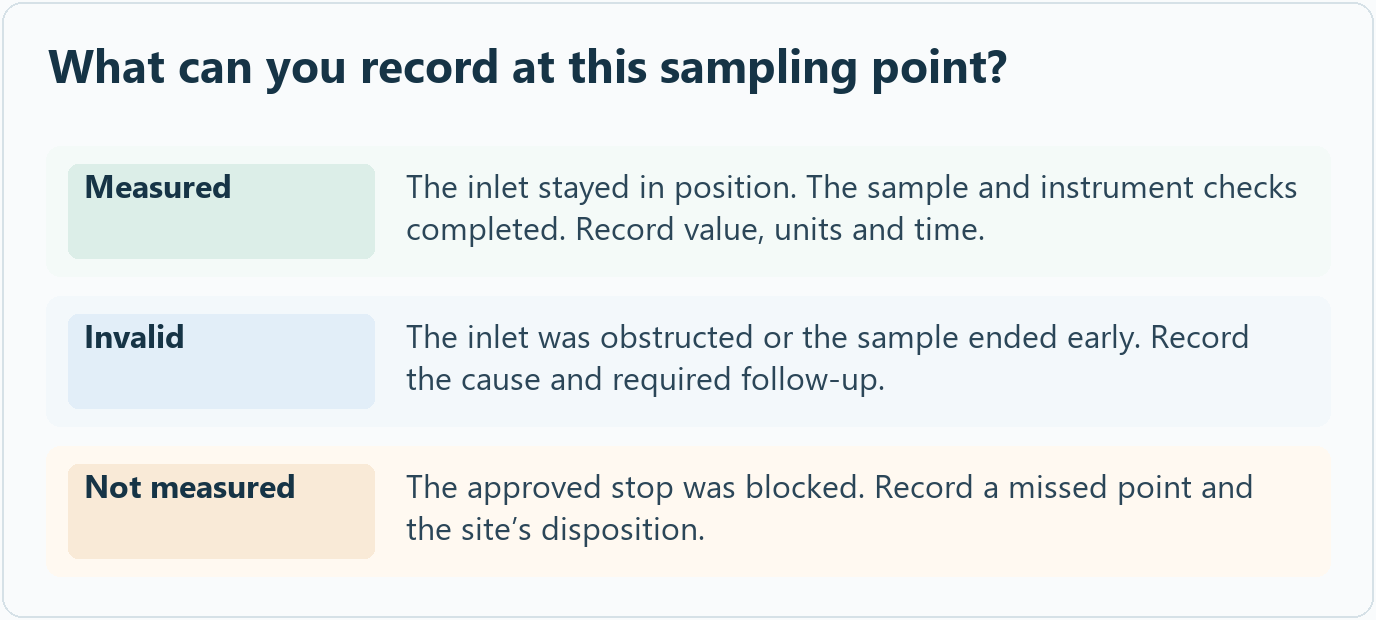
An example route calls for a spot sample from an approved stop outside an equipment bay. The point card identifies the inlet location relative to a permanent door frame and tells the operator which ventilation state to record. The robot stops and begins its dwell. On the first pass a cart blocks the approved stop. The operator records the point as not measured, saves the reason, and follows the site’s missed-point procedure. The team keeps the result separate from measurements collected at the remaining stops.
On the repeat pass the point is accessible. The result is measured only after the configured sample completes and the health and configuration checks pass. If a value requires action, the reviewing role follows the approved site procedure. This example shows how one card distinguishes a blocked stop, an invalid sample and a valid observation. It supplies no alarm threshold or operating permission.
The industrial gas plant robot inspection case study shows how selected observation points fit into a larger route. Use that example to think about where the stop fits, then add the inlet details from the card before judging sampling coverage.
Choose instrument and deployment conditions using the robot gas detection planning guide. Fit the card into your industrial inspection workflow. If you want to plan a facility inspection, bring one target point and the procedure your team would use for a missed or abnormal result.

Iven Wang
Iven Wang is the Co-Founder of Warpify Robotics, specializing in the commercialization and deployment of robotic solutions. With a background in electrical engineering and product management, he works with manufacturers, integrators, and enterprise clients across industrial inspection, security, logistics, and Robotics-as-a-Service.
Subscribe to our newsletter today
Get practical robotics deployment insights, case studies, and planning guidance from Warpify Robotics.