Robot Deployment Responsibilities: OEM, Integrator, Operator and Customer
A lifecycle responsibility and evidence-handoff framework for robot OEMs, integrators, local operators and customer sites.

Robot projects fail between organizational boxes. The OEM may know the platform, the integrator the application, the local operator the recovery process, and the customer the site—but no one owns the complete evidence needed to start, change or stop the service.
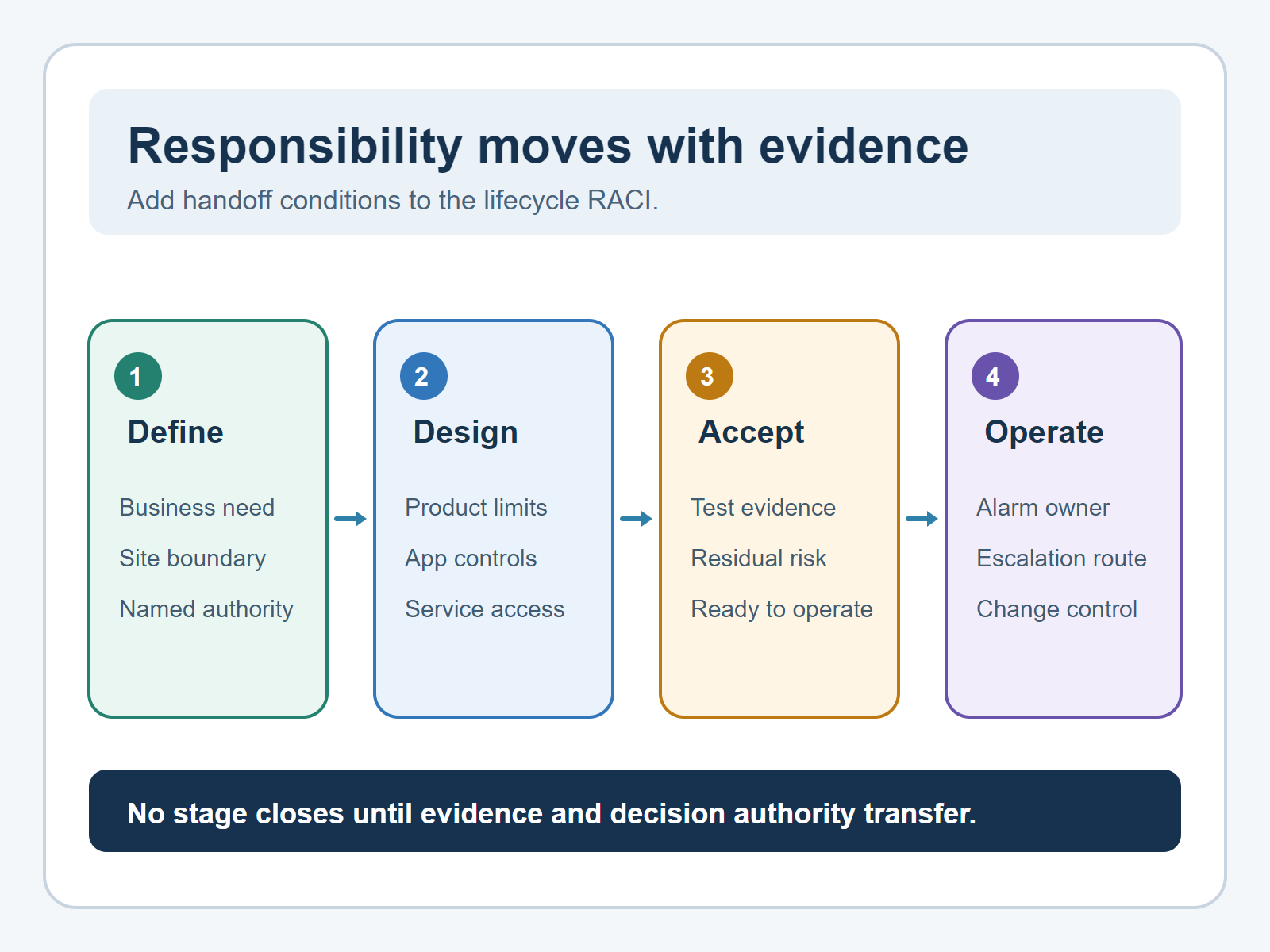
A useful responsibility model covers the full lifecycle and connects every task to three things: a named accountable decision-maker, the evidence that person needs, and the condition under which ownership transfers. A RACI chart without those handoff rules is only a meeting artifact.
Do not confuse product responsibility with application responsibility
The robot platform is not the whole deployed application. Site layout, payload interfaces, networking, doors, lifts, traffic, operating procedures, staffing and maintenance access can change the risk and service outcome. OSHA's robot-systems guidance makes this systems boundary explicit for industrial applications, and ISO 10218-2:2025 addresses integration through commissioning, operation, maintenance and decommissioning within its industrial scope.
Those sources do not create one universal allocation for every service robot or jurisdiction. They reinforce the need to identify who performs integration and who controls the workplace. For applications outside the standard's scope, select the applicable product, machinery, workplace, sector and local requirements with qualified reviewers.
Define the four roles by deliverable
OEM or platform provider: supplies product specifications, supported configurations, instructions, product-level diagnostics, known limitations and the agreed escalation or warranty route. Integrator: designs and validates the application interfaces and documents the accepted configuration. Local operator or service provider: monitors service, performs permitted first response, maintains support readiness and escalates with evidence. Customer or site: owns the business process, facility facts, worker and visitor controls, staffing, operational permission and acceptance of residual site risk.
One company may hold several roles. That does not remove the boundaries; it makes them more important. Record which legal entity and named person is acting in each role for each decision.
Add an interface register beside the RACI
Most deployment gaps occur at interfaces rather than inside one party's deliverable. Create one row for every boundary that can stop or change the service: robot-to-payload, robot-to-facility, application-to-network, operator-to-support desk, alarm-to-response, maintenance-to-production and change request-to-approval. For each row, name the design owner, information provider, verifier, acceptance evidence, operating owner and escalation path.
The register should also record assumptions and expiry triggers. A doorway width, wireless survey, payload mass, fire-door permission or software version may be valid at acceptance and wrong six months later. Linking each interface to a change trigger turns responsibility from a static chart into a lifecycle control.
Start with a lifecycle RACI, then add handoff evidence
The following Warpify modelled framework is an illustrative scenario, not legal advice, a certification result or a universal allocation. “A” means accountable, “R” responsible for performing the work, and “C” consulted. Replace every organizational label with named people and have safety, legal, cybersecurity and technical specialists review the applicable scope.
Scroll horizontally to compare all columns.
| Lifecycle stage | OEM or platform | Integrator | Local operator or service provider | Customer or site |
|---|---|---|---|---|
| Application definition | C: capability evidence | R: solution concept | C: serviceability input | A: business need and operating boundary |
| Site and system design | C: product constraints | R: integrated design | C: support and access design | A/R: facility information and site changes |
| Risk and control review | R: product information | R: application evidence within contracted scope | C: maintenance and recovery procedures | A: employer/site controls and approval |
| Commissioning and acceptance | C/R: product issues | R: integrated tests and records | R: support readiness | A/R: operational acceptance and user readiness |
| Operate and maintain | R: agreed product escalation | C/R: agreed integration support | R: monitoring, first response and planned service | A/R: permitted operation, staffing and site controls |
| Change or decommission | C: product impact and supported versions | R: integration impact and retest | R: service transition and records | A: change permission, data and site disposition |
Avoid assigning multiple accountable owners to the same acceptance decision. Shared work is normal; shared final authority is often an unresolved decision.
Use an evidence handoff gate
At each lifecycle transition, create a short gate record with: the accepted service and configuration; decisions completed; tests and evidence references; unresolved conditions; prohibited uses; required training and procedures; monitoring and support state; named owner after handoff; change triggers; and the person with authority to accept, reject or roll back.
The gate should distinguish “document delivered” from “evidence accepted.” A manual can be complete while the site procedure is unusable. A test report can pass while the customer has not staffed recovery. Acceptance requires the receiving role to understand the boundary it is taking over.
Give security its own cross-role allocation
NIST SP 800-82 emphasizes that OT security must account for performance, reliability and safety. Assign ownership for asset inventory, identity and access, network segmentation, remote support, logging, vulnerability intake, patch assessment, backup, recovery and incident coordination. The OEM may provide a patch; the integrator may test compatibility; the operator may schedule the change; and the customer may approve the outage. “The vendor handles security” hides these separate decisions.
Keep responsibility alive after go-live
Operational ownership should cover alarm receipt, safe-state confirmation, manual fallback, evidence collection, remote escalation, field dispatch, restart authority and communications to affected teams. Define coverage windows and deputies. A role assigned to an unavailable person is not coverage.
Changes need the same discipline. New routes, payloads, software, facility layouts, integrations, operating hours or support suppliers can invalidate prior assumptions. The change owner should identify affected evidence, required review, retesting and rollback before promotion.
Write stop and restart authority as separate decisions. The person allowed to place a service in a safe stopped state may not be qualified to approve a configuration change or return it to production. Define who can stop, who diagnoses, who accepts temporary operation, who approves rollback and who communicates the decision to the customer workflow. This matters most outside normal hours, when the project team is unavailable and local staff must act from the operating record.
Audit gaps, not just completed tasks
Review unowned decisions, overdue conditions, expired training, unsupported versions, missing backups, untested recovery, stale site drawings and incidents passed between teams. Measure time without an owner as its own risk signal. A fast project schedule is not evidence of a complete responsibility model.
Use Warpify's robotics solutions framework, deployment-gate timeline and production acceptance framework to attach evidence to this responsibility map. To define the boundary for a specific site, request a deployment assessment.

Iven Wang
Iven Wang is the Co-Founder of Warpify Robotics, specializing in the commercialization and deployment of robotic solutions. With a background in electrical engineering and product management, he works with manufacturers, integrators, and enterprise clients across industrial inspection, security, logistics, and Robotics-as-a-Service.
Subscribe to our newsletter today
Get practical robotics deployment insights, case studies, and planning guidance from Warpify Robotics.