Robot Deployment Timeline: What Controls Pilot and Rollout Duration
A dependency-led robot deployment timeline covering decision gates, workstreams, pilot evidence, change control and rollout readiness.
There is no reliable universal answer to "How long does a robot deployment take?" A pilot with one stable workflow and no building-system integration is different from a multi-site rollout that depends on interfaces, construction, security review and operational change. A useful timeline is therefore a dependency model, not a marketing countdown.
This guide shows project managers and procurement teams how to build that model, identify the critical path and separate pilot evidence from rollout readiness.
It also creates a common language for vendors, site owners and reviewers when one dependency moves the forecast.
Plan from decision gates
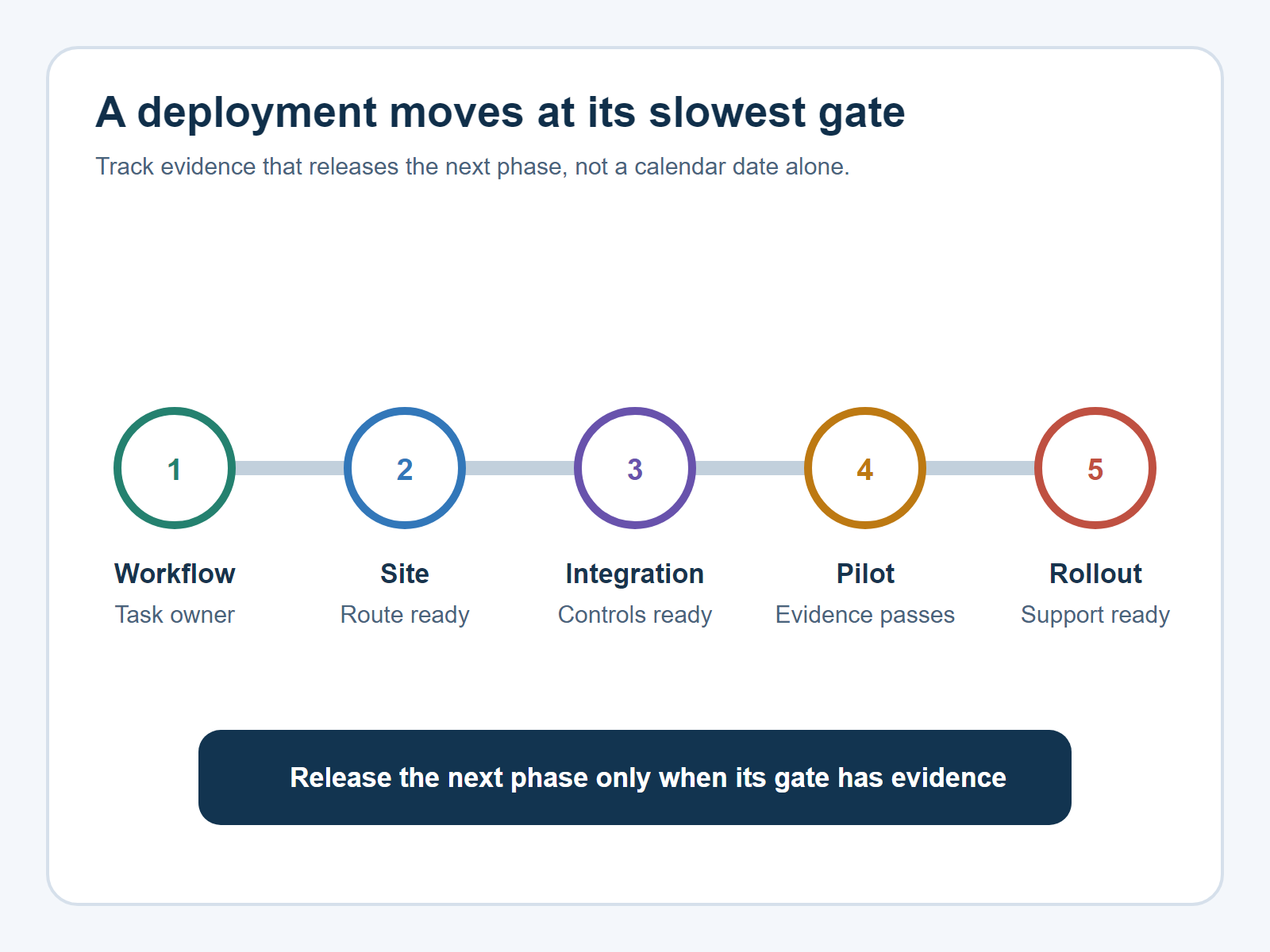
Organize the schedule around decisions that release the next commitment. A typical sequence is discovery, feasibility, solution definition, site and interface readiness, factory or configuration testing, site commissioning, controlled pilot, acceptance and rollout. The names can change, but every gate needs an owner, required evidence and a decision: proceed, revise, pause or stop.
A date without entry criteria encourages premature work. For example, scheduling installation before network, power, route and access prerequisites are verified can create visible activity without progress. NIST's first-integration guidance highlights the practical controls behind a better plan: involve the people who own the current process, appoint an internal champion, be realistic about support capacity and start with manageable scope.
Find the workstreams that control duration
Robot projects usually combine several clocks. Procurement and logistics may run in parallel with workflow design. Building interfaces may not. Safety review can begin early but cannot close before the intended system and use are defined. Cybersecurity review may depend on an architecture, data-flow and remote-access proposal. Operational readiness depends on staffing, training and approved procedures.
Size the pilot to answer a decision
A pilot is not a smaller rollout. Its job is to reduce named uncertainties. Define the decision first: can the workflow operate safely, reliably and usefully under representative conditions? Then select the routes, payloads, shifts, interfaces and exceptions needed to answer it.
Duration should reflect the evidence window, not a round number of weeks. If demand changes by weekday, the test must cover that variation. If an elevator is the main constraint, include high-traffic periods and degraded-mode tests. If staff adoption is uncertain, observe multiple shifts. Do not extend a pilot indefinitely to compensate for missing acceptance criteria.
Separate controllable work from external lead time
For each schedule item, identify the responsible party, predecessor, earliest start, review time and recovery option. External approvals, building works, imported equipment and third-party interfaces often carry greater uncertainty than robot configuration. Put explicit decision dates around them and keep a fallback plan where possible.
Use ranges for uncertain tasks. A three-point estimate (optimistic, most likely and conservative) communicates uncertainty better than false precision. Record the assumption behind the range. When a dependency changes, update the forecast and decision impact rather than hiding delay inside "commissioning."
Control scope before it controls the schedule
Late additions can change the critical path: a new payload, another floor, a different door interface, extra reporting or a higher availability requirement. Use a change record that states the request, reason, safety and technical impact, evidence required, cost or commercial impact, schedule impact and decision owner.
Protect the pilot's learning objective. A desirable feature that does not answer the pilot decision may belong in the rollout backlog. Conversely, a newly discovered safety or operational condition cannot be deferred simply to preserve a date.
Build rollout readiness during the pilot
While the pilot runs, develop the operating system around it: training records, support contacts, spares, incident categories, data access, maintenance windows, release management and site handover. A technically successful pilot still cannot scale if each new location must reinvent these controls.
Before rollout approval, confirm that results are transferable. Identify which site conditions were assumed, what must be surveyed at every location and what variation the design supports. Create a repeatable readiness checklist and an escalation path for sites outside the envelope.
Report schedule health with evidence
A weekly timeline review should show the current gate, critical dependencies, upcoming decisions, overdue evidence, open changes and forecast range. Percent-complete alone is weak: a project can appear nearly complete while one unowned interface prevents acceptance.
Warpify helps teams structure workflow discovery, pilot evidence and rollout responsibilities. Explore our robotics solutions, compare the demo and POC responsibility checklist, and assess your robot workflow to build a defensible deployment plan.

Iven Wang
Iven Wang is the Co-Founder of Warpify Robotics, specializing in the commercialization and deployment of robotic solutions. With a background in electrical engineering and product management, he works with manufacturers, integrators, and enterprise clients across industrial inspection, security, logistics, and Robotics-as-a-Service.
Subscribe to our newsletter today
Get practical robotics deployment insights, case studies, and planning guidance from Warpify Robotics.