Choosing a Robotics Vertical and Market for a Partner Business
Choose a robotics partner market by buyer access, repeatable workflows, service geography and commercial fit before expanding your offer.

A robotics partner’s first market should match its customer access, workflow knowledge and ability to deliver service. A large industry forecast does not establish a reachable opportunity, and a familiar robot does not establish a repeatable customer problem. Choose the intersection of a defined workflow, a serviceable territory and a buyer who can sponsor change.
This is a market-selection method for integrators, distributors and local operators. It does not forecast revenue or rank countries. Use it alongside Warpify’s partner pathway to identify a bounded opportunity and the delivery support it would require.
Define a segment as work, buyer and place
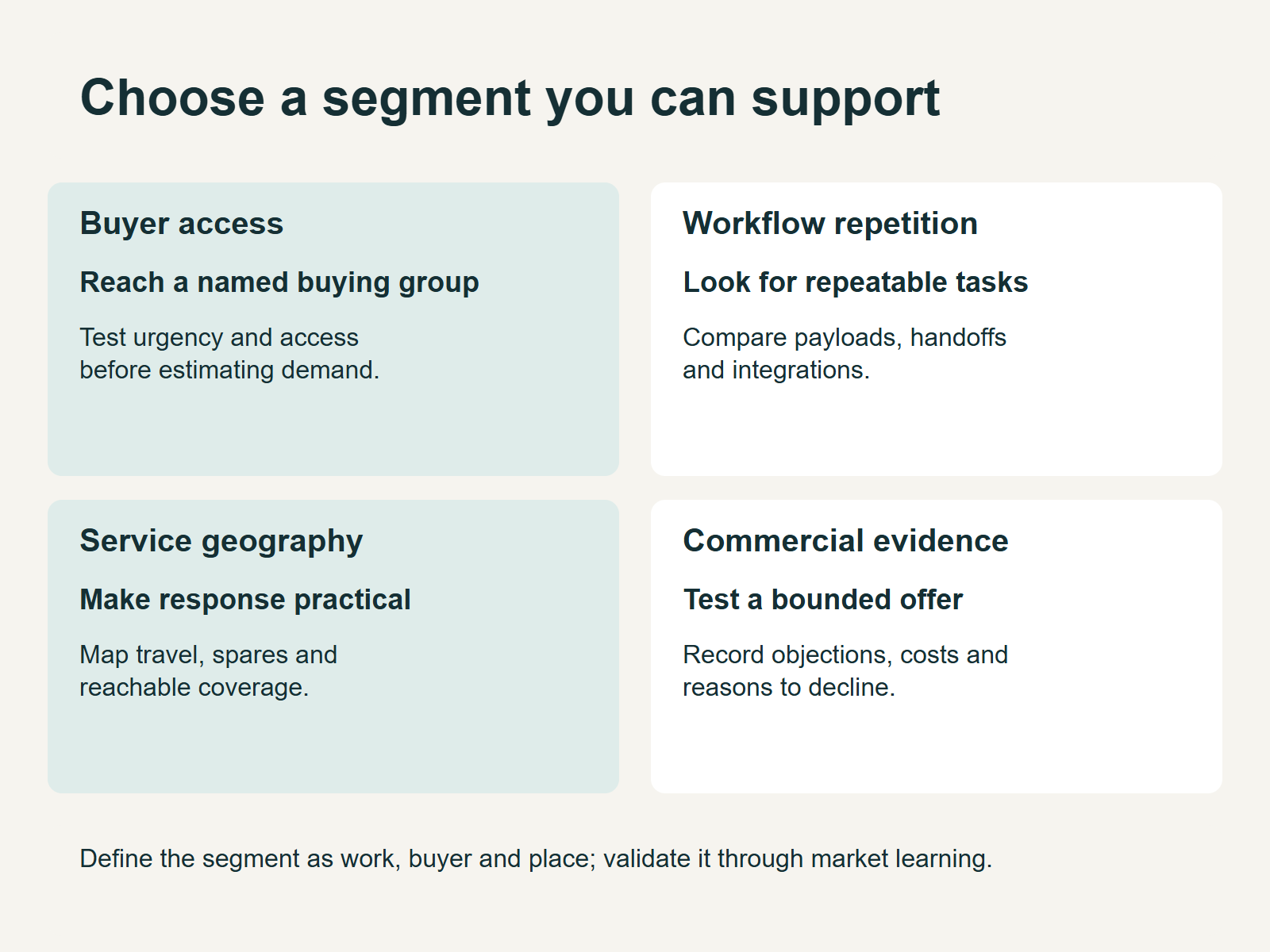
Replace broad labels such as healthcare or manufacturing with a more specific description. Identify the task, facility type, operational buyer, service area and buying trigger. Two companies in the same industry may have different route constraints, budgets and decision processes.
An illustrative segment might be scheduled internal material movement in a reachable group of production sites with repeatable containers and named logistics owners. The description is useful because it can be tested through conversations and site evidence. It is not a claim that the segment is ready to purchase.
Keep different audience journeys separate. An end user seeking workflow assessment is different from a reseller seeking territory or supply. Combining them in one pipeline can make apparent demand difficult to interpret.
Test access before estimating scale
List the organizations the team can realistically reach through existing relationships, industry channels or authorized prospecting. Identify the role that experiences the problem and the role that can fund and approve a project. Count access evidence separately from interest, evaluation and qualified opportunity.
Ask whether you can obtain a site conversation, a process baseline and a responsible sponsor. A list of company names is not evidence of purchase intent. Likewise, an enthusiastic demonstration visitor may have no authority over the workflow or its budget.
Do not use broad market size as a substitute for these checks. Keep any external market estimate attributed, dated and distinct from the number of customers your business can serve.
Compare repeatability at the workflow level
Look for repeatable task definitions, payloads, interfaces, operating conditions and acceptance methods. Record the variations that still require engineering. A common robot platform does not make two deployments equivalent when doors, elevators, access control or handoff procedures differ.
Manufacturer case studies can show how a specific application was configured. For example, MiR’s Blum-Novotest case describes a real intralogistics implementation. Such examples are useful for identifying integration questions; they do not establish local demand, your company’s capability or transferable results.
Build a reusable core with a visible exception list. If every proposed customer requires a different technical and service model, account for that complexity before calling the offering scalable.
Map the service geography
Plot candidate sites against the team’s field coverage, spare-parts location and travel constraints. Consider site-access approvals, operating hours, language and the availability of qualified subcontractors where needed. A territory agreement cannot create local response capacity by itself.
Test the support model with an ordinary fault and a more difficult interruption. Identify who can attend, what they can do, which parts they can obtain and who authorizes restart. Use the after-sales support guide to turn this into an operating plan.
Customer density matters to your planning because travel and coverage are shared resources. Do not assume a particular density creates profit; test the actual service activities and commercial terms.
Use gates before comparative scoring
Set a small number of conditions that every candidate segment must satisfy: a plausible supported application, reachable buyers, a testable value case and a service model your team can support. A failed condition should trigger further work or deferral, not disappear inside a weighted score.
Then compare eligible segments on evidence quality, repeatability, integration burden, sales process, service effort and commercial exposure. Mark each input as observed, customer-stated or assumed. A precise score built from guesses is less useful than a simple comparison with clear uncertainty.
Keep separate records for capability, demand and economics. Strong technical fit does not prove willingness to pay; a strong commercial conversation does not prove deployment readiness.
Run a bounded market-learning cycle
Choose one segment and define what would change the decision. Conduct authorized discovery, document actual workflows and identify a pilot candidate only when the required parties and evidence are available. Review objections and non-fit findings alongside positive signals.
Before a demonstration, agree what question it answers and which responsibilities remain outside it. The demo and proof-of-concept checklist helps avoid treating a successful demonstration as a production commitment.
End the cycle with a proceed, narrow, investigate or defer decision. State the evidence, unresolved assumptions and next test. Avoid expanding into another vertical merely because the first one produced difficult integration questions.
Prepare a short opportunity brief with the target workflow, customer access, territory, local service capacity and support needed from a robotics provider. Use it to discuss a partner opportunity without implying exclusivity, guaranteed earnings or capabilities that have not been demonstrated.
Sources and scope
- MiR: Blum-Novotest material transport case — Attributed manufacturer case example; not Warpify experience or proof for other factories.

Iven Wang
Iven Wang is the Co-Founder of Warpify Robotics, specializing in the commercialization and deployment of robotic solutions. With a background in electrical engineering and product management, he works with manufacturers, integrators, and enterprise clients across industrial inspection, security, logistics, and Robotics-as-a-Service.
Subscribe to our newsletter today
Get practical robotics deployment insights, case studies, and planning guidance from Warpify Robotics.