Acoustic Inspection Robots for Leak and Anomaly Detection
A practical method for choosing acoustic sensing, building baselines, validating localization and routing anomalies into maintenance decisions.
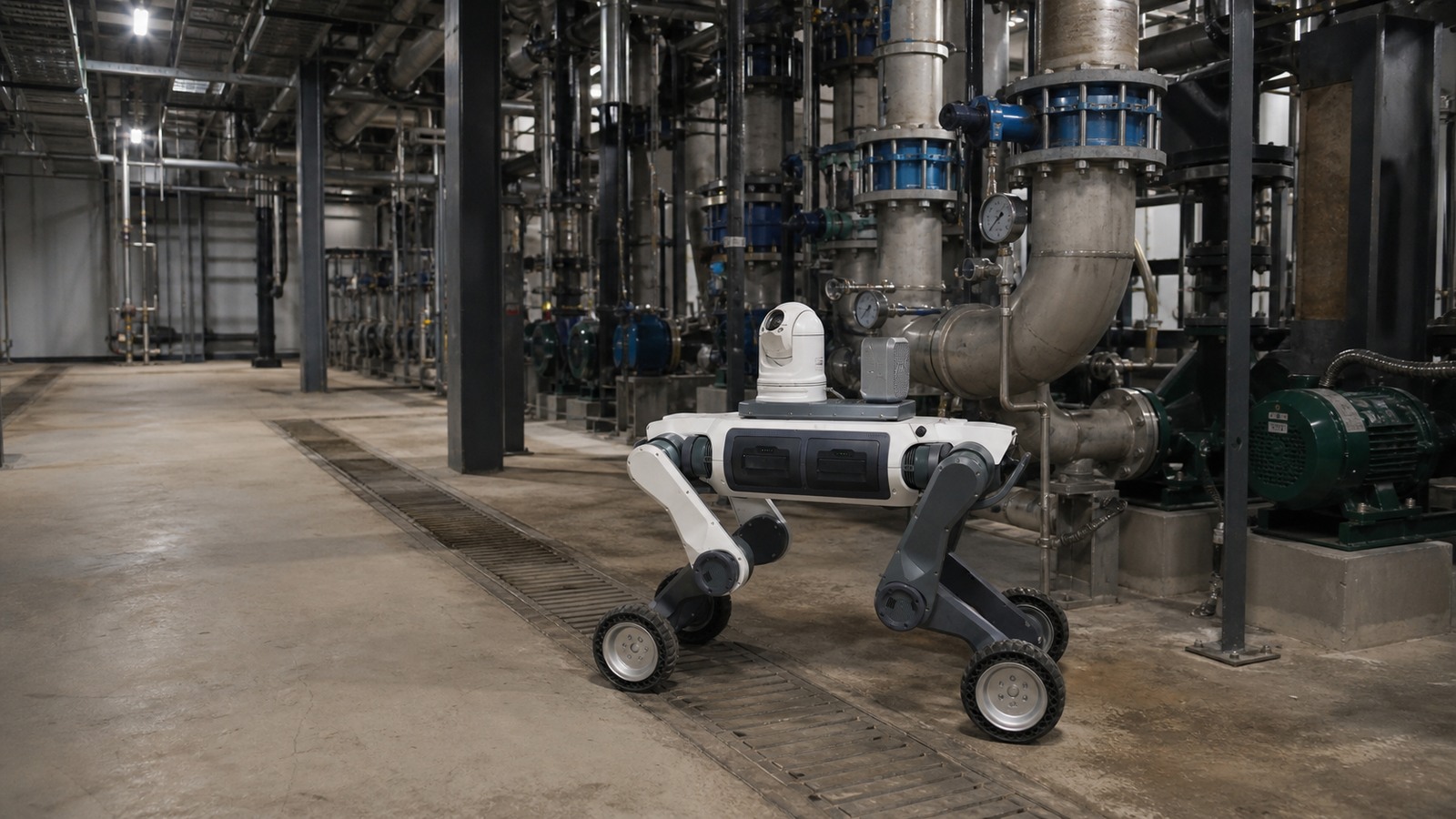
An acoustic inspection robot can extend repeatable listening and imaging rounds, but it does not turn every unusual sound into a confirmed leak or mechanical fault. The practical decision is whether the route, sensor, acquisition method and review workflow can distinguish a repeatable anomaly from background noise and convert it into an evidence-backed maintenance action.
Begin with the asset and failure question, then evaluate the industrial inspection robotics workflow. Mobility is only one layer. Sensor range, orientation, background conditions, baseline data, asset identity, operator review and escalation determine whether the result is useful.

Choose the acoustic method for the physical signal
“Acoustic inspection” covers several methods. Audible microphones, ultrasonic detectors, acoustic cameras and contact-based sensors observe different phenomena and have different constraints. A compressed-air leak, steam-trap condition, bearing anomaly and electrical partial discharge should not be treated as interchangeable targets.
The U.S. Department of Energy’s operations and maintenance guide identifies ultrasonic applications for pressure and vacuum leaks, steam traps, bearings, pumps, motors, gearboxes and electrical phenomena such as arcing, tracking and corona. It also notes that ultrasound travels only a short distance in some scanning applications and that specialized sensing arrangements may be used to extend detection range. The method and geometry must therefore be chosen for the target—not added as a generic payload.
Write a read-point specification
Each acoustic read point should state what the robot is trying to detect and how a valid sample is acquired. Include:
- Asset and component: identify the valve, joint, bearing, enclosure or electrical component.
- Phenomenon: define leak signal, mechanical signature or discharge-related emission.
- Sensor and band: record the device, configuration, relevant frequency range and calibration state.
- Geometry: define distance, orientation, field of view and acceptable occlusion.
- Operating state: record pressure, load, speed, valve state or comparable condition when material.
- Background: characterize nearby equipment, air movement, reflections and transient noise.
- Acquisition: specify dwell, repeats and supporting visual or thermal evidence.
- Decision: define valid, uncertain, invalid and escalation outcomes.
A map waypoint is not enough. The robot may arrive at the correct place while the sensor faces the wrong joint, the target is not operating, or background equipment dominates the measurement.
Build a baseline before writing alarm rules
An acoustic exception needs a comparison basis. Depending on the task, that may be a known-good component, a repeated observation of the same asset under comparable conditions, or a reviewed signature pattern. DOE guidance describes storing and analyzing ultrasonic signatures and comparing equipment profiles; this supports a baseline-and-trend approach rather than a one-off “loud equals bad” rule.
Collect baseline data across expected operating states. Record the conditions that make comparisons valid. If a pump, line or fan changes load, pressure or speed, a signal change may be normal. The workflow should either normalize for that state, route it for human review, or refuse to compare unlike conditions.
Use localization and severity as separate decisions
An acoustic camera may help localize a source in the field of view. That does not automatically establish the gas identity, leak rate, financial loss, urgency or repair method. Treat these as separate questions:
- Is a repeatable acoustic signal present?
- Can the system localize it to a component or bounded area?
- Does supporting evidence identify the asset and operating state?
- Does the organization have an approved method to estimate severity?
- Who decides whether to inspect, isolate, repair, monitor or dismiss it?
Vendor documentation can demonstrate that mobile acoustic imaging configurations exist. For example, ANYbotics documents acoustic imaging and gas-sensing options for its ANYmal platform. That is feasibility evidence for that configured product, not proof that any robot, camera or route will achieve the same result.
Validate against known conditions
Before autonomous use, test the sensing chain under controlled or safely simulated conditions approved by the site. Verify sensor response, field-of-view alignment, asset association, timestamping and storage. Include known non-events and common background sources so the team can see how the workflow behaves when the target signal is absent.
Then validate individual read points and route segments. Vary the robot pose within the allowed tolerance and test expected background changes. Measure whether the process can:
- capture a repeatable signal when the target condition is present;
- avoid or flag an unsupported conclusion when it is absent;
- associate the record with the correct asset and route version;
- recognize invalid acquisitions and attempt an approved reacquisition;
- deliver an exception to the right reviewer with the original evidence.
Use a labelled test set and record false alarms, missed detections, uncertain samples and review time. Do not collapse these into a single route-completion percentage.
Design the exception workflow
Every acoustic anomaly needs a lifecycle. Define the initial classification, supporting data, priority rule, reviewer, acknowledgement time, maintenance handoff and closure evidence. Preserve the raw or minimally processed record where policy allows, together with configuration and environmental context.
Use conservative language in alerts. “Acoustic anomaly near valve V-104; review required” is more defensible than “confirmed hazardous leak” unless the sensing and review method actually supports the stronger claim. When worker exposure or a hazardous atmosphere may be involved, follow the site’s safety and gas-monitoring procedures rather than relying on an acoustic result alone.
Know the non-fit conditions
Pause the project when the target signal is not detectable from a safe route, background sources cannot be separated, operating conditions cannot be recorded, the payload cannot hold the required pose, the robot introduces unacceptable noise, or the team lacks a qualified review and repair process. Acoustic inspection also may not fit assets that require contact sensing or a certified test method that the mobile payload cannot perform.
Use a pilot acceptance checklist
- Define each asset, phenomenon and maintenance decision.
- Select the sensing method and configured payload.
- Record pose, operating state, background and acquisition rules.
- Build known-good and known-exception baseline evidence.
- Test localization, repeatability, invalid-sample handling and review.
- Assign calibration, cleaning, data, alarm and maintenance owners.
- Approve the language used for uncertain and confirmed outcomes.
Use the industrial inspection deployment guide to evaluate route access, communications and site integration before specifying the pilot.
Related planning: Place each acoustic read point and exception path in the autonomous inspection route-design method.
Sources and scope
This guide applies primary maintenance guidance and first-party product documentation to an editorial decision method. It does not provide a leak-rate calculation, hazardous-atmosphere determination, electrical-safety decision or evidence of a Warpify deployment.
- Operations & Maintenance Best Practices Guide: Release 3.0 — U.S. Department of Energy
- ANYmal Autonomous Robotic Inspection Solution — ANYbotics
Take the next step
Bring a target asset list, sample acoustic records and current escalation process to a scoped review: request an industrial inspection assessment.

Iven Wang
Iven Wang is the Co-Founder of Warpify Robotics, specializing in the commercialization and deployment of robotic solutions. With a background in electrical engineering and product management, he works with manufacturers, integrators, and enterprise clients across industrial inspection, security, logistics, and Robotics-as-a-Service.
Subscribe to our newsletter today
Get practical robotics deployment insights, case studies, and planning guidance from Warpify Robotics.