Standardizing Wok Cooking Without Replacing the Chef
This case study documents a real Warpify customer deployment in Singapore. Identifying details are withheld; a supervised robotic wok station supported process repeatability while chefs retained culinary control.
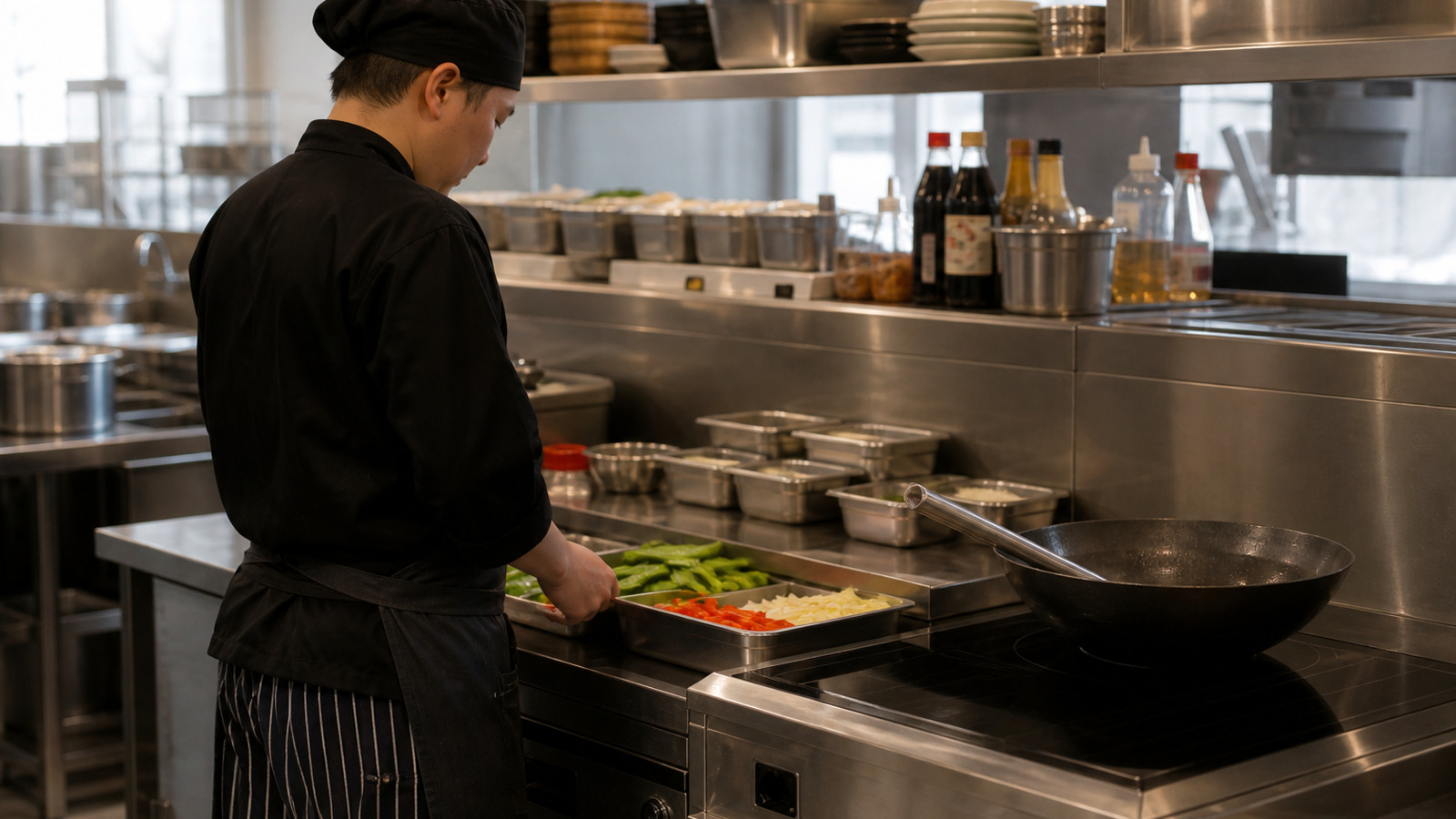
Confidentiality notice: This case study documents a real Warpify customer deployment in Singapore. The customer’s identity, facility details, commercial terms, and detailed operating data have been withheld. The deployed cooking system was the MSS2K, product model JYC08A-01.
A Singapore food-service operator wanted to reduce variability in selected wok dishes without compromising the flavour, texture, and quality standards established by its chefs.
Warpify helped the customer introduce the MSS2K, product model JYC08A-01, a supervised robotic cooking station that executes approved heating, stirring, seasoning, and timing sequences. Chefs continued to define each recipe, kitchen staff remained responsible for ingredients and food safety, and every finished dish was subject to human inspection.
The result was not an unattended kitchen. It was a more structured production model in which automation handled repeatable cooking actions while the culinary team retained control over everything requiring judgment.
Project at a glance
Scroll horizontally to compare all columns.
| Project detail | Deployment summary |
|---|---|
| Customer | Confidential Singapore food-service operator |
| Environment | Existing commercial kitchen |
| Application | High-temperature wok cooking for selected repeatable dishes |
| Deployed system | MSS2K, product model JYC08A-01 |
| Operating model | Human-supervised robotic cooking |
| Warpify scope | Workflow assessment, application selection, kitchen-readiness planning, recipe digitization, controlled testing, operator training, and deployment support |
| Project objective | Improve process repeatability and reduce continuous manual attention at the wok |
| Results disclosed | Qualitative operational outcomes; customer-specific production, staffing, and financial figures remain confidential |
Operational context: why this project mattered in Singapore
Singapore’s food-service industry continues to face rising labour costs, manpower constraints, and difficulty attracting and retaining employees for physically demanding kitchen roles.
The government-appointed Tripartite Cluster for Food Services Industry identified long hours, weekend shifts, and demanding working conditions as continuing recruitment and retention challenges. The Ministry of Manpower’s 2026 Food Services Progressive Wage Model update states that the sector’s PWM covers more than 53,000 full-time and part-time workers.
From 1 July 2026, the minimum monthly gross wage for a full-service cook is S$2,520, while the minimum for a full-service kitchen assistant is S$2,320. These wage floors are scheduled to rise to S$2,800 and S$2,600 respectively from July 2028.
For operators, this does not mean that robotics should simply replace kitchen employees. It means that skilled labour should be concentrated where it creates the most value: recipe development, quality control, customer-specific requests, exception handling, and culinary judgment.
That principle shaped the MSS2K deployment.
Baseline workflow and measurement boundary
The customer already knew how its dishes should taste. Its challenge was reproducing that standard consistently during everyday operations.
Traditional wok cooking requires a closely coordinated sequence of actions:
Experienced chefs often manage these variables instinctively. However, an intuitive cooking process can be difficult to reproduce consistently across employees, shifts, and periods of peak demand.
Variations in timing, stirring, seasoning, or ingredient preparation can affect flavour, texture, moisture, appearance, serving consistency, and customer experience.
The customer therefore wanted to determine whether selected recipes could be produced through a more controlled process while keeping chefs responsible for the final food standard.
Could a robotic cooking station reproduce the repeatable parts of an approved recipe while chefs and trained kitchen staff remained responsible for ingredients, food safety, exceptions, and final acceptance?
MSS2K was not introduced to cook every item on the menu. It was deployed for dishes whose ingredients and cooking methods could be converted into stable, testable sequences.
Establishing the right automation boundary
One of Warpify’s most important responsibilities was defining what the robot should—and should not—control.
The cooking workflow was separated into three layers.
1. Culinary judgment
The chef retained responsibility for defining:
2. Repeatable execution
MSS2K was assigned the recipe actions that could be converted into controlled instructions, including:
3. Human verification
Trained kitchen personnel remained responsible for:
The chef owned the food standard. MSS2K reproduced the approved cooking process.
Verified scope and deployment process
Warpify approached the project as a complete kitchen-workflow integration rather than an equipment sale.
The machine’s ability to cook was only one part of the assessment. The complete process also had to account for ingredient preparation, kitchen utilities, operator responsibilities, cleaning, peak-period demand, and manual fallback.
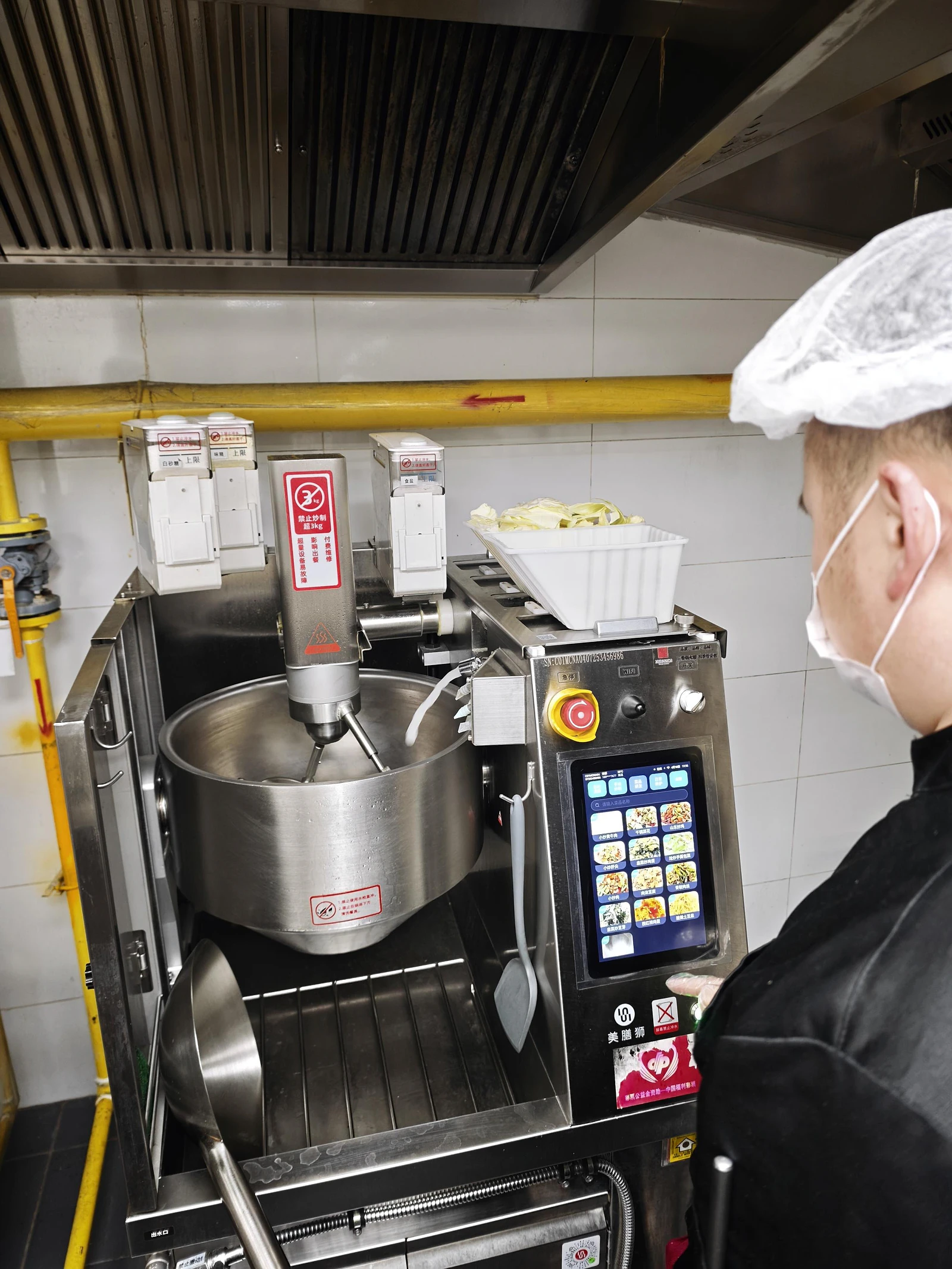
Phase 1: Mapping the existing workflow
Warpify reviewed how work moved through the existing wok station, from ingredient preparation to final service.
The assessment covered menu structure, ingredient preparation and staging, existing wok-cooking steps, peak-period handoffs, loading and unloading, final inspection and plating, water and drainage, electrical supply, ventilation and exhaust capture, cleaning access, maintenance clearance, emergency access, and manual production procedures.
This prevented the customer from evaluating the system solely on the basis of machine cycle time. A robot can complete a cooking cycle quickly while the surrounding process remains inefficient. A complete robotics workflow assessment examines the entire path to an accepted dish.
Phase 2: Selecting suitable recipes
Not every dish was a good candidate for automation.
Warpify worked with the culinary team to screen recipes based on their repeatability. Strong candidates generally had stable ingredients, controlled portion sizes, a defined loading sequence, measurable seasoning quantities, repeatable heating and stirring requirements, and a clear chef-approved reference result.
Dishes requiring extensive customization, frequent last-minute substitutions, or continuous visual improvisation remained in the manual cooking workflow.
This selective approach was critical. The objective was not to maximize the number of recipes programmed into the machine. It was to automate the recipes for which controlled execution could create meaningful operational value.
Phase 3: Preparing the kitchen
MSS2K needed to function as part of the existing production line.
Deployment planning addressed delivery access, equipment positioning, electrical requirements, water supply, drainage, exhaust capture, heat and steam discharge, service and maintenance space, ingredient staging, seasoning replenishment, safe unloading, cleaning access, and emergency stopping.
The team also defined how the kitchen would continue operating if the robotic station became temporarily unavailable. These checks follow the same workflow-first discipline described in Warpify’s robot deployment readiness checklist.
Phase 4: Digitizing chef-approved recipes
The culinary team translated each selected dish into a controlled cooking sequence.
Depending on the recipe, the program documented ingredient order, ingredient weight and portion, heating stages, stirring direction and behaviour, oil and seasoning quantities, reduction time, stage-transition points, and discharge timing.
The team did not assume that a generic manufacturer recipe would suit the customer’s ingredients or flavour profile. Local ingredients, preparation methods, and customer preferences were tested directly. The chef-prepared dish remained the reference standard throughout commissioning.
Phase 5: Controlled testing
Recipes were introduced through controlled test batches.
The project team reviewed cooking consistency, ingredient loading, seasoning delivery, heat and stirring execution, finished appearance, taste and texture, operator interaction, cycle interruptions, and cleaning and reset procedures.
The culinary team adjusted recipe parameters where necessary. Only approved programs were released into the operating workflow.
Phase 6: Operator training
Training extended beyond basic machine operation.
Kitchen personnel were trained on pre-use inspections, ingredient and portion verification, loading sequence, recipe selection, cycle monitoring, safe stopping, alarm response, finished-dish inspection, sanitation and cleaning, replenishment, fault escalation, and return to manual cooking.
The objective was to establish process discipline—not merely teach employees how to operate a touchscreen.
The documented workflow: robotic cooking
Recipe modifications, ingredient substitutions, and quality exceptions were returned to the chef or designated kitchen lead. MSS2K did not independently make culinary decisions.
Division of responsibilities
The kitchen team remained responsible for
MSS2K was responsible for
This separation ensured that automation did not weaken accountability for food quality or safety.
Singapore Food Agency guidance requires food handlers in SFA-licensed retail and non-retail food establishments to attain WSQ Food Safety Course Level 1 certification and complete the applicable retraining. Introducing robotic equipment does not transfer those obligations from the operator to the machine.
Operational results
The deployment produced several qualitative improvements in the customer’s kitchen workflow.
More repeatable recipe execution
Chef-approved cooking actions were converted into controlled programs. For approved dishes, operators no longer had to reproduce every heat, stirring, seasoning, and timing decision from memory. The system followed the same defined sequence across operating cycles.
Less continuous wok attendance
Before deployment, the wok cook remained directly engaged from the beginning of heating through final discharge.
With MSS2K, employees still prepared ingredients, monitored the cycle, checked the finished dish, and handled exceptions. However, they did not need to manually control every stage of the cooking process. This allowed the kitchen to redirect attention to other productive activities while an approved recipe was running.
A clearer production path during busy periods
The MSS2K station created a dedicated workflow for repeatable dishes. Chefs could retain greater attention for special requests, customized dishes, recipe exceptions, quality issues, and work requiring active culinary judgment.
Automation supported the kitchen team rather than attempting to remove it.
More structured operator training
New employees still required training in food safety, ingredient handling, equipment operation, and quality inspection. However, the programmed recipes provided a clearer sequence and acceptance reference than relying only on verbal instruction or informal transfer of experience.
Preserved culinary ownership
The culinary team continued to develop and approve recipes, define the desired result, evaluate ingredients, adjust flavour profiles, manage substitutions, resolve exceptions, and accept or reject finished dishes.
MSS2K reproduced the chef’s process; it did not define it.
Greater operational resilience
The customer retained a manual cooking path for recipes outside the approved scope and for situations involving equipment faults, unavailable utilities, unsuitable ingredients, special orders, unexpected demand, or recipe exceptions.
The kitchen therefore gained automation without making service entirely dependent on one machine.
Evidence and source boundary
The deployment narrative and qualitative outcomes come from the project team’s approved account. Product information is limited to details cleared for public use, while the wage, CPF, and food-safety context comes from the linked Singapore government guidance. The financial figures below are illustrative calculations rather than customer results.
Model, formulas, and data quality: a Singapore labour-cost benchmark
The customer’s actual wages, staffing levels, and labour savings remain confidential. The following calculation is therefore a market benchmark, not a reported project result.
From July 2026, Singapore’s Food Services Progressive Wage Model gross-wage floor for a full-service cook is S$2,520 per month, or S$13.22 per hour for the corresponding part-time benchmark.
For a Singapore citizen or permanent resident from the third year of permanent-resident status, aged 55 or below and earning more than S$750 per month, the 2026 employer CPF contribution rate is 17%. Applied to the hourly PWM benchmark, this produces an illustrative direct employer cost of approximately S$15.47 per hour, before overtime, bonuses, leave, meals, recruitment, training, and other employment expenses.
Scroll horizontally to compare all columns.
| Illustrative cook capacity released | Monthly capacity equivalent | Annual capacity equivalent |
|---|---|---|
| 1 hour per operating day | Approximately S$402 | Approximately S$4,826 |
| 2 hours per operating day | Approximately S$804 | Approximately S$9,652 |
| 4 hours per operating day | Approximately S$1,609 | Approximately S$19,303 |
Assumption: 26 operating days per month. Values use the July 2026 PWM hourly full-service cook benchmark plus 17% employer CPF.
These figures do not represent automatic cash savings. Released time only creates commercial value when the operator uses it productively—for example, to support additional orders, reduce peak-period bottlenecks, prepare ingredients, handle higher-value dishes, improve quality control, reduce overtime, avoid an incremental hire, or support another production station.
For this reason, Warpify measures active operator touch time rather than assuming that every minute of automated operation becomes a labour saving.
Sensitivity and alternative scenarios
The displayed one-, two-, and four-hour scenarios show how the capacity equivalent changes with released operator time. Actual value will also vary with the operator’s wage profile, CPF eligibility, operating calendar, overtime, hiring plans, and whether the released time is used productively. A site-specific business case should replace every benchmark assumption with verified operating data.
What should be measured after deployment
A defensible production and financial assessment should measure the complete kitchen workflow—not merely the robot’s cooking-cycle duration.
Scroll horizontally to compare all columns.
| Measurement | Why it matters |
|---|---|
| Accepted dishes per operating hour | Measures usable output rather than theoretical machine capacity |
| Active operator time per dish | Shows whether attention is genuinely released |
| First-pass acceptance rate | Tracks consistency and rework |
| Intervention frequency | Identifies recipes or operating steps requiring improvement |
| Preparation and loading time | Reveals upstream bottlenecks |
| Cleaning and changeover time | Captures non-cooking workload |
| Equipment availability | Measures the effect of faults and maintenance |
| Manual fallback frequency | Shows how often the robotic workflow cannot be used |
| Ingredient and seasoning variance | Helps isolate preparation-related quality differences |
| Peak-period output | Tests the system under commercially relevant demand |
Financial evaluation should also distinguish between redeployed labour capacity, avoided overtime, avoided future hiring, actual reduction in paid labour hours, additional production capacity, and reduced rework or waste.
This prevents a productivity improvement from being presented inaccurately as direct cost savings. Warpify’s robot ROI and total-cost-of-ownership framework explains how to keep workflow evidence, cost assumptions, and commercial outcomes separate.
Outcome drivers: what made the deployment work
Stable ingredient preparation
Ingredient size, weight, moisture, and marination needed to remain within the approved recipe range. A robot can reproduce the same cooking sequence accurately, but inconsistent input will still produce inconsistent output.
Careful recipe selection
The strongest candidates were dishes with stable ingredients and well-defined cooking stages. Automation was not forced onto dishes requiring continuous improvisation.
Disciplined operation
Employees needed to load the correct ingredients, select the correct program, monitor the cycle, and inspect the result. Automation reduced continuous manual wok control; it did not remove the need for competent operators.
Kitchen readiness
Water, drainage, electricity, ventilation, workspace, ingredient staging, and cleaning access all influenced the effectiveness of the deployment.
Chef involvement
The culinary team’s involvement in recipe development and testing was essential. Without chef approval, a technically repeatable dish would not necessarily meet the customer’s culinary standard.
Risks, limitations, and exception handling
The disclosed outcomes are qualitative, and the benchmark does not establish customer savings or payback. Ingredient variation, unsuitable recipes, utility interruptions, equipment faults, special orders, and unexpected demand can all change performance. Trained staff therefore remain responsible for food safety, abnormal conditions, final inspection, and a workable manual fallback.
The central lesson
Successful cooking automation does not begin by asking how many chefs a machine can replace.
It begins by identifying:
For this Singapore operator, MSS2K became a supervised production tool rather than an autonomous chef.
Chefs defined the standard. Staff controlled the ingredients, safety, and final acceptance. MSS2K reproduced approved cooking actions consistently.
That model allowed the customer to introduce automation without sacrificing culinary ownership or operational control.
What a real site assessment should verify
Before selecting a cooking robot, food-service operators should determine:
Warpify Robotics helps food-service operators assess applications, select suitable robotic systems, prepare kitchen workflows, digitize recipes, conduct controlled testing, train operators, and establish the measurements required for a scale decision.
Next step: request an assessment
Bring your target dishes, current workflow, peak-period demand, utilities, staffing assumptions, and quality requirements into a structured review. Request a robotics workflow assessment to define application fit, pilot scope, operating responsibilities, and evidence requirements before a scale decision.
Related solution: Review how Warpify scopes commercial cooking robot solutions around menu fit, kitchen integration, pilot acceptance, training and lifecycle support.

Iven Wang
Iven Wang is the Co-Founder of Warpify Robotics, specializing in the commercialization and deployment of robotic solutions. With a background in electrical engineering and product management, he works with manufacturers, integrators, and enterprise clients across industrial inspection, security, logistics, and Robotics-as-a-Service.
Subscribe to our newsletter today
Get practical robotics deployment insights, case studies, and planning guidance from Warpify Robotics.