Linen and Waste Transport by AMR: Designing Clean and Dirty Routes
A route-design method for hospital linen and waste transport that separates payload classes, containment, handoffs, cleaning, exceptions and pilot evidence.
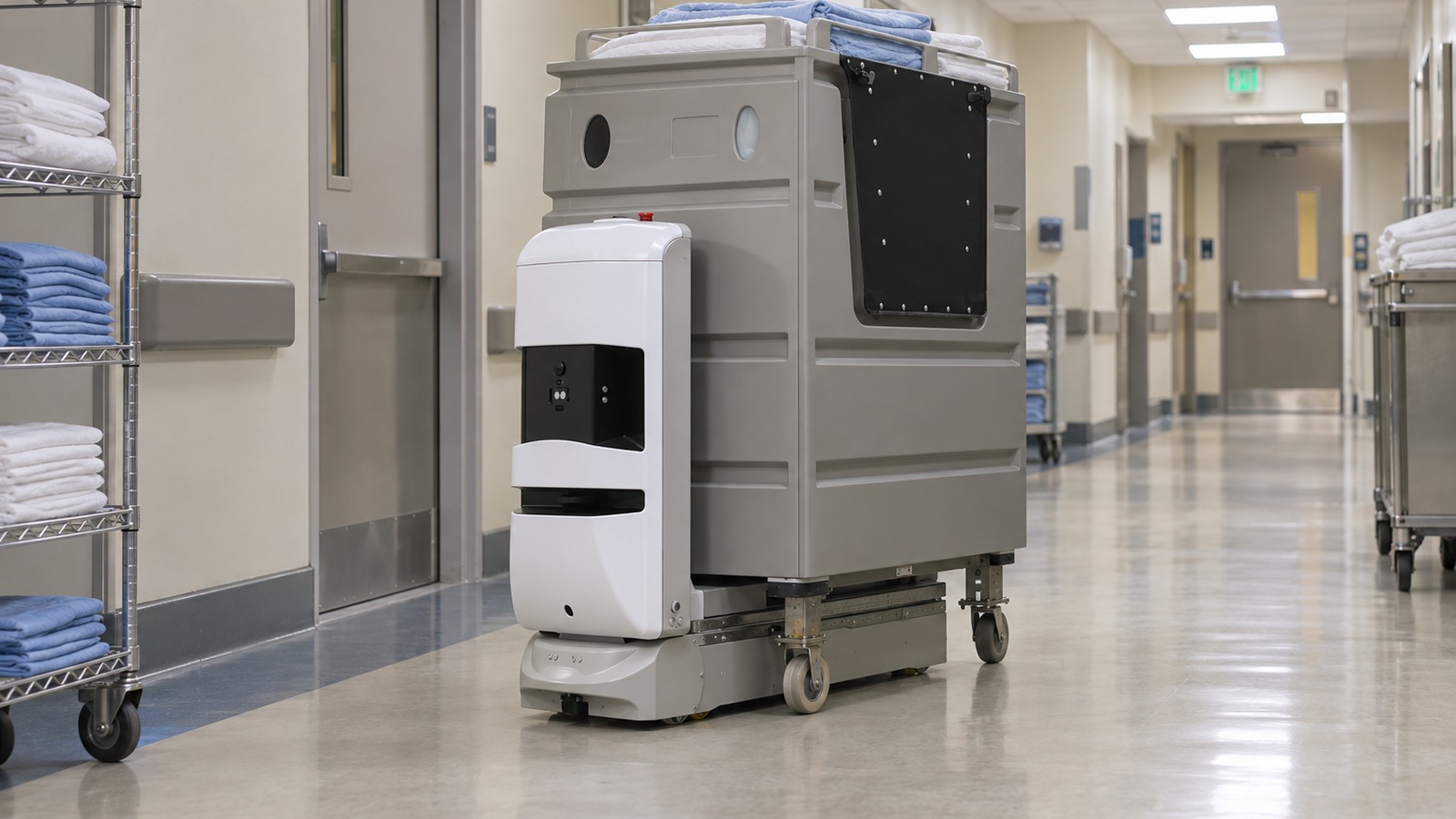
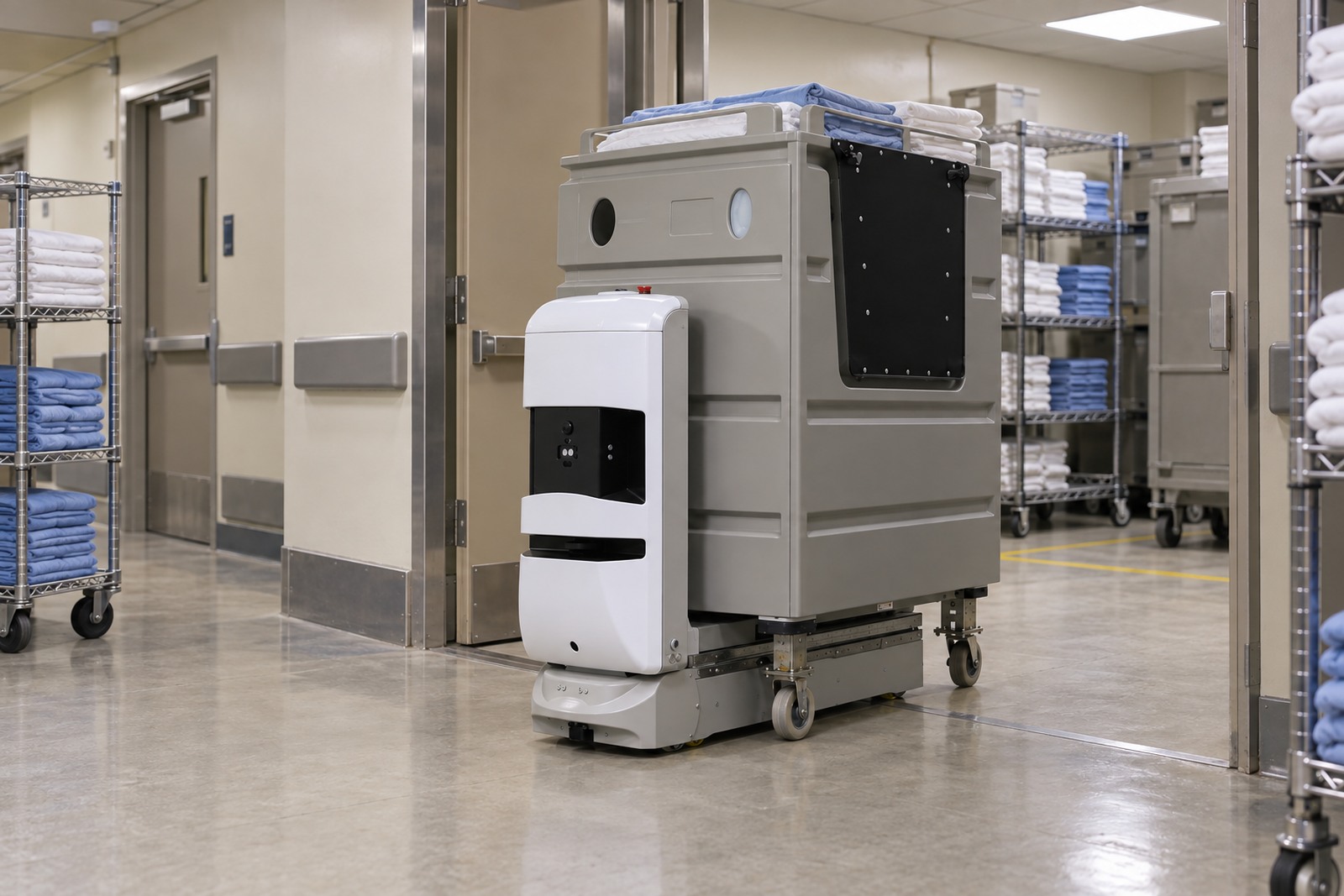
A hospital autonomous mobile robot (AMR) may be able to move a covered linen cart or a closed waste container, but movement is only one part of the service. The hospital must first decide what the load is, who may release it, how clean and soiled flows stay separated, where custody changes, how the carrier is reprocessed, and what happens when the normal route fails.
The safest starting point is not “automate linen and waste.” It is one bounded flow—such as clean linen from central storage to two wards—with one container design, one route window and one human fallback. Soiled linen, regulated waste and general waste should be treated as separate services until their controls are independently accepted.
Separate the flows before drawing the route
CDC guidance calls for soiled linen to be contained at the point of use with minimal agitation, while clean linen should be protected from dust, debris and soiled items during transport and storage. WHO guidance treats health-care waste segregation, internal transport, storage, route design and contingency capacity as parts of one facility waste-management system. These principles make classification and containment prerequisites to automation.
Create a route register with a distinct service ID for clean linen, soiled linen, each locally defined regulated-waste category and general waste. For each service, name the releasing department, container specification, normal volume and peak, route window, interim storage, receiver, carrier-cleaning method, exception owner and manual fallback. Do not allow a scheduler to substitute one carrier or destination merely because the route geometry looks similar.
Scroll horizontally to compare all columns.
| Flow | Release condition | Carrier and route rule | Receiving evidence | Stop condition |
|---|---|---|---|---|
| Clean linen | Covered load released from approved clean storage | Dedicated clean carrier; protected from dust, debris and soiled items | Named destination accepts quantity and condition | Cover, carrier cleanliness or receiving area is not ready |
| Soiled linen | Bagged or containerized at point of use with minimum handling | Clearly identified, leak-resistant when needed; never co-loaded with clean linen | Laundry or interim area accepts closed load | Leak, overfill, damaged closure or wrong handoff point |
| Regulated or hazardous waste | Hospital-approved classification and closed compliant container | Dedicated route, custody and storage interface defined by local rules | Authorized receiver records acceptance | Unknown category, damaged container, protrusion, spill or unauthorized receiver |
| General waste | Segregated at source under facility policy | Route and carrier kept distinct where mixing could undermine segregation | Approved waste point accepts the load | Mis-sorted item, full storage area or route conflict |
Use separation controls that match the hospital layout
Clean and dirty separation does not always mean constructing a second corridor. Depending on the hospital's infection-prevention decision and local rules, separation may combine dedicated carriers, physical barriers, route zoning, time separation, one-way circulation, controlled lift windows, protected staging and verified cleaning between service states. The approved combination must be visible in the operating procedure and enforceable in dispatch logic.
Map where a clean load could meet an unclean carrier, full waste store, spill response, food route, public waiting area or emergency traffic. Then record a control at each interface. A useful map shows sources, staging points, lifts, doors, handoff zones, cleaning stations, charging areas and no-go zones, plus who can close or reopen each path.
Design the container and handoff as part of the system
The robot should not be asked to compensate for an unsuitable container. Verify closure, leak resistance where required, stability, loading height, weight distribution, cleanability, identification, access control, wheel or latch condition, and compatibility with the selected lift or carrier interface. A container that can roll away, open in transit or be mistaken for another category is not ready for automated movement.
Define release and receipt as explicit events. The releasing team confirms the correct container, closure and destination. The receiving team confirms arrival, condition and acceptance. If authentication or scanning is used, specify the authoritative record and the response to unreadable codes, duplicate missions or unavailable systems. The AMR records transport status; it does not decide whether waste is correctly classified or linen is hygienically acceptable.
Schedule around shared-space reality
Observe the route across shifts before selecting a timetable. Record elevator demand, bed and trolley traffic, cleaning activity, visiting hours, fire-door states, temporary obstructions, staff response time and the capacity of source and destination buffers. A route that works at 14:00 may fail during meal delivery, theatre turnover or night staffing.
Give urgent clinical movement and emergency access clear priority over material transport. Define where an AMR may wait without blocking circulation, how long it may hold a lift, who receives a congestion alert and when the mission returns to manual service. Route priority must be understandable to the people sharing the space, not only to the fleet controller.
Write stop rules before recovery steps
Stop the mission for a damaged or leaking container, unknown payload class, broken seal, wrong destination, full or locked receiving area, cleaning-status uncertainty, blocked emergency path, unsafe floor condition, loss of localization, repeated obstruction or unresponsive receiver. The first response is to protect people and contain the load under hospital procedure—not to force the robot to continue.
Assign separate owners for payload disposition, corridor control, robot recovery, carrier cleaning, incident documentation and route restart. If the AMR or carrier must be handled manually, define who is trained and what protective measures apply. Preserve the event history so a repeated exception is corrected in the route design rather than normalized as routine intervention.
Check the applicable safety scope
ISO 3691-4:2023 covers certain driverless industrial trucks including AMRs, but its published scope excludes specific hygienic requirements and operation in public zones. A hospital team therefore cannot treat conformity to one mobile-equipment standard as the complete infection-control, public-space or application safety case. Confirm the platform classification, applicable local requirements, intended operating zones and additional hospital controls with qualified specialists.
Review the whole system: mobile platform, carrier interface, load, charger, maps, doors, lifts, communications, dispatch software, people, cleaning method, storage and manual recovery. Any change to payload, route, software, access rule or cleaning chemistry should trigger a bounded change review.
Use the pilot to replace assumptions with evidence
Start with supervised, non-critical runs and an empty or simulated load where appropriate. Measure mission completion, on-time arrival, intervention causes, container integrity, separation breaches, receiving delay, blocked-route recovery, cleaning turnaround, lift contention, battery reserve and manual-fallback activation. Record near misses and staff observations even when the mission technically completed.
Advance only when the hospital's infection-prevention, environmental-services, facilities, safety and operations owners agree that the selected flow is controlled. A successful clean-linen route does not approve soiled linen or waste. Each new flow needs its own containment, route, handoff, cleaning and exception evidence.
Plan one route as an operating agreement
Use Warpify's hospital AMR solution framework to connect the route, carrier, building interfaces, pilot and lifecycle support. The hospital AMR workflow-fit guide, hospital AMR safety and infection-control guide and hospital AMR pilot acceptance guide provide adjacent planning steps.
Bring one flow map, one container specification and one exception path to an assessment. Assess one hospital linen or waste route before selecting fleet size or combining services.
Sources and scope
This guide synthesizes the CDC's linen-management guidance, the WHO health-care waste handbook and the public scope of ISO 3691-4:2023. This is a modelled scenario: the matrix and pilot measures are planning tools, not a universal procedure. Local law, hospital infection-prevention policy, equipment instructions and qualified safety review remain controlling.

Iven Wang
Iven Wang is the Co-Founder of Warpify Robotics, specializing in the commercialization and deployment of robotic solutions. With a background in electrical engineering and product management, he works with manufacturers, integrators, and enterprise clients across industrial inspection, security, logistics, and Robotics-as-a-Service.
Subscribe to our newsletter today
Get practical robotics deployment insights, case studies, and planning guidance from Warpify Robotics.