Robotics-as-a-Service Contract Checklist: Data, Exit, Replacement and Transition
Prepare a robotics service contract checklist covering data access, replacement, transition costs and exit responsibilities before procurement review.
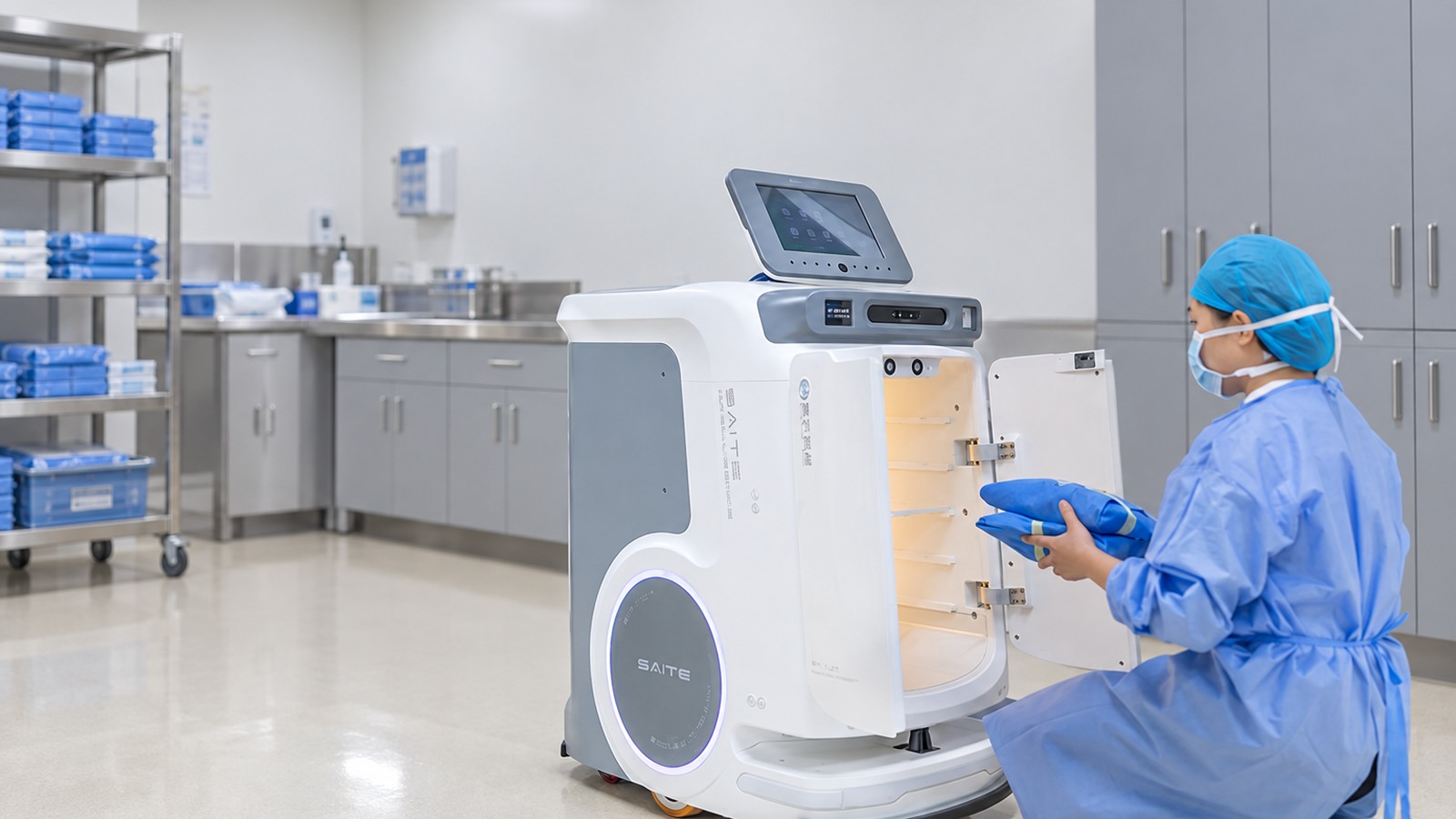
A Robotics-as-a-Service (RaaS) contract should explain how the work continues when the original plan changes. Monthly pricing matters, but the practical test is what happens when a robot fails, a building interface changes, the provider changes platform, or the customer needs to leave. A contract that describes normal operation precisely but leaves transition vague can move uncertainty into the most difficult part of the relationship.
Use this checklist to prepare a commercial requirements schedule for procurement, operations, IT and legal review. It does not supply contract clauses or determine legal enforceability. Start with the service boundary described in Warpify’s RaaS overview, then make each promise observable at the site.
Define the service that must survive a change
Write down the accepted task, operating area, service window, payload, handoff and completion rule. State which customer dependencies must remain available. A robot completing a route is different from goods reaching an authorized recipient, and a technically available robot is different from an available transport service.
Attach the accepted configuration: robot and payload version, map, software, building interfaces, connectivity and operating procedures. Make the process for changing that configuration explicit. Otherwise a replacement can satisfy the equipment description while failing the workflow that justified the agreement.
For each dependency, record who detects a failure, who restores it, who communicates with users and which manual process continues the work. Keep this operating schedule consistent with the RaaS responsibility matrix and robot service-level guide.
Separate data access from data portability
List the information the customer needs during operation and after exit: mission events, timestamps, asset identifiers, maps, configurations, support history, maintenance records and inspection evidence. Separate customer business data from provider software and third-party intellectual property. Do not assume that access to a dashboard means access to exportable records.
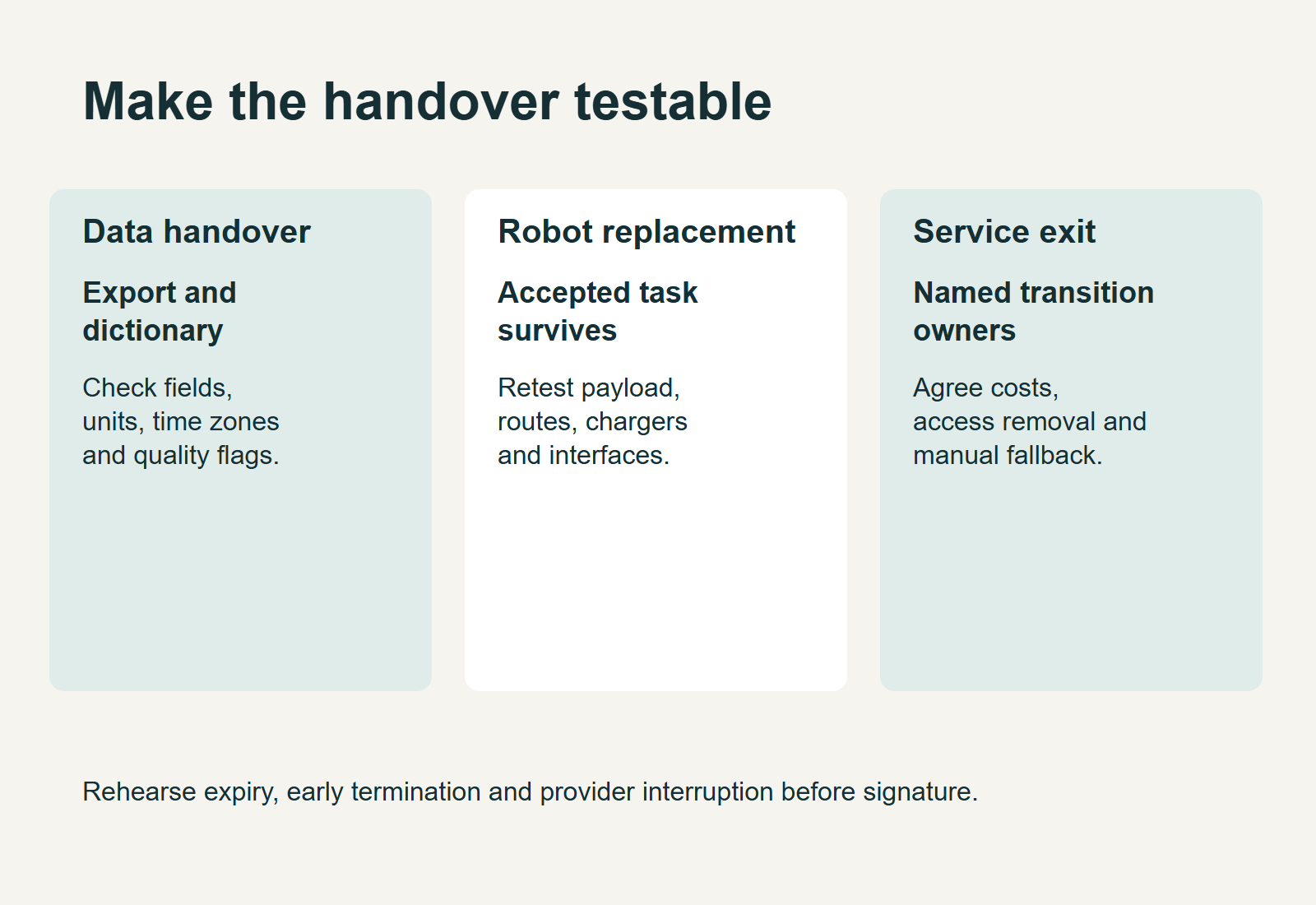
Ask the provider to demonstrate an export. Can a receiving team interpret its fields, units, time zone, quality flags and event relationships? Can the export be produced without a continuing software subscription? Who supplies the data dictionary, and which configuration elements cannot move to another platform?
Set the intended retention and deletion process with the appropriate legal and privacy owners. Include backups, subcontractors, access credentials and confirmation records in that discussion. The aim is a testable handover, not a vague promise that data will be available.
Specify replacement by accepted function
A replacement clause should identify the trigger and the acceptance process. Distinguish a temporary loan unit, repair of the original unit, and permanent substitution. For each, ask who handles transport, site admission, installation, integration, training and renewed testing.
A different model may alter payload clearance, charger compatibility, mapping, door behavior or operating procedures. Require a documented assessment of those changes and an agreed return-to-service test. Do not accept the phrase equivalent robot without defining equivalence at the task and interface level.
For inspection, equivalence may depend on sensor output and repeatable read quality. For delivery, it may depend on secure handoff and building access. Hardware specifications alone cannot settle either question.
Rehearse three transition events
Before signature, walk through ordinary expiry, early termination and provider service interruption. These are planning scenarios, not predictions about a supplier. For each event, identify the continuing service, responsible person, information required, dependencies, cost categories and proof of completion.
- Ordinary expiry: agree renewal notice, equipment collection, export, access revocation and the final service date.
- Early termination: identify the agreed commercial process, supported transition activities, open incidents and customer-owned site work.
- Service interruption: identify the manual fallback, retained local instructions, support contacts and the conditions for a controlled restart.
Include removal of chargers or interfaces where applicable, restoration of premises, handling of spare parts and closure of open support cases. Ask whether another provider can use any installed infrastructure, and obtain a specific answer rather than assuming transferability.
Put a price boundary around change
Compare offers using the same list of possible charges: commissioning, remapping, relocation, interface changes, replacement travel, data export, extended support and decommissioning. A blank line is an unresolved item, not a zero price. Ask which changes are included, which require approval and how the customer can challenge an unexpected charge.
Keep accounting classification separate from marketing terminology. The IFRS Interpretations Committee’s lease discussion examines control of an identified asset and substantive substitution rights; the label RaaS alone does not settle a particular arrangement. Finance advisers should assess the actual agreement under the applicable reporting framework.
Require evidence before closing the checklist
Use a small review record for each issue: question, proposed answer, accountable owner, supporting document, demonstration or test, and unresolved condition. Close a row only when the relevant team can explain how it works in practice. A commercial signature should not be the first time operations sees the exit plan.
An illustrative review exercise is to ask a replacement operator to interpret a sample mission export and configuration inventory using only the proposed handover pack. Missing definitions become visible before they affect live service. Keep test data synthetic or appropriately authorized.
Bring the task definition, responsibility schedule and transition questions to a workflow assessment. The useful outcome is a contract scope that operations can actually run, finance can compare and counsel can review.
Sources and scope
- IFRS Interpretations Committee: March 2023 update — Identified asset, control and substantive substitution rights; not a determination for any contract.

Iven Wang
Iven Wang is the Co-Founder of Warpify Robotics, specializing in the commercialization and deployment of robotic solutions. With a background in electrical engineering and product management, he works with manufacturers, integrators, and enterprise clients across industrial inspection, security, logistics, and Robotics-as-a-Service.
Subscribe to our newsletter today
Get practical robotics deployment insights, case studies, and planning guidance from Warpify Robotics.