Robot Maintenance and Support: Building a Production-Ready Service Plan
A production-ready robot maintenance and support plan built from service criticality, approved maintenance sources, recovery coverage and change control.
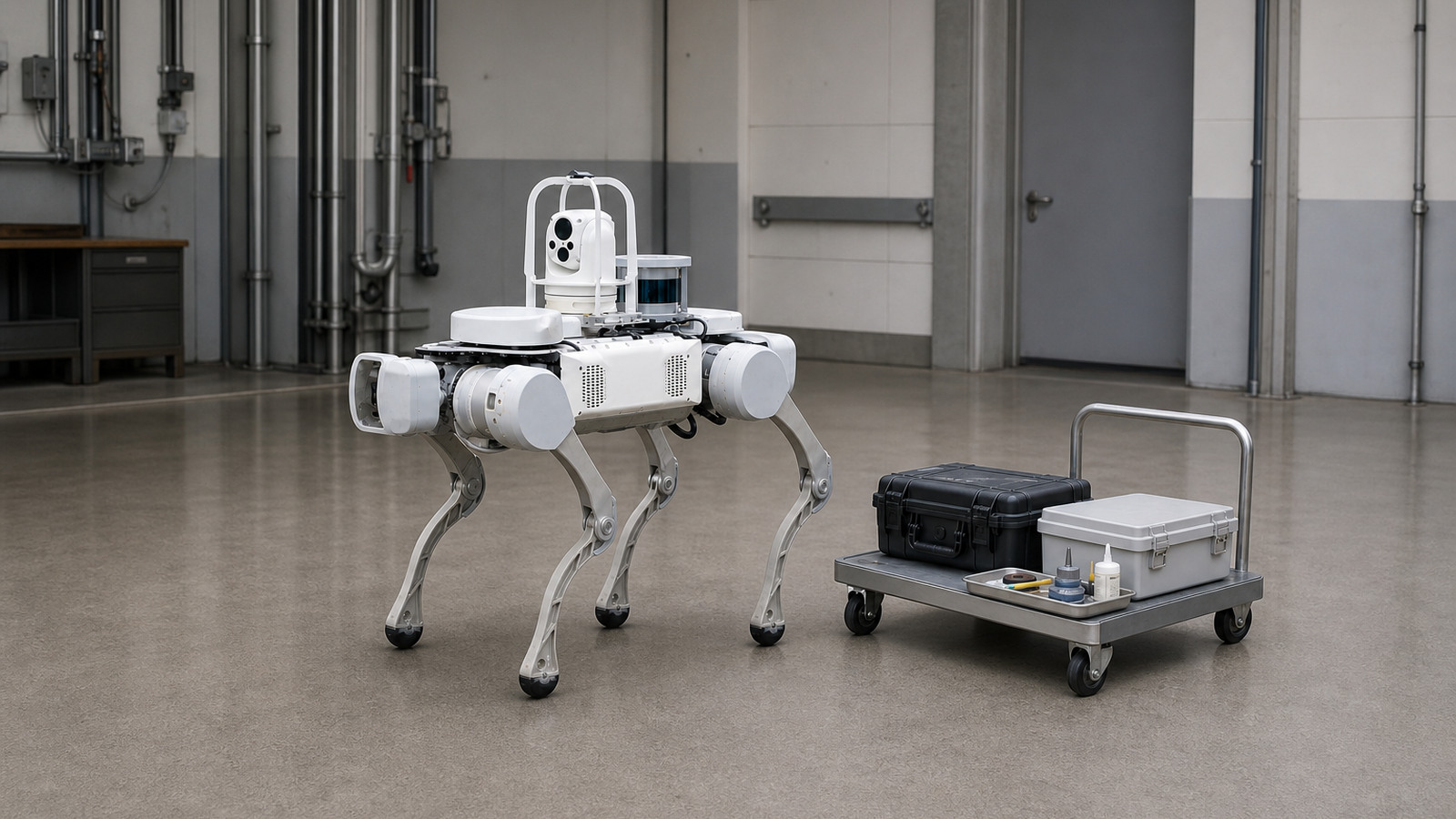
A production-ready robot maintenance plan is not a copied interval table. It is the operating agreement that keeps the complete service supportable: robot platform, batteries and chargers, sensors, payload equipment, fixtures, network and software configuration, facility interfaces, safety functions, backups, spares, technicians and manual fallback.
The plan should preserve the customer workflow while respecting product instructions, site safety, cybersecurity and change control. It must also show who may defer work, what evidence is required and how the service returns to its accepted state.
Separate maintenance, support, warranty and SLA
Maintenance is planned or condition-based work intended to preserve required condition and performance. Support is the operating coverage used to answer, diagnose, recover and escalate. Warranty addresses defined defects under stated terms. An SLA defines measurable service commitments and remedies. Buying one does not prove the others are complete.
Current ABB and KUKA service pages provide vendor-specific examples that separate technical or remote support, inspections, preventive maintenance, on-site repair, parts and training. They are useful category references, not evidence of universal intervals, inclusions or Warpify delivery capability.
Classify service criticality before choosing coverage
Use locally defined ordinal bands for four questions: what is the consequence of service loss; how quickly is degradation detectable; what safe manual or redundant recovery exists; and how long do the necessary skills, parts and access take to mobilize? Record the rationale instead of hiding it in a multiplied score.
Then assign a service class. A high-criticality class might require monitored coverage, local first response, protected spares and tested fallback. A medium class might use regional parts and scheduled on-site response. A low class might accept longer restoration if the business process has a safe alternative. The classes are a Warpify modelled framework—an illustrative scenario for planning, not a universal SLA or safety classification.
Build every maintenance task from an approved source
OSHA's industrial-robot guidance calls for maintenance aligned with manufacturer requirements and relevant associated equipment, with documented inspection and maintenance. The exact requirements depend on the application. Create tasks only from current product instructions, qualified engineering decisions, site procedures or validated condition rules; record the source and revision.
Scroll horizontally to compare all columns.
| Plan field | Record | Decision it supports |
|---|---|---|
| Asset and baseline | System component, configuration and operating environment | Confirms the instruction applies to the installed service |
| Approved task source | Manufacturer or qualified engineering instruction and revision | Prevents improvised or obsolete work |
| Trigger | Calendar, runtime, cycle, condition or event threshold | Explains why the task is due |
| Work prerequisites | Safe state, isolation, access, competence, tools and parts | Determines whether work may begin |
| Service impact | Planned outage, fallback, recovery test and communications | Protects the customer workflow during maintenance |
| Evidence and deferral | Completion record, findings, next due point and named deferral authority | Makes completion and risk acceptance auditable |
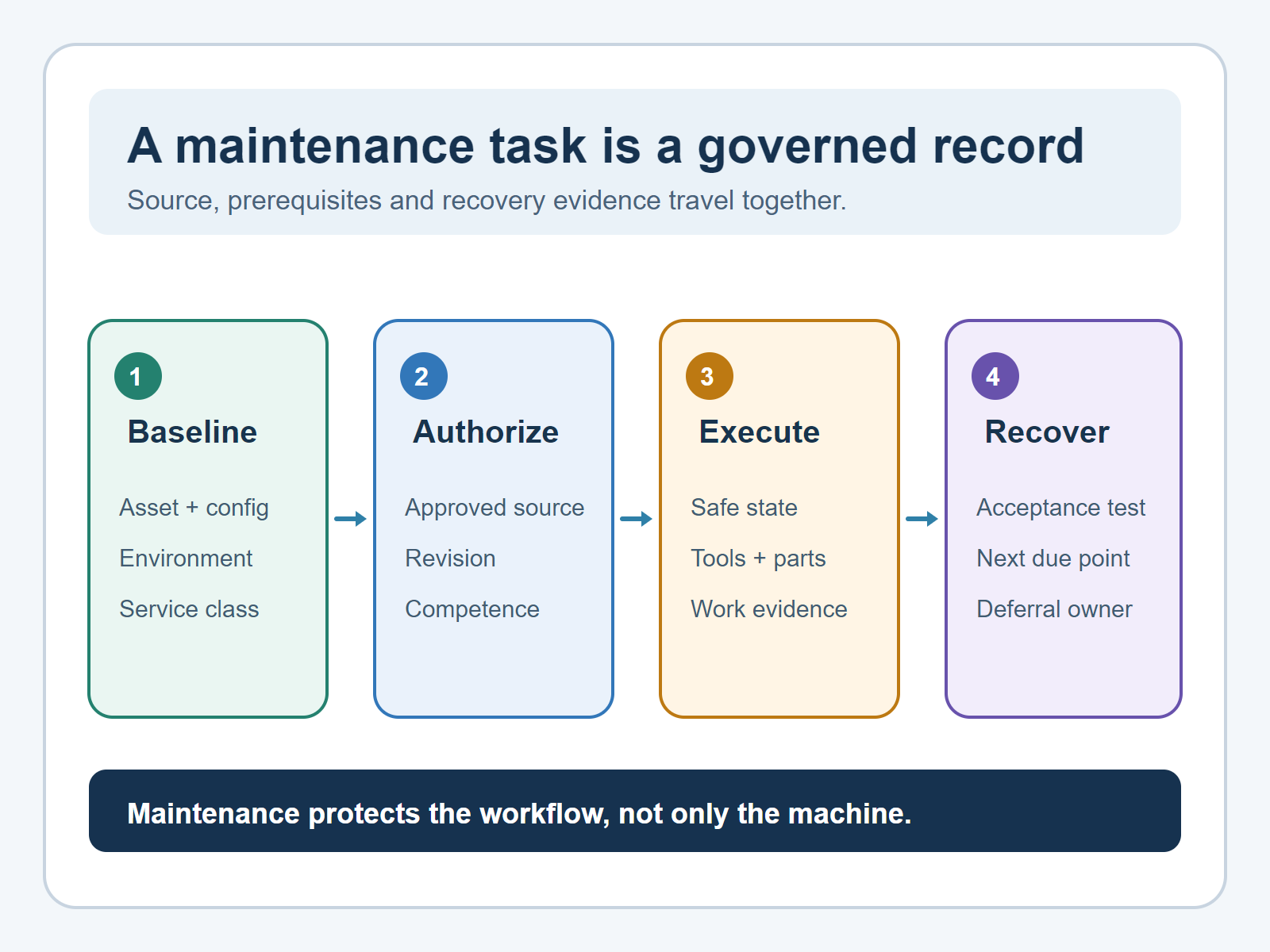
Do not treat completion as a checkbox. Record readings, wear, replaced parts, abnormal findings, configuration changes, evidence location and the post-work functional or acceptance test. If the task reveals a new risk or unsupported condition, route it into engineering change or incident review.
Combine time-based and condition-based triggers carefully
Calendar or runtime triggers are predictable and easy to plan. Condition data can help target attention, but it is only useful when asset identity, data quality, thresholds and decision ownership are controlled. Define whether a condition advances, supplements or may defer a scheduled task; do not let a dashboard silently override manufacturer instructions.
Track operating context such as dust, temperature, washdown, payload, floor condition, duty cycle and charging pattern when relevant. A nominal interval can be inappropriate if the installed environment differs from the assumptions behind it.
Control deferrals as risk decisions
A missed task and an approved deferral are not the same state. A deferral record should identify the task and source, reason, current condition evidence, risk controls, revised due point, affected service class, approving authority and review trigger. Do not let a scheduler move the date without preserving who accepted the exposure. Repeated deferrals should trigger an engineering, capacity or commercial review rather than becoming the normal interval by habit.
Make support coverage an executable process
For each coverage window, identify alarm recipient, safe-state check, local first response, remote escalation, field dispatch, parts release, customer communication and restart authority. Include deputies and contact validation. Test the path with a controlled exercise before relying on it.
Maintain a usable escalation packet: service and asset ID, configuration, timestamps, symptom, current safe state, logs, recent changes, actions attempted, parts status, site access and business impact. Link the maintenance record to incidents and repeat faults so preventive plans improve from actual evidence.
Plan software, backup and cybersecurity maintenance
Robotics maintenance includes software and connected infrastructure. Inventory supported versions, configuration backups, certificates, service accounts, remote-access dependencies and restore tests. NIST SP 800-82 emphasizes that OT security controls must respect performance, reliability and safety, so patching needs impact review, compatibility testing, an approved window and rollback—not indefinite avoidance or automatic deployment without context.
Protect the workflow during planned and unplanned work
Define the fallback service, allowed backlog, customer notification, payload disposition and restart acceptance for each service class. Confirm that technicians can reach equipment safely and that facility permits, isolation, cleaning or escort requirements are known. A spare part in stock does not restore service if access or qualified labor is unavailable.
Separate part availability from restoration readiness. For each critical replaceable item, verify compatible configuration, usable stock, storage condition, access to fitting instructions, required tools, qualified labor, site-entry prerequisites and the post-repair test. A pooled regional spare may be appropriate when transport and access fit the recovery target; a shelf part is ineffective when firmware, fixtures or authorization are missing. Review the complete recovery chain during service drills.
Run a monthly lifecycle review
Review overdue work, schedule compliance, condition exceptions, repeat failures, remote and field recovery, mean time to restore by service class, first-visit completion, parts readiness, unsupported configurations, backup tests, deferred tasks and changes outside the accepted baseline. Connect the indicators to customer service and risk, not just maintenance activity.
ISO 55000's lifecycle perspective is useful here: the objective is value from assets in support of organizational goals. That can justify preventive work, upgrades or retirement even when a short-term utilization metric would prefer continued operation.
Combine this plan with Warpify's robotics solutions framework, robot SLA guide, after-sales support model and responsibility map. To assess a live or planned service, request a production-readiness assessment.

Iven Wang
Iven Wang is the Co-Founder of Warpify Robotics, specializing in the commercialization and deployment of robotic solutions. With a background in electrical engineering and product management, he works with manufacturers, integrators, and enterprise clients across industrial inspection, security, logistics, and Robotics-as-a-Service.
Subscribe to our newsletter today
Get practical robotics deployment insights, case studies, and planning guidance from Warpify Robotics.